


Automotive LED Light Warranty Terms: What's Actually Covered

Table of Contents
- Understanding Automotive LED Light Warranty Terms
- What's Covered Under Limited Warranty for LED Lighting
- Exclusions and Limitations: What Won't Be Covered
- Aftermarket LED vs. OEM Factory Warranty: How Installation Affects Coverage
- How to File an Automotive Lighting Warranty Claim
- Average Lifespan of Automotive LED Bulbs vs. Warranty Protection
- Pro-Rata vs. Full Replacement Coverage
- Common Warranty Mistakes That Void Your Coverage
Last Updated: August 3, 2026
Understanding automotive LED light warranty terms is essential for anyone upgrading their vehicle's lighting system. Knowing what's covered and what's not can save you thousands in unexpected costs. At RMS Lighting LLC, we help vehicle owners navigate these complex warranty landscapes so they can upgrade with confidence.
Understanding Automotive LED Light Warranty Terms
Rated life refers to the manufacturer's estimate of how long an LED bulb will function before lumen depreciation becomes noticeable, typically 25,000 to 50,000 operating hours for quality automotive LEDs. Limited warranty is a legal guarantee that covers specific defects for a defined period. An LED bulb might have a rated life of 40,000 hours but only a two-year limited warranty, meaning the bulb could theoretically last far longer than the warranty protection covers.
A bulb failing at year three is your problem, even if the rated life suggested it should work for five years. When comparing LED options, always ask for both the rated life and the warranty period in writing. The warranty period is what actually protects your investment.
Limited Warranty vs. Rated Life: The Critical Difference
Limited warranty represents a manufacturer's promise to repair or replace a product if it fails due to defects in material and workmanship within a specified timeframe. Rated life is an engineering estimate based on testing and industry standards, not a guarantee. Many manufacturers deliberately set warranty periods shorter than rated life to limit liability exposure.
When evaluating LED bulbs for your vehicle, the warranty period is the only metric that provides actual consumer protection.
Standard Coverage Duration for LED Bulbs
Most automotive LED bulbs come with limited warranties ranging from one to three years, though some premium options extend to five years. Budget-tier LEDs often carry one-year warranties, while mid-range options typically offer two years.
Your warranty start date matters significantly. Most manufacturers begin the warranty period from the date of purchase, not installation. Some warranties require product registration within 30 days of purchase to activate full coverage; failure to register may limit you to a pro-rata warranty or void coverage entirely.
The warranty typically covers the bulb itself, not labor costs for removal and installation. If your LED fails at month 18 and is covered under warranty, the manufacturer will replace the bulb, but you pay for the technician's time to remove and install it. This cost can range from $50 to $200 depending on the vehicle and light position.
What's Covered Under Limited Warranty for LED Lighting
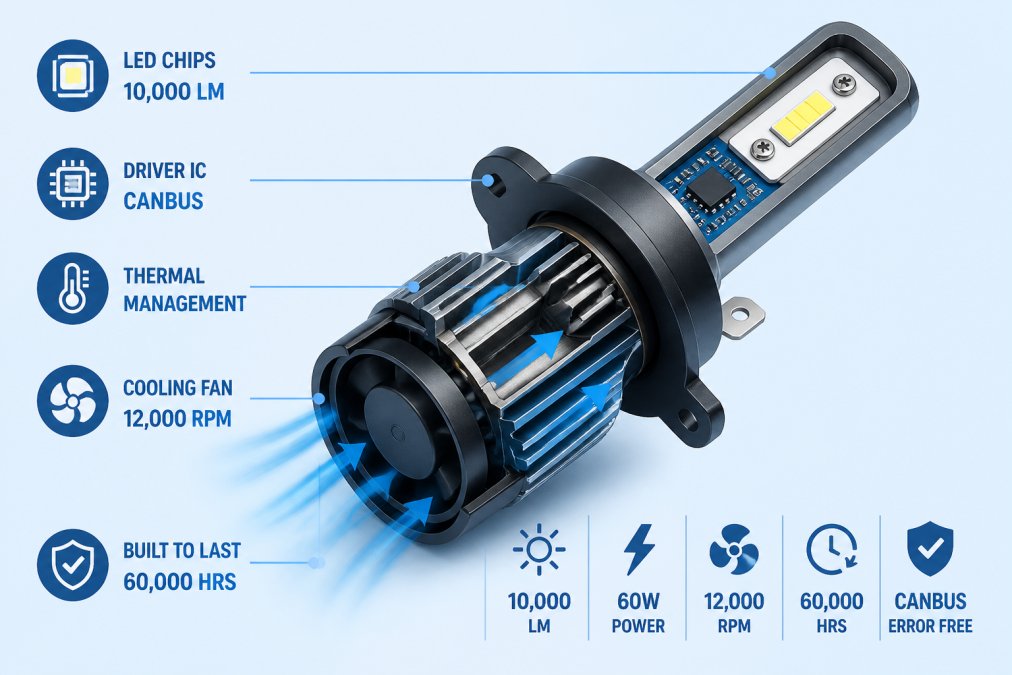
Limited warranty for automotive LEDs covers defects in material and workmanship, manufacturing flaws, component failures, and design defects that cause premature failure. If a circuit board is soldered incorrectly at the factory or the heat sink is insufficiently designed, that's covered.
What's typically not covered includes normal wear, improper installation, and environmental damage. If you install an LED in a cracked headlight housing and water seeps in, that's environmental damage. If you force a bulb into a socket and damage the connector, that's installation error.
Component failure related to thermal management is a gray area. Many LED failures stem from inadequate heat dissipation in the vehicle's original housing. If the LED was designed for standard automotive thermal conditions and fails because your vehicle's housing doesn't provide sufficient cooling, the manufacturer may argue this is an an environmental limitation, not a defect.
Defects in Material and Workmanship
Defects in material and workmanship means the LED bulb or its components failed to meet the manufacturer's own specifications due to production errors or design flaws. A solder joint that cracks, a circuit board trace that shorts, or a heat sink that separates from the LED package would all qualify. These defects typically manifest early, within the first few months of use.
When a bulb fails within the warranty period due to a defect that should have been caught during manufacturing, the manufacturer is obligated to replace it. Documentation of the failure is essential. RMS Lighting LLC recommends keeping all packaging and receipts for this reason.
Component Failure and Thermal Management Issues
Thermal management failures represent a significant warranty issue in automotive LED lighting. LEDs generate heat that must be dissipated through the bulb's heat sink and into the vehicle's light housing. If the heat sink is undersized, poorly attached, or made from low-conductivity material, the LED junction temperature rises excessively, causing accelerated lumen depreciation and premature failure.
Many warranty disputes center on whether thermal failure is a manufacturing defect or an environmental limitation. If an LED is marketed as compatible with a specific vehicle model and fails due to thermal issues in that vehicle, you may have a stronger warranty claim.
Lumen depreciation over time is not a warranty defect. LEDs naturally lose brightness gradually; this is normal aging, not failure.
Exclusions and Limitations: What Won't Be Covered
Your automotive LED light warranty explicitly excludes certain conditions and scenarios. The most common exclusions include installation errors, environmental damage, electrical system incompatibility, improper handling, and normal wear.
Installation errors are the leading cause of warranty denials. If you force an LED bulb into a socket designed for a different connector type, damage the wiring during installation, or fail to secure the bulb properly, the manufacturer will deny coverage.
Environmental damage includes water intrusion, corrosion, physical impact, and exposure to extreme temperatures outside the manufacturer's specifications. Voltage fluctuations and electrical system incompatibility are common exclusions. Quality LEDs should include voltage regulation circuitry to handle minor fluctuations.
Installation Errors and Improper Electrical System Compatibility
Installation errors are the primary reason warranty claims get denied. Forcing a bulb into the wrong socket, bending connector pins, cracking the bulb housing during removal, or damaging the circuit board through electrostatic discharge all fall under installation error.
Electrical system compatibility issues arise when you install an LED in a vehicle with an incompatible electrical architecture. Some vehicles use load-sensing systems that detect when a bulb burns out and trigger a dashboard warning. LEDs, which draw far less current than halogen bulbs, may not trigger these sensors. Other vehicles use pulse-width modulation (PWM) dimming systems or have capacitive loads in the wiring that can cause LEDs to flicker or fail prematurely.
Environmental Damage and Voltage Fluctuations
Environmental damage covers scenarios beyond the manufacturer's control. Extreme heat, cold, moisture, salt spray, dust, and physical impact all fall into this category. Quality LEDs should tolerate normal automotive voltage ranges of 13.5-14.5 volts without failure.
Documenting environmental conditions at the time of failure strengthens your warranty claim. If you can show that your vehicle's electrical system was functioning normally when the LED failed, you have a better argument that the failure was due to a manufacturing defect.
Aftermarket LED vs. OEM Factory Warranty: How Installation Affects Coverage
Installing aftermarket LEDs in a vehicle with factory halogen lights raises complex warranty questions. Under the Magnuson-Moss Warranty Act, a manufacturer cannot void your entire vehicle warranty simply because you've replaced one component with an aftermarket part, unless the manufacturer can prove the aftermarket part directly caused the failure you're claiming.
However, if you install an incompatible LED that damages your vehicle's electrical system, the manufacturer may deny coverage for those related failures. The safest approach is to choose LEDs specifically tested for compatibility with your vehicle model.
Does Aftermarket LED Installation Void Your Vehicle Warranty?
No, installing aftermarket LED bulbs does not automatically void your vehicle's factory warranty. The Magnuson-Moss Warranty Act explicitly prohibits manufacturers from voiding warranties based on the use of non-OEM parts unless the manufacturer can demonstrate that the aftermarket part directly caused the failure being claimed.
To protect your vehicle warranty, choose LEDs that are explicitly tested for your vehicle model.
The Magnuson-Moss Warranty Act and Your Rights
The Magnuson-Moss Warranty Act is a federal law that protects consumers from overly restrictive warranty policies. Manufacturers cannot condition warranty coverage on the use of proprietary parts or services unless those parts or services are provided free of charge. Manufacturers cannot void your entire warranty based on the use of a single aftermarket component.
Under Magnuson-Moss, if the LED installation causes direct damage to related components, such as the wiring harness or lighting control module, the manufacturer can deny coverage for those damaged components. Documentation is essential. Keep records of your LED purchase, installation date, and any communications with the vehicle manufacturer about compatibility.
How to File an Automotive Lighting Warranty Claim
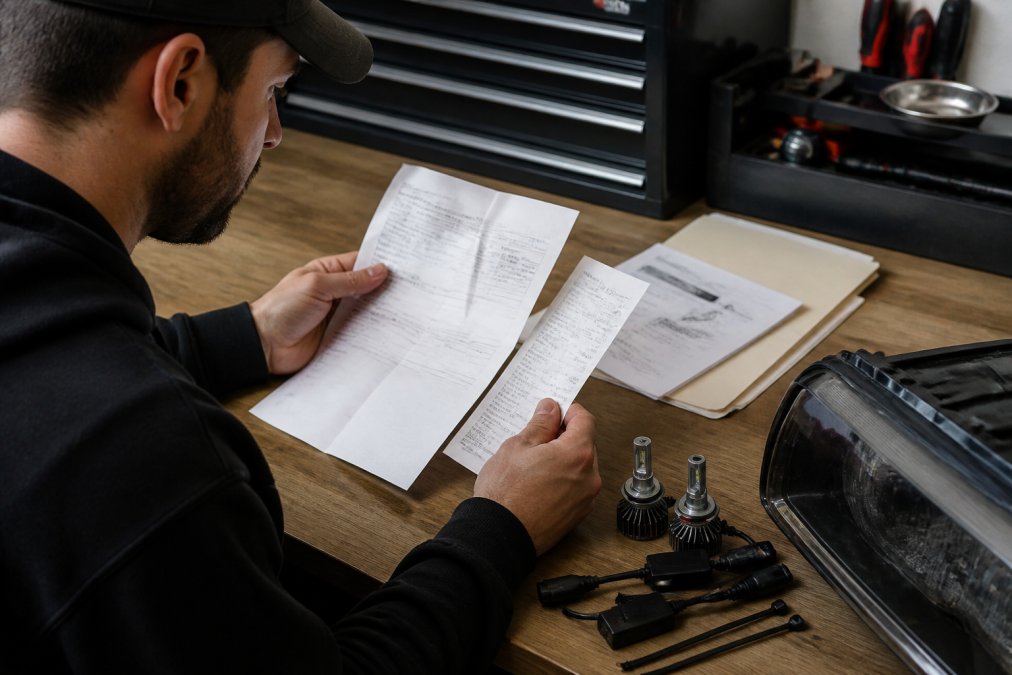
Filing a warranty claim requires documentation, patience, and a clear understanding of the process. Start by locating your proof of purchase. Next, document the failure with clear photos of the failed bulb, showing any visible damage, discoloration, or defects. Contact the manufacturer directly through their dedicated warranty support email or online claim portal. Provide your proof of purchase, photos of the failed bulb, and a description of the failure.
Step-by-Step Warranty Claim Process
-
Gather Documentation, Locate your proof of purchase, warranty card, and any product registration information.
-
Document the Failure, Take clear photographs of the failed bulb showing any visible defects, discoloration, or damage.
-
Contact the Manufacturer, Find the warranty support contact information on the product packaging or manufacturer's website. Email is typically the most documented method.
-
Provide Failure Details, Describe when the bulb was purchased, when it was installed, how long it operated before failing, and what you observed. Include the vehicle make, model, and year.
-
Follow Manufacturer Instructions, Some manufacturers request that you mail the failed bulb for failure analysis. Carefully package the bulb to prevent further damage. Keep your shipping receipt as proof of submission.
-
Await Determination, The manufacturer will examine the bulb and determine whether the failure was due to a manufacturing defect or an excluded cause. This typically takes 2-4 weeks.
-
Receive Replacement or Denial, If approved, the manufacturer will send a replacement bulb or provide a prepaid shipping label for return.
Documentation Requirements and Proof of Purchase
Proof of purchase is the foundation of any warranty claim. This can be a receipt from an online retailer, an invoice from a local auto parts store, or a credit card statement showing the purchase. The document must clearly show the product name, purchase date, and seller.
If you've lost your original receipt, some retailers can look up your purchase in their system if you provide the purchase date and payment method. Some manufacturers require product registration within 30 days of purchase to activate full warranty coverage. If you've registered your product, include your registration confirmation in your claim.
Photos of the failed bulb are critical. Clear, well-lit images showing the bulb from multiple angles help the manufacturer assess the failure. Some manufacturers request the failed bulb itself for failure analysis. If you're asked to mail the bulb, package it carefully and include your claim reference number. Keep your shipping receipt as proof of submission.
Shipping and Labor Cost Responsibility
The LED manufacturer typically covers the cost of shipping the replacement bulb to you. If the manufacturer requests that you ship the failed bulb for analysis, they usually provide a prepaid shipping label or reimburse shipping costs.
Labor costs for removal and installation of the replacement bulb are your responsibility. The total out-of-pocket cost for a warranty claim is typically just the labor for installation, usually $50 to $150 depending on the light position and vehicle.
Average Lifespan of Automotive LED Bulbs vs. Warranty Protection
Quality automotive LED bulbs typically have rated lifespans of 25,000 to 50,000 operating hours. In reality, most LED bulbs last 5 to 10 years before experiencing noticeable lumen depreciation or component failure. Warranty coverage, however, is typically only 1 to 3 years. This means your LED will likely outlast its warranty protection.
The gap between warranty period and rated life is intentional. Manufacturers set warranty periods based on their confidence in the product and their tolerance for replacement costs. Most failures that do occur happen early, within the first few months, due to manufacturing defects.
Lumen depreciation is normal and expected. An LED that maintains 80% of its original brightness after five years is performing well. This gradual dimming is not a warranty defect; it's normal aging.
Operating Hours and Lumen Depreciation
Operating hours are the actual time the LED bulb is powered on and producing light. This is different from calendar time. Most automotive lighting warranties are based on calendar time (one year, two years, etc.) rather than operating hours. However, some premium LED products include operating-hour warranties, which can be more favorable if you drive infrequently.
A quality automotive LED typically maintains 90% of its initial brightness after 10,000 hours of operation, and 70% after 50,000 hours.
Visual Indicators of Failure Before Warranty Expires
Several visual signs indicate that an LED bulb is failing or about to fail. Flickering is a common early indicator. If an LED flickers intermittently, especially when the vehicle is idling or accelerating, this suggests a problem with the driver circuit or power supply.
Discoloration of the lens is another sign. If the LED's lens develops a purple, blue, or brown tint, or if the interior of the bulb shows blackening, this indicates internal degradation. Dimness that develops suddenly, rather than gradually, is suspicious.
If you observe any of these signs, document them with photos and contact the manufacturer immediately.
Pro-Rata vs. Full Replacement Coverage
Some automotive LED warranties include pro-rata coverage, while others offer full replacement. Full replacement coverage means the manufacturer will replace the bulb at no cost if it fails during the entire warranty period, regardless of how much time has elapsed. Pro-rata coverage means the manufacturer's obligation decreases over time. If you have a two-year pro-rata warranty and the bulb fails at the end of year one, you might pay 50% of the replacement cost.
Pro-rata warranties are less consumer-friendly than full replacement warranties. Most quality automotive LED manufacturers offer full replacement coverage during the warranty period.
Common Warranty Mistakes That Void Your Coverage
Certain actions or oversights will void your warranty coverage, even if the bulb fails during the warranty period. Failing to register your product is a common mistake. If the manufacturer requires registration within 30 days of purchase and you don't register, they may deny your warranty claim. Register immediately after purchasing to be safe.
Improper installation is a leading cause of warranty denial. If you force a bulb into a socket, bend connector pins, or damage the bulb during installation, the manufacturer will deny coverage. Always follow the installation instructions carefully.
Modifying the bulb or its circuit voids coverage. Using the bulb outside its rated specifications voids coverage. Failing to keep proof of purchase is a practical mistake that prevents you from filing a claim.
Product Registration and Warranty Start Date
Product registration is often a prerequisite for warranty coverage. Manufacturers use registration to verify the purchase date, establish the warranty start date, and contact you if there's a product recall. If your LED came with a registration card or instructions to register online, do so immediately.
The warranty start date is typically the date of purchase, not the date of installation. Some manufacturers allow you to extend the warranty start date if you register the product before installation. Keep your registration confirmation email or certificate.
Improper Handling and Circuit Board Damage
Improper handling during installation is a frequent cause of warranty denial. LEDs contain delicate circuit boards and electrical components that can be damaged by physical force, electrostatic discharge, or moisture.
When installing an LED bulb, avoid touching the circuit board or connector pins with bare hands. Electrostatic discharge from your body can damage sensitive components. Never force an LED bulb into a socket. If it doesn't fit smoothly, stop and verify that you have the correct bulb for your vehicle.
Moisture damage is another concern. If you install an LED in a light housing that's cracked or not properly sealed, water can seep in and damage the circuit board. Ensure the light housing is intact and properly sealed before installing an LED.
Navigating automotive LED light warranty terms doesn't have to be confusing. The key is understanding what's actually covered, recognizing the gap between rated life and warranty protection, and avoiding common mistakes that void coverage. When you're ready to upgrade your vehicle's lighting with confidence, RMS Lighting LLC offers LED bulbs that are rigorously tested for compatibility with your specific vehicle, backed by clear warranty terms and responsive customer support. Our products feature correct LHD lens patterns and original-style conversion kits that install easily, with dedicated guidance on warranty registration and claim procedures. Learn More about how RMS Lighting LLC can help you upgrade your lighting while protecting your investment.
Frequently Asked Questions
What is the typical warranty period for aftermarket automotive LED bulbs?
Most aftermarket automotive LED bulbs carry a limited warranty ranging from 1 to 3 years from the warranty start date, though this varies by manufacturer. The warranty covers defects in material and workmanship under normal operating conditions. However, the rated life of LED bulbs often exceeds the warranty period significantly. Always check your specific product documentation and register your purchase to activate coverage. Some manufacturers offer extended replacement programs for bulbs that fail before the warranty expires.
Does installing aftermarket LED conversion kits void my vehicle's factory warranty?
Under the Magnuson-Moss Warranty Act, a manufacturer cannot automatically void your entire vehicle warranty simply because you installed aftermarket parts. However, the manufacturer can deny coverage for specific components damaged by the LED installation or related electrical system failures. If your LED kit causes dashboard error codes, hyper-flashing, or electrical system compatibility issues, those repairs may not be covered. The key is proper installation and ensuring the LED kit is compatible with your vehicle's electrical system to avoid voiding coverage on that specific system.
What does the automotive lighting warranty claim process involve?
File a warranty claim by contacting the LED manufacturer with proof of purchase, the product registration information, and documentation of the defect. Provide photos or videos showing the failure (such as dim output, burnout, or signaling light malfunction). The manufacturer will typically request the defective unit for failure analysis before authorizing replacement. Shipping costs to return the defective product may be your responsibility, though some manufacturers cover return shipping. Full replacement coverage means you receive a new unit at no cost if the defect is confirmed within the warranty period.
What visual indicators show an LED bulb is failing before the warranty expires?
Watch for reduced brightness or lumen depreciation (dimmer than when new), flickering or intermittent operation, color shift (yellowing or fading from the original 6500K output), and complete burnout of one or both bulbs in a pair. For signaling lights and matrix strips, hyper-flashing or uneven illumination indicates driver failure. A failed heat sink can cause thermal management problems, leading to premature failure. Document these visual indicators with photos before contacting the manufacturer, as failure analysis may require the defective unit to confirm coverage under your limited warranty.
This article was written using GrandRanker