


Best High Performance LED Headlight Bulbs: 2026 Guide

Table of Contents
- Why Upgrade to High Performance LED Headlight Bulbs?
- How We Evaluated the Best High Performance LED Headlight Bulbs
- Quick Comparison: Top LED Headlight Bulbs at a Glance
- Halogen vs. HID vs. LED Headlight Bulbs: Which Wins?
- Headlight Bulb Size Chart and Vehicle Compatibility Guide
- CANbus LED Headlight Bulbs: Solving Flickering and Error Codes
- Thermal Management, Cooling Systems, and Long-Term Performance
- LED Headlight Bulb Legal Requirements in the United States
Last Updated: July 31, 2026
Finding the best high performance led headlight bulbs is harder than it looks. The market is flooded with options that make enormous lumen claims but deliver scattered, blinding light that actually makes night driving worse. At RMS Lighting LLC, we've tested and evaluated LED headlight conversions across many vehicles, and the difference between a precision-engineered bulb and a cheap kit is immediately visible on the road. Below, we'll show you exactly how to identify the right bulb for your vehicle, what the specifications actually mean, and which products deliver on their promises.
Here's what most guides get wrong: raw lumen output is nearly irrelevant without proper emitter placement and a clean cut-off line. A 30,000-lumen bulb that throws light everywhere is less useful than a 10,000-lumen bulb with a focused hotspot aimed at the road ahead.
Quick Picks:
- Best Overall: RMS Lighting LLC 130W CANbus LED Bulbs - precision-engineered, correct LHD beam pattern, available in H4, H7, H11, 9005, 9006, 9007, 9012, H13, and 9004
- Best for Plug-and-Play Simplicity: RMS Lighting LLC H4 60W 10K Lumens LED Bulbs - compact, fan-cooled, direct replacement for factory H4 halogen
Why Upgrade to High Performance LED Headlight Bulbs?
Factory halogen bulbs burn a tungsten filament, converting most energy to heat rather than visible light. LED headlight bulbs replace that filament with semiconductor emitters that convert electricity directly into light, producing significantly more brightness per watt.

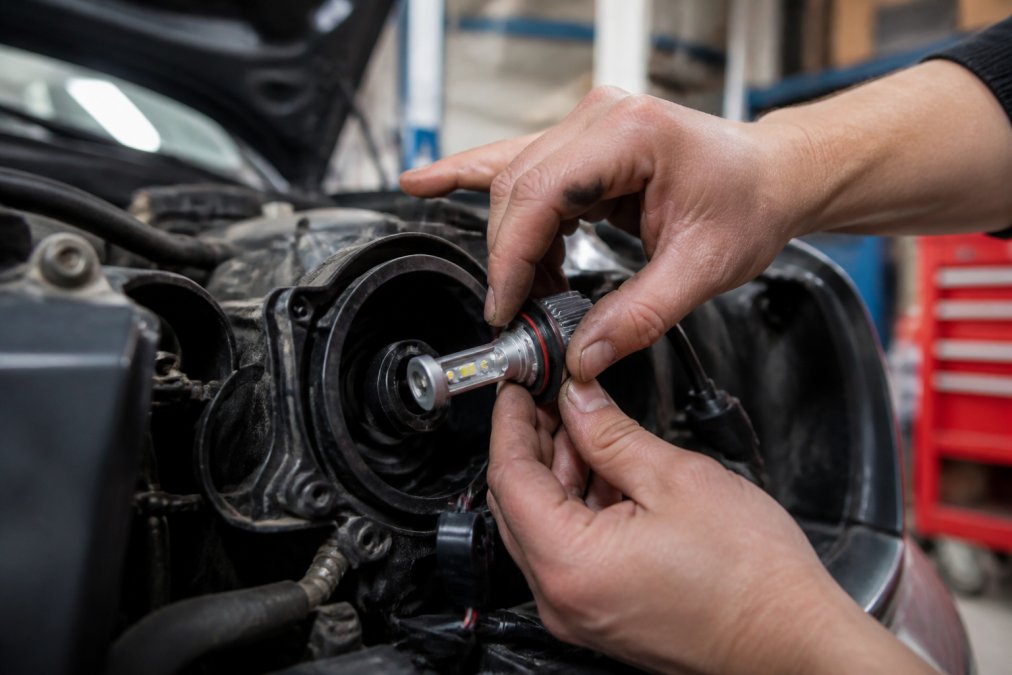
Drivers upgrading from halogen to quality LED consistently report seeing further down the road, identifying hazards earlier, and feeling less fatigued on long nighttime drives. A 55-watt halogen produces around 1,200 lumens; an LED drawing similar wattage outputs many times that figure.
Quality LED systems are rated for 30,000 to 50,000 hours of operation versus 450 to 1,000 hours for halogen, meaning years of reliable service without roadside replacements. LED bulbs also draw far less current, reducing load on older electrical systems, a meaningful benefit for classic cars and trucks with aging wiring.
How We Evaluated the Best High Performance LED Headlight Bulbs
Evaluating LED headlight bulbs requires more than reading spec sheets. Manufacturers routinely inflate lumen figures by measuring raw emitter output rather than actual light delivered at the road surface.
Our evaluation framework centers on five criteria: measured brightness at the road surface, beam pattern quality, thermal management, CANbus compatibility, and installation simplicity.
Key Performance Metrics: Lumens, Lux, and Color Temperature
Lumens measure total light output from the source. Lux measures how much of that light actually reaches a surface at a given distance. For headlights, lux at 25 meters ahead of the vehicle is the number that matters for driving visibility.
Color temperature, measured in Kelvin, affects how light interacts with the road. Bulbs in the 5,000K to 6,500K range produce cool white light that the human eye perceives as bright and crisp. The RMS Lighting LLC 130W CANbus series operates at 6,500K, providing strong contrast against road markings and obstacles.
According to NHTSA's vehicle lighting research and standards, proper headlight beam aim and light distribution are critical factors in nighttime crash prevention.
Beam Pattern, Cut-Off Line, and Emitter Placement
The cut-off line is the sharp horizontal boundary between the illuminated road ahead and the dark zone above it. A well-defined cut-off line keeps light off the faces of oncoming drivers while maximizing road illumination below.
Achieving a proper cut-off line depends on emitter placement. The LED chip must sit at the same focal point as the original halogen filament. If the emitter is even a few millimeters off, the beam pattern degrades, the cut-off line disappears, and the bulb creates dangerous glare.
RMS Lighting LLC addresses this directly: their conversion kits feature correct LHD lens patterns and are engineered so the emitter placement matches factory focal geometry.
Quick Comparison: Top LED Headlight Bulbs at a Glance
| Bulb | Socket Types | Power | Color Temp | CANbus | Best For |
|---|---|---|---|---|---|
| RMS Lighting LLC 130W CANbus | H4, H7, H11, H13, 9004, 9005, 9006, 9007, 9012 | 65W per bulb | 6500K | Yes | Classic cars, DIY conversions, correct beam pattern |
| RMS Lighting LLC 60W H4 | H4 | 30W per bulb | 6500K | Built-in fan | Plug-and-play H4 replacement |
Halogen vs. HID vs. LED Headlight Bulbs: Which Wins?
Halogen bulbs are the factory standard on most vehicles built before 2018. They're inexpensive and simple to replace, but a standard H4 halogen produces roughly 1,200 lumens while consuming 55 watts and generating substantial heat. Lifespan is measured in hundreds of hours.
HID (High-Intensity Discharge) bulbs produce significantly more light than halogen and have longer lifespan. However, they require a ballast, take several seconds to reach full brightness, and can cause severe glare if installed in housings designed for halogen.
LED headlight bulbs produce high lumen output, reach full brightness instantly, draw less current than halogen, and last far longer than either alternative. A precision-engineered LED with correct emitter placement outperforms both halogen and HID in every practical metric.
SAE International's technical standards for automotive lighting provides engineering benchmarks that separate quality LED designs from substandard ones.
Headlight Bulb Size Chart and Vehicle Compatibility Guide
Getting the socket type right is the first step. The most common headlight bulb sizes in the US market are H4, H7, H11, H13, 9004, 9005, 9006, 9007, and 9012. Each has a distinct base configuration that physically locks into the headlight housing.
| Socket | Common Application | Beam Type | RMS Lighting LLC Option |
|---|---|---|---|
| H4 | Many classic cars, trucks, motorcycles | Dual beam (high/low) | RMSH4S130 or RMSH4M2S |
| H7 | European vehicles, many modern sedans | Single beam | RMSH7S130 |
| H11 | Low beams on many US trucks and SUVs | Single beam | RMSH11S130 |
| H13 | Ford F-150, Ram trucks (dual beam) | Dual beam | RMSH13S130 |
| 9004 | Older US vehicles | Dual beam | RMS9004S130 |
| 9005 | High beam on many US vehicles | Single beam (high) | RMS9005S130 |
| 9006 | Low beam on many US vehicles | Single beam (low) | RMS9006S130 |
| 9007 | Many older US trucks and vans | Dual beam | RMS9007S130 |
| 9012 | Chrysler, Dodge, Jeep low beams | Single beam | RMS9012S130 |
Vehicle-Specific Compatibility: Beyond Just the Socket Type
Socket type is necessary but not sufficient for successful LED conversion. Older vehicles with reflector housings designed for halogen present specific challenges.
The housing geometry matters. Reflector housings use the curved mirror surface to shape the beam, and that geometry was designed around the specific light source position of the original halogen filament. An LED emitter that doesn't precisely replicate that position will produce a degraded beam pattern.
Projector headlights are generally more forgiving of LED retrofits because the projector lens and shield do the beam-shaping work. Reflector housings demand tighter emitter placement tolerances.
Vehicles with factory daytime running light circuits, automatic headlight systems, or load-sensing modules add complexity. These systems monitor bulb resistance and current draw; when an LED draws significantly less current than the halogen it replaces, the vehicle's computer may interpret this as a burned-out bulb. This is the CANbus problem, addressed in the next section.
For classic car owners, most pre-1990 vehicles have simple, non-multiplexed electrical systems where plug-and-play LED installation is straightforward. The RMS Lighting LLC 130W CANbus series covers the most common socket types for these vehicles.
CANbus LED Headlight Bulbs: Solving Flickering and Error Codes
Modern vehicles use a Controller Area Network bus system to monitor every electrical component. A standard halogen H11 draws around 55 watts. An LED replacement might draw 30 watts. The vehicle's computer sees that lower draw, interprets it as a failed bulb, and triggers a dashboard warning light, causes flickering, or activates hyper-flash in turn signal circuits.
The solution is a CANbus-compatible LED bulb with built-in load resistors or a decoder circuit that mimics the electrical signature of the original halogen. RMS Lighting LLC's 130W CANbus series integrates this decoder directly into the bulb design. The vehicle's computer sees the expected resistance and current draw, and the warning lights stay off.
For vehicles where the built-in decoder isn't sufficient, external CANbus decoders can be wired in parallel with the LED bulb.
The RMS Lighting LLC 130W CANbus H4 pair is priced at $109.00 and covers dual-beam applications. The same $109.00 price point applies across the full 130W CANbus range including H7, H11, H13, 9004, 9005, 9006, 9007, and 9012 variants. For a plug-and-play H4 application with a smaller form factor, the 60W H4 kit is available at $50.00.
Thermal Management, Cooling Systems, and Long-Term Performance
Heat is the primary failure mode for LED headlight bulbs. LED semiconductor emitters are highly efficient, but they still generate heat at the junction, and if that heat isn't removed quickly, the emitter degrades through thermal lumen depreciation.
Quality LED headlight designs address this through two main approaches: active cooling with a fan, and passive cooling with a heat sink.
Fan-cooled designs use a small electric motor to move air across a heat sink. They're effective and allow for a compact bulb body. The RMS Lighting LLC 60W H4 kit uses a built-in driver with fan, which keeps the emitter temperature well within operating range during extended use.
Fanless heat sink designs use aviation-grade aluminum fins to passively conduct heat away from the emitter. They have no moving parts to fail, but require a larger heat sink body. The RMS Lighting LLC 130W CANbus series uses CSP35 technology with thermal management engineered for the higher power output of the 65W-per-bulb configuration.
Department of Energy's solid-state lighting research on LED thermal management documents how junction temperature directly affects LED lifespan, confirming that thermal management quality is the single most predictive factor for long-term LED performance.
A quality LED headlight bulb should maintain most of its initial output after thousands of hours of operation. Cheap bulbs with inadequate thermal management can lose significant brightness within the first year of regular use.
LED Headlight Bulb Legal Requirements in the United States
Under FMVSS 108 Federal Motor Vehicle Safety Standards for lighting, headlamps installed on vehicles for use on public roads in the United States must meet specific photometric requirements for beam pattern, intensity, and aim. Factory-installed LED headlamps from vehicle manufacturers are engineered and certified to these standards. Aftermarket LED retrofit bulbs installed in housings designed for halogen are in a legal gray area that varies by state.
Most LED retrofit kits are sold with language indicating they are for off-road use only, precisely because achieving FMVSS 108 compliance requires the entire headlamp assembly to be tested and certified together.
For daily drivers concerned about street legality, the safest approach is to purchase complete LED headlamp assemblies sold as DOT-compliant units for specific vehicle applications. For classic car owners, show vehicles, and off-road applications, high-performance LED retrofit bulbs deliver exceptional results without the compliance constraint.
State inspection requirements vary. Some states check headlamp aim and beam pattern during annual safety inspections. A properly aimed LED retrofit with a clean cut-off line will typically pass these checks.
The RMS Lighting LLC product range is engineered with correct LHD lens patterns, which means the beam geometry is designed for left-hand drive road use in the United States.
Upgrading your vehicle's lighting is one of the highest-impact modifications you can make for nighttime safety, but only if the bulb you choose delivers a proper beam pattern alongside its brightness claims. RMS Lighting LLC offers rigorously tested LED headlamp conversion kits with correct LHD beam patterns, full CANbus compatibility, and many socket types covering most US vehicles. Whether you're restoring a classic truck or upgrading a daily driver, explore the RMS Lighting LLC LED headlight range to find the right fit for your vehicle.
Frequently Asked Questions
Are high performance LED headlight bulbs legal in the US?
In the United States, aftermarket LED headlight bulbs must comply with FMVSS 108, which is enforced by the NHTSA. Many aftermarket LED conversion bulbs are not DOT-compliant and are technically intended for off-road use only. To stay street-legal, look for bulbs that meet FMVSS 108 standards or are sold as DOT-compliant. Always verify compliance claims before purchasing LED headlight bulbs for on-road use.
Do LED headlight bulbs require a CANbus adapter?
Not always, but many modern vehicles, particularly those from 2005 onward, use a CANbus electrical system that monitors bulb resistance and wattage. Standard LED headlight bulbs draw significantly less power than halogen bulbs, which can trigger error messages, flickering, or hyper-flashing. CANbus-compatible LED headlight bulbs have built-in decoders or resistors that mimic the load of a halogen bulb, preventing these issues without needing a separate adapter.
What is the difference between lumens and color temperature for LED headlights?
Lumens measure the total raw light output of an LED headlight bulb, higher lumens generally mean a brighter beam. Color temperature, measured in Kelvin, describes the hue of the light. A rating around 5000K-6500K produces a cool white or slightly blue-white light similar to daylight, which many drivers find easier on the eyes at night. Lumens tell you how much light is produced; Kelvin tells you what color that light appears.
How do I choose the right LED headlight bulb size for my car?
Start by checking your owner's manual or using an online vehicle fitment guide, your headlight housing will require a specific socket type such as H4, H7, H11, 9005, or 9006. Beyond socket type, verify physical clearance behind the headlight housing, since some LED bulbs with cooling fans or large heat sinks may not fit tighter spaces. Also confirm whether your vehicle uses a reflector or projector housing, as this affects beam pattern and overall performance.
How long do high performance LED headlight bulbs last compared to halogen?
High performance LED headlight bulbs are generally rated for 30,000 to 50,000 hours of operation, compared to a typical halogen bulb lifespan of roughly 450 to 1,000 hours. However, real-world longevity depends heavily on thermal management, bulbs with inadequate heat sinks or cooling fans can degrade faster. Over time, LED semiconductor emitters experience lumen depreciation, meaning brightness gradually decreases even before the bulb fully fails. Choosing bulbs with quality cooling systems helps preserve long-term output.
What are the most common problems with aftermarket LED headlight bulbs?
The most frequently reported issues include CANbus error codes or dashboard warning lights, flickering caused by incompatible voltage regulation, and poor beam patterns that scatter light instead of projecting a focused hotspot onto the road. Incorrect emitter placement relative to the original filament position is a leading cause of beam pattern problems, especially in reflector housings. Overheating due to inadequate thermal management is another common issue that shortens lifespan and reduces brightness over time.
This article was written using GrandRanker