


Best LED Bulbs for Older Halogen Housings: 2026 Guide

Table of Contents
- Why LED Upgrades for Older Halogen Housings Matter
- Top LED Bulb Options for Older Halogen Housings
- Beam Pattern and Light Dispersion: Why Testing Matters
- Heat Dissipation and Thermal Management in LED Conversions
- Flickering LED Lights Troubleshooting in Older Vehicles
- Dimmable LED Bulbs for Halogen Dimmers: Compatibility Explained
- LED vs Halogen Heat Output: What Changes in Your Vehicle
- Legal and Safety Implications of Retrofitting Older Housings
Best LED Bulbs for Older Halogen Housings: 2026 Guide
Last Updated: August 4, 2026
Finding the best LED bulbs for older halogen housings requires more than brightness specs. Most LED conversions fail because they don't account for how older reflector designs focus light or how older electrical systems handle thermal stress. At RMS Lighting LLC, we've tested dozens of LED solutions across classic vehicles. Success comes down to beam pattern compatibility, thermal management, and whether the bulb fits without modification.
Why LED Upgrades for Older Halogen Housings Matter
Factory halogen housings weren't engineered for LED technology, focal point, reflector curve, and cooling capacity all differ fundamentally. Installing the wrong LED bulb creates glare that blinds oncoming drivers, scattered light that doesn't improve visibility, or heat that damages your vehicle's electrical harness.
The real value isn't just brightness. LED bulbs last 50,000+ hours compared to halogen's 1,000 hours. For a classic car you actually drive, that means you stop replacing bulbs every season. Most guides miss the legal and safety dimension: not all LED conversions are street legal. Beam pattern matters enormously, a cutoff line that's too high or too diffuse can result in a ticket or crash from blinding oncoming traffic.
Top LED Bulb Options for Older Halogen Housings
RMS Lighting Gen2 and Gen3 Conversion Kits
RMS Lighting LLC specializes in sealed beam LED conversion kits for vehicles with factory sealed beam housings common in cars and trucks built before the 1990s. Their Gen2 and Gen3 kits replace the entire sealed beam unit with a glass-fronted LED assembly that maintains original appearance while delivering modern light output.
Gen2 kits come in three sizes: 5.75" round, 7" round, and 5x7" rectangular. The 10,000 lumen versions ($179-$219) suit daily driving. The 30,000 lumen versions ($239) deliver performance-level brightness. Gen3 kits feature mini projector lenses inside the sealed beam housing for a tighter, more focused beam pattern with less glare. Gen3 costs more ($249-$289) but produces superior cutoff line definition.

RMS Lighting's housings use correct left-hand drive (LHD) lens patterns. Glass construction resists UV degradation. Installation is plug-and-play for most vehicles, the sealed beam simply drops into the existing headlight bucket with no wiring modifications.
RMS Lighting Gen2 and Gen3 Comparison:
| Kit Type | Lumen Output | Best For | Price | Projector Lens |
|---|---|---|---|---|
| Gen2 5.75" Round | 10,000 LM | Daily driving, restoration | $179-$219 | No |
| Gen2 7" Round | 10,000-30,000 LM | Trucks, SUVs | $179-$239 | No |
| Gen2 5x7" Rectangle | 10,000-30,000 LM | Mid-size sedans | $179-$239 | No |
| Gen3 5.75" Round | 10,000 LM | Precision beam pattern | $289 | Yes |
| Gen3 4x6" Square | 10,000 LM | Quad-light setups | $289 | Yes |
Cougar Motor H11 LED Headlight Bulb
For vehicles with H11, H8, or H9 halogen sockets, Cougar Motor delivers a wireless, all-in-one LED bulb that replaces the halogen unit without additional wiring. The bulb maintains a 1:1 size ratio to the original halogen, keeping the light source in the exact same focal point.
The design produces 22,000 lumens at 6500K (cool white), roughly 300% brighter than halogen. A side-mounted turbo fan dissipates heat away from the bulb and housing, extending lifespan to 50,000 hours. Installation takes three minutes, no wiring, no decoder, no modification. Some vehicles with advanced onboard diagnostics may trigger error codes; you'll need a separate LED decoder ($20-$40) if this occurs.
SEALIGHT S7S 9006/HB4 LED Headlight Bulbs
SEALIGHT's S7S series targets the 9006/HB4 socket, common in many 1990s-2010s vehicles. The spec: 33,040 lumens per pair at 6500K color temperature. Each bulb draws 65 watts, mimicking halogen power draw to prevent dashboard warning lights on vehicles with load-sensing diagnostics.
Installation is wireless and tool-free. SEALIGHT claims a 60,000-hour lifespan backed by proactive cooling. The design uses a multi-chip architecture with high-efficiency LEDs. At maximum brightness, 33,000 lumens can create glare in certain housing designs; SEALIGHT bulbs work best in reflector housings engineered for high-output lighting.
Fahren Termitor H4/9003/HB2 LED Bulbs
Fahren's Termitor targets the H4/9003/HB2 socket, one of the most common headlight connectors. The design uses 24 high-performance LED chips, delivering 9 times the brightness of stock halogen while maintaining a focused beam pattern with a defined cutoff line that prevents scattered light.
Aerospace-grade aluminum housing with a 22,000 RPM turbo cooling fan keeps the bulb running cool during extended use, contributing to a 70,000+ hour lifespan. Installation takes three minutes. Some vehicles with advanced driver-assistance systems may require a separate LED decoder to prevent error codes.
AUXITO H4/9003 LED Headlight Bulbs (X5 Series)
AUXITO's X5 Series delivers 32,000 lumens at 6500K with a super-focused beam pattern 3 times brighter than original halogen while maintaining wider lighting range. A dual-layer cooling system with both passive and active components ensures the bulb stays cool under sustained high-beam operation.
AUXITO backs the X5 with a two-year warranty and CanBUS-ready engineering to work with modern vehicle electrical systems without triggering error codes. The main consideration: the X5 draws significant power, so inspect your headlight harness before installation.
BEAMTECH 9007 LED Headlight Bulb (Fanless Design)
BEAMTECH's 9007 LED bulb uses a fanless design with high-quality thermal conductive copper plate and aviation aluminum shell to dissipate heat passively. This produces quieter, more stable operation with no moving parts to fail. The fanless design trades some cooling efficiency for reliability, with a 30,000+ hour lifespan. Installation is straightforward plug-and-play into the 9007/HB5 socket.
Beam Pattern and Light Dispersion: Why Testing Matters
Beam pattern is the single most important factor in choosing the best LED bulbs for older halogen housings. A proper beam pattern has three key characteristics: a defined cutoff line (sharp boundary between light and dark), adequate width to illuminate the full road surface, and minimal scatter above the cutoff.
In older sealed beam housings, the reflector design was engineered for halogen's specific filament position and light distribution. Move the light source a few millimeters, and the entire beam focus shifts. This is why 1:1 size matching between the LED bulb and original halogen bulb matters. If the LED chip sits in a different focal point than the halogen filament, the reflector won't focus the light properly. RMS Lighting LLC's Gen3 kits include mini projector lenses specifically to achieve precise beam pattern control.
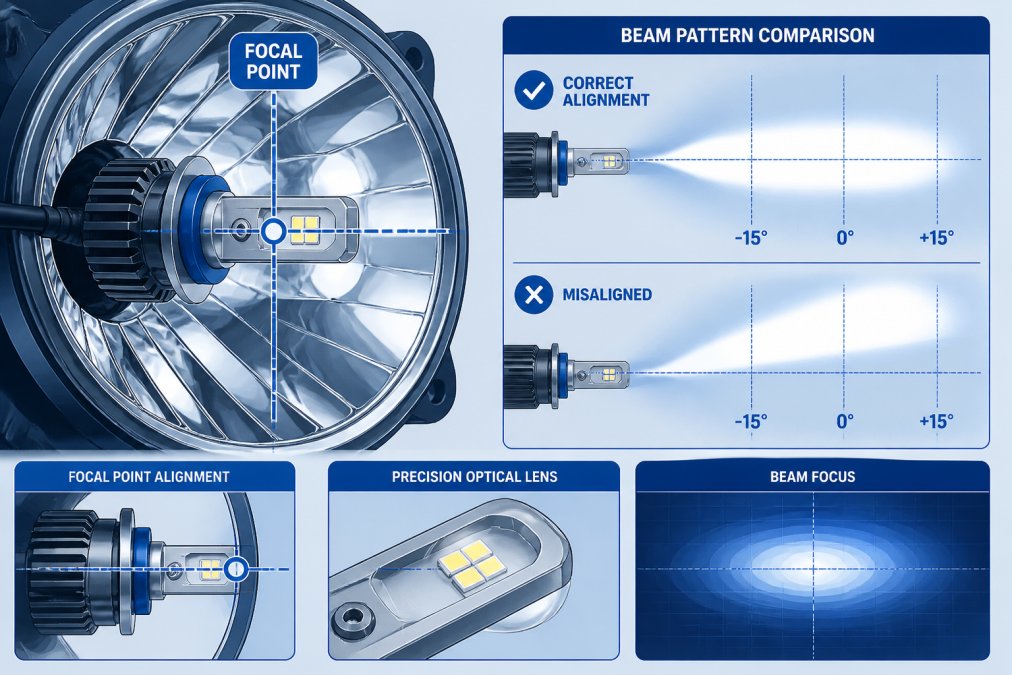
If you're retrofitting an older vehicle, prioritize bulbs that explicitly state they've been tested for beam pattern. Ask the manufacturer for beam pattern photos or test data.
Heat Dissipation and Thermal Management in LED Conversions
LED bulbs generate less heat than halogen, but thermal management remains critical in older housings. A halogen bulb produces 3,000-4,000 degrees of radiant heat. An LED bulb produces 150-300 degrees. That's a 99.7% reduction, but it's still enough to damage plastic housings, melt wiring insulation, or overheat the bulb itself if cooling is inadequate.
Older vehicles have a compounding problem: their headlight housings, harnesses, and connectors were never designed for sustained high-temperature operation. Plastic reflector bowls can warp. Connector terminals can corrode. Wiring insulation becomes brittle.
Active cooling systems (turbo fans) address this by forcing air across the bulb and heatsink. Passive cooling (aluminum heatsinks, copper thermal plates) relies on natural convection. The best approach for older vehicles is hybrid: a bulb with both passive and active cooling, plus a harness upgrade if the original wiring is suspect.
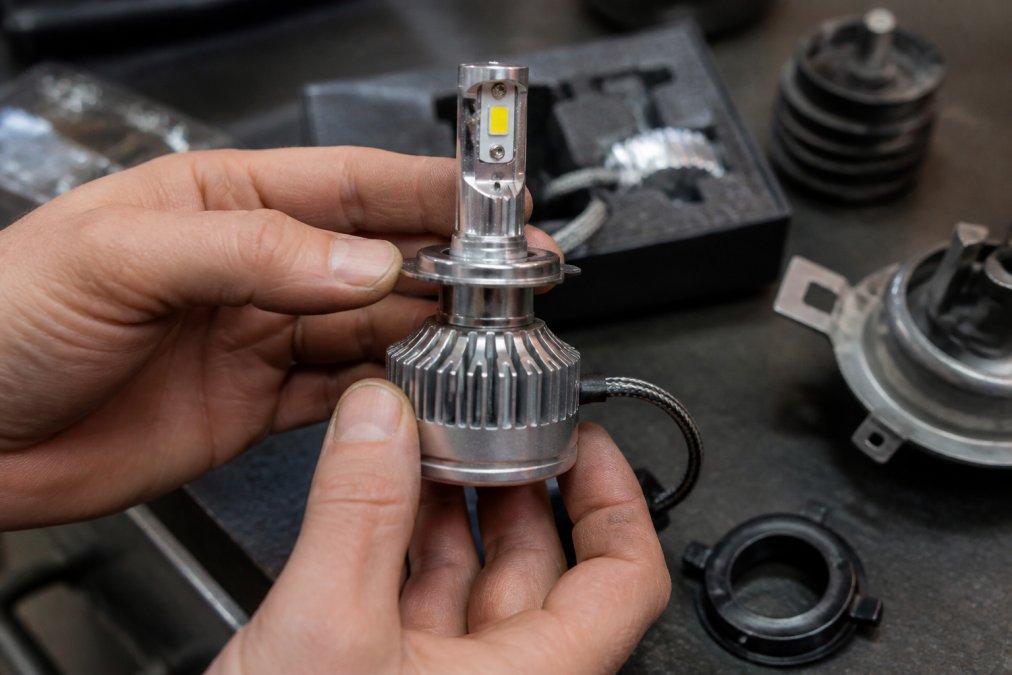
Before installation, inspect your vehicle's headlight connector. If it's corroded, oxidized, or loose, clean it or replace it. A poor connection creates resistance, which generates heat. Check your vehicle's headlight harness voltage under load. A healthy system delivers 12-14.5 volts at the headlight connector with the engine running and high beams on.
Flickering LED Lights Troubleshooting in Older Vehicles
Flickering is the most common problem after LED installation in older vehicles. It manifests as a pulsing or strobing effect, sometimes synchronized with engine RPM, sometimes random.
Cause 1: Insufficient Electrical Load
LED bulbs draw far less power than halogen. Many vehicles have load-sensing onboard diagnostics that monitor current draw. When they detect unusually low current, they trigger a warning or disable the circuit, causing flickering or shutdown. Solution: Use LED bulbs designed to mimic halogen power draw (like SEALIGHT's 65-watt design) or add external LED decoders that simulate load ($20-$50).
Cause 2: Poor Electrical Connection
Corroded connectors, loose terminals, or damaged wiring create intermittent contact. Solution: Inspect and clean the headlight connector. If corrosion is heavy, replace the connector entirely. Use dielectric grease on all connections to prevent future oxidation.
Cause 3: Incompatible Ballast or Regulator
Some vehicles have active headlight management systems that adjust voltage based on engine load. LED bulbs with internal electronics can interact poorly with these systems. Solution: Check if your vehicle has active headlight leveling or adaptive lighting before installing aftermarket LED bulbs.
Dimmable LED Bulbs for Halogen Dimmers: Compatibility Explained
Some older vehicles have headlight dimmer circuits that reduce voltage to the bulbs rather than switching between high and low beams. Installing a standard LED bulb in these vehicles often results in the LED not dimming or dimming erratically.
Dimmable LED bulbs handle voltage reduction without flickering or shutting off. They use sophisticated internal circuitry that maintains stable operation across a wider voltage range (typically 8-16 volts instead of the standard 12-14.5 volts).
If your vehicle has a dimmer circuit, you have three options: Replace the dimmer with a relay-based high/low switch ($50-$150), use a dimmable LED bulb designed for your specific application, or keep halogen bulbs and upgrade everything else to LED. Before buying, understand whether your vehicle uses a traditional high/low switch or a dimmer circuit.
LED vs Halogen Heat Output: What Changes in Your Vehicle
A halogen bulb produces roughly 3,500 watts of radiant heat. An LED bulb produces roughly 10-20 watts of heat. That's a 99.7% reduction.
For most vehicles, this is fantastic. Less heat means the headlight housing stays cooler, plastic lenses don't degrade as quickly, and the wiring harness ages more slowly. The reduced heat means you can run LED headlights for extended periods without worrying about overheating.
High-power LED bulbs like AUXITO's X5 Series (170 watts) generate significant heat at the connector. If the connector is corroded or the wiring is marginal, that heat concentrates at the connection point, potentially causing failure. Thermal management for LED conversions focuses on the connector and wiring, not the bulb-to-housing interface. Keep connections clean and tight. Upgrade wiring if it's original and brittle. Use dielectric grease to prevent corrosion.
Legal and Safety Implications of Retrofitting Older Housings
LED headlight retrofits exist in a legal gray area in most US states. Federal regulations (FMVSS 108 and SAE standards) define what constitutes a legal headlight. Most aftermarket LED bulbs don't meet these standards because they alter the beam pattern, intensity, or color temperature from the original design.
Safety is more important than legality. A beam pattern that's too high or too diffuse endangers oncoming drivers. The best LED bulbs for older halogen housings maintain the original beam pattern characteristics while improving brightness. Before installation, consider your use case. If the vehicle is a weekend show car or off-road-only, legal compliance matters less. If you drive it on public roads regularly, prioritize compliance and safe beam patterns.
Comparison Table: Best LED Bulbs for Older Halogen Housings
| Product | Socket Type | Lumen Output | Best For | Price | Key Advantage |
|---|---|---|---|---|---|
| RMS Lighting Gen2 (7" Round) | Sealed Beam | 10,000-30,000 | Drop-in replacement, factory look | $179-$239 | Plug-and-play, LHD compliant |
| RMS Lighting Gen3 (5.75" Round) | Sealed Beam | 10,000 | Precision beam pattern | $289 | Mini projector lens, sharp cutoff |
| Cougar Motor H11 | H11/H8/H9 | 22,000 | Quick upgrade, simple install | $57.99 | Wireless, 1:1 size match |
| SEALIGHT S7S 9006 | 9006/HB4 | 33,040 | Maximum brightness | $50-$100 | Load-matching, error-code prevention |
| Fahren Termitor H4 | H4/9003/HB2 | 9x brighter | Precision beam focus | $40-$60 | Sharp cutoff line, 70K hour lifespan |
| AUXITO X5 H4 | H4/9003 | 32,000 | Performance-focused | $40-$60 | Dual-layer cooling, 2-year warranty |
| BEAMTECH 9007 | 9007/HB5 | Variable | Silent operation | $49.99 | Fanless design, no moving parts |
Upgrading to the best LED bulbs for older halogen housings transforms your nighttime driving experience, but the choice requires understanding your vehicle's specific electrical system, housing type, and intended use. RMS Lighting LLC's sealed beam conversion kits offer the most straightforward path for classic vehicles with factory sealed beams, they're engineered for legal compliance, maintain factory appearance, and deliver 50,000+ hour reliability. For vehicles with modern reflector housings, prioritize bulbs with proven beam pattern testing and thermal management designed for your specific socket type. Balance brightness, beam quality, thermal reliability, and long-term durability. Test fit when possible, inspect your electrical system before installation, and upgrade connectors or wiring if they show signs of age or corrosion.

Frequently Asked Questions
Can I install LED bulbs in my older halogen housing without modification?
It depends on the specific housing and LED bulb design. Many modern LED bulbs use a 1:1 size ratio to halogen bulbs for plug-and-play installation in older housings. However, reflector housings and projector lenses behave differently optically. Sealed beam conversions like RMS Lighting's Gen2 and Gen3 kits replace the entire housing, eliminating fitment concerns. Before purchasing, verify your vehicle's headlight type (sealed beam, reflector, or projector) and confirm the LED bulb's focal point alignment matches your housing's optical design.
Why do LED bulbs cause flickering and error codes in older vehicles?
Flickering LED lights in older vehicles typically result from two issues: electrical load mismatch and CanBUS decoder incompatibility. Halogen bulbs draw consistent wattage that vehicle electronics expect; LEDs draw far less power, triggering error codes. Additionally, older vehicles lack the sophisticated power management systems that modern cars use. Installing a decoder or load resistor compensates by mimicking the halogen's electrical signature. Some vehicles also require active cooling systems in the LED bulb itself to maintain consistent power delivery and prevent voltage fluctuations that cause flicker.
What is the difference between LED vs halogen heat output, and does it affect my vehicle?
Halogen bulbs generate significant heat (around 1000+ degrees at the filament), while LEDs produce minimal heat at the diode itself. This difference affects your vehicle in two ways: first, LED housings don't need the same thermal tolerance as halogen housings, reducing risk of plastic lens damage; second, older vehicles designed around halogen heat may have ventilation assumptions that change with LEDs. The real concern is internal LED heat dissipation. Quality LED bulbs use heat sinks and active or passive cooling to manage the concentrated thermal load from the diode and driver circuitry, preventing premature failure and maintaining lumen output over time.
Are dimmable LED bulbs compatible with my halogen dimmer switch?
Most standard LED bulbs are not compatible with halogen dimmer switches without modification. Halogen dimmers use phase-cut dimming technology that reduces voltage to the bulb. LEDs require constant voltage and interpret dimming signals as flicker or failure, causing erratic behavior. If your older vehicle has a dimmer-controlled headlight circuit, you have two options: install LED bulbs specifically designed for dimmer compatibility (which include internal dimmer-compatible drivers), or replace the dimmer switch with a standard on/off switch. Check your vehicle's wiring diagram to determine if your headlights are actually dimmer-controlled or simply on/off.
What makes RMS Lighting's conversion kits different from standalone LED bulbs?
RMS Lighting offers sealed beam conversion kits that replace the entire headlight assembly, not just the bulb. This approach eliminates beam pattern and compatibility issues because the new housing is engineered specifically for LED optics. Their Gen2 kits (10,000 LM options) and Gen3 kits with mini projector lenses (10,000 LM) provide correct LHD lens patterns and factory-style appearance. Conversion kits cost more than standalone bulbs (starting at $179 for 7" round) but guarantee proper beam focus, cutoff line definition, and electrical compatibility. For vehicles with severely aged or damaged reflector housings, conversion kits are often the only way to achieve safe, legal beam patterns.
This article was written using GrandRanker