


Best LED Conversion for Classic Cars: 2026 Buyer's Guide

Table of Contents
- Quick Comparison: Best LED Conversion Kits for Classic Cars
- How We Evaluated These LED Sealed Beam Headlights for Classic Cars
- Top Classic Car LED Headlight Upgrade Kits Ranked
- DOT Approved LED Headlights for Classic Cars: What the Law Requires
- Compatibility with Vintage Electrical Systems: Load Analysis Before You Buy
- Installing LED Headlights in a Classic Car: Step-by-Step
- Troubleshooting Common LED Conversion Issues in Classic Cars
- Which LED Conversion Kit Should You Choose?
Last Updated: August 2, 2026
Finding the best LED conversion for classic cars is harder than it looks. Sealed-beam headlights on vintage vehicles were designed when 35 watts of yellow halogen light was adequate, it isn't. RMS Lighting LLC has helped countless classic car owners solve this problem, and the answer is almost never the cheapest kit on Amazon. Below, we'll show you how to choose the right LED conversion kit, what the law requires, and how to avoid electrical issues that plague budget installs.

Most guides focus entirely on lumen output and ignore beam pattern, Kelvin rating compatibility with vintage reflector housings, and the load analysis your old wiring actually needs. Get those three wrong and you'll have a kit that's technically brighter but practically worse than what you started with.
Quick Picks:
- Best for Projector Technology: RMS Lighting Gen3 Pro Series
- Best for Maximum Lumens: RMS Lighting Gen2 High-Output Series
- Best Plug-and-Play Value: RMS Lighting Gen1 Entry Series
Quick Comparison: Best LED Conversion Kits for Classic Cars
| Kit | Size | Lumens | Technology | Price | Best For |
|---|---|---|---|---|---|
| RMS3303PRO Gen3 | 7" Round | 10,000 LM | Mini Projector | $249 | Sharpest beam cutoff, no glare |
| RMS3307PRO Gen3 | 5x7" Square | 10,000 LM | Mini Projector | $249 | Muscle cars, trucks |
| RMS3305PRO Gen3 | 4x6" Square | 10,000 LM | Mini Projector | $289 | Fox Body, compact classics |
| RMS3301PRO Gen3 | 5.75" Round | 10,000 LM | Mini Projector | $289 | Small round housings |
| RMS3321S130 Gen2 | 7" Round | 30,000 LM | H4 LED | $239 | Maximum raw output |
| RMS3322S130 Gen2 | 5x7" Square | 30,000 LM | H4 LED | $239 | High-output trucks |
| RMS3323S130 Gen2 | 4x6" Square | 15,000 LM | H4 LED | $299 | Fox Body, high output |
| RMS3301M2S Gen1 | 5.75" Round | 10,000 LM | H4 LED | $219 | Budget-conscious entry |
How We Evaluated These LED Sealed Beam Headlights for Classic Cars
Every kit was evaluated against three technical criteria that directly affect real-world driving performance. Lumen ratings alone tell you almost nothing useful. A 30,000-lumen bulb firing into a poorly matched reflector housing produces scattered light that blinds oncoming drivers instead of illuminating the road.
Beam Pattern and Light Output
Beam pattern is the single most important specification for a classic car LED headlight upgrade. A correct left-hand-drive lens pattern concentrates light ahead with a sharp cutoff line on the driver's side, preventing glare while maximizing road illumination.
RMS Lighting LLC's kits feature correct LHD lens patterns engineered for American vintage vehicle reflector housings. Generic H4 bulbs designed for the European market produce a different cutoff angle. Install one in a 1969 Camaro and you'll light up oncoming windshields instead of the road. High beam coverage should extend at least 400 feet ahead with a clean, defined edge on low beam.
Color Temperature and Kelvin Rating
Color temperature determines how the light looks and how well the human eye processes it at speed. For classic car applications:
- 5,000K-6,500K: Modern white output, closest to daylight. Best for maximum contrast and road detail. RMS Gen2 and Gen1 series run at 6,500K.
- 3,000K-3,500K: Warm white, closer to original halogen character. Preferred by owners wanting period-correct appearance with LED efficiency.
The 6,500K range wins on visibility; warm white wins on aesthetics. Neither is wrong, the choice depends on whether you're building a driver or a show car.
Vintage Aesthetic and Glass Lens Design
A conversion kit that looks obviously modern defeats the purpose on a classic vehicle. The best kits use glass lens construction that replicates the original sealed-beam appearance. Glass holds clarity over time, resists UV yellowing, and produces correct light diffusion through original-style reflector housings.
RMS Lighting LLC's entire lineup uses glass lens construction. This detail separates a conversion kit that looks factory from one that screams aftermarket. Polycarbonate lenses are cheaper but develop a hazy, oxidized appearance within years.
Top Classic Car LED Headlight Upgrade Kits Ranked
RMS Lighting Gen3 Pro Series: Best for Projector Technology
The Gen3 Pro prioritizes beam precision over raw lumen output. Mini projector technology inside a glass sealed-beam housing produces a tighter, more controlled beam pattern than reflector-only designs. Light goes where you need it, with a sharp cutoff that won't draw complaints from oncoming drivers.
Available in four sizes: 7" round at $249, 5x7" square at $249, 4x6" square at $289, and [5.75" round](https://rmslighting.net/products/5-75-gen3-small-round-headlight-conversion-kit-with-10-000-lm-h4-led-bulbs) at $289. All deliver 10,000 lumens per set.
The projector element creates a defined low-beam cutoff that reflector-only designs can't match. For daily drivers on public roads, this is the responsible choice.
RMS Lighting Gen2 High-Output Series: Best for Maximum Lumens
The Gen2 series prioritizes maximum light output. At 30,000 lumens for the 7" and 5x7" configurations and 15,000 lumens for the 4x6", these are the brightest kits in the RMS lineup.
The 7" Gen2 kit and 5x7" Gen2 kit are both priced at $239. The 4x6" Gen2 comes in at $299 and includes harness adapters. All run at 6,500K and 130 watts.


More lumens only means better visibility when the beam pattern distributes them correctly. The Gen2's glass lens and H4 bulb design work well with most factory reflector housings, but the Gen3 projector will outperform it in beam precision on low beam. At 130 watts, the Gen2 draws more current than the Gen3, so run the electrical load analysis before installing on a 6-volt or early 12-volt system.
RMS Lighting Gen1 Entry Series: Best Plug-and-Play Value
The Gen1 5.75" kit at $219 is the most accessible entry point in the RMS lineup. It delivers 10,000 lumens with H4 LED technology, includes harness adapters for true plug-and-play installation, and uses the same glass lens construction as higher-tier kits. This is the right choice for owners upgrading a 5.75" housing who want significant improvement over halogen without the projector premium.

DOT Approved LED Headlights for Classic Cars: What the Law Requires
DOT-compliant headlights are a legal requirement for any vehicle operated on public roads in the United States, and the rules apply to classic cars the same as modern vehicles.
According to FMVSS 108 headlighting standards published by NHTSA, headlighting equipment must meet Federal Motor Vehicle Safety Standard No. 108. This standard governs photometric output, beam pattern, and marking requirements. A DOT-compliant headlight carries a DOT marking and, in most cases, an SAE marking indicating the function tested.
H4 conversion kits sold as "off-road use only" do not meet FMVSS 108 and are not legal for street use. Some kits carry this designation because they cannot pass the photometric tests required for DOT approval. RMS Lighting LLC's conversion kits are designed with correct LHD lens patterns and built to meet standards required for street use. Always verify the specific kit's compliance documentation before purchase.
Compatibility with Vintage Electrical Systems: Load Analysis Before You Buy
Vintage electrical systems are the most overlooked variable in any classic car LED conversion. Many classic vehicles left the factory with 6-volt positive-ground systems. Even those converted to 12-volt negative-ground may have undersized wiring, marginal voltage regulators, and generators rather than alternators.
LED headlights draw significantly less current than halogen or sealed-beam units they replace. A traditional sealed-beam headlight draws roughly 4-5 amps per lamp. The Gen3 Pro kits draw considerably less, reducing total electrical load on the system. This is particularly meaningful for vehicles with original generators that struggle to keep pace with modern electrical demands.
The load analysis you need to run before buying:
- Identify your system voltage: 6V or 12V.
- Confirm ground polarity: Positive or negative ground. Certain LED drivers are polarity-sensitive.
- Check your charging system: Generator or alternator.
- Measure wiring gauge to the headlights: Undersized wiring causes voltage drop, which causes LED flicker.
- Assess your voltage regulator: An unstable regulator causes flicker and can shorten LED driver life.
According to guidance on automotive electrical system fundamentals, voltage drop across a circuit should not exceed 0.5 volts for lighting circuits. If your headlight circuit shows more than that under load, address the wiring before installing new lamps.
Installing LED Headlights in a Classic Car: Step-by-Step
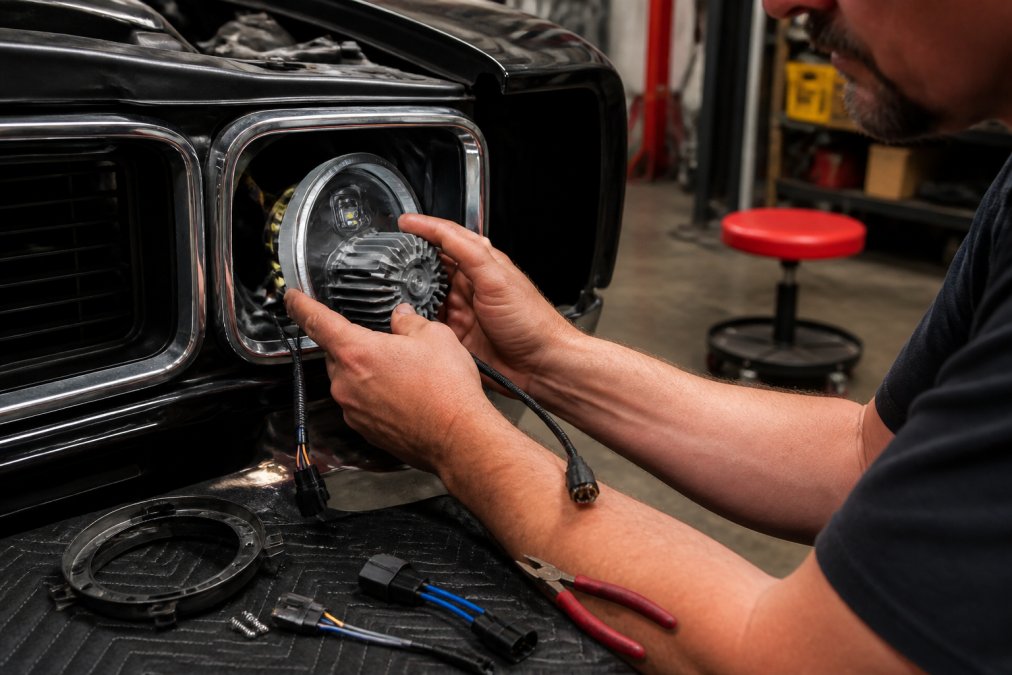
Installing a classic car LED headlight upgrade is straightforward on most vehicles. Budget 60-90 minutes for a two-headlight installation if you've done basic automotive work before.
Tools and Prep Work
Gather these before you start: flathead and Phillips screwdrivers, trim ring removal tool or flathead with tape to protect chrome, multimeter for voltage and polarity verification, wire crimpers and heat-shrink connectors, and masking tape for marking headlight aim reference points.
Before removing anything, use your multimeter to confirm system voltage and ground polarity at the headlight connector. Mark the vehicle's current headlight aim on a wall or garage door before removal so you can reset aim accurately after installation.
Wiring Harness Connection and Flicker-Free Setup
The plug-and-play nature of RMS Lighting's kits means the H4 connector plugs directly into the factory harness on most applications. Included harness adapters in the Gen1 and Gen2 4x6" kits handle vehicles where the factory connector doesn't match the H4 standard.
Flicker is the most common complaint after a classic car LED conversion, and it almost always traces to one of three causes: voltage instability (use a relay harness that draws power directly from the battery), PWM dimming conflict (add a capacitor-based filter on the power input line), or loose ground connections (clean the ground connection at the headlight bucket and chassis).
Once connected, recheck headlight aim. LED conversion kits have a different light source position than the original sealed beam, which can shift the beam pattern slightly.
Troubleshooting Common LED Conversion Issues in Classic Cars
Hyper-flashing turn signals: LED turn signal bulbs draw less current than incandescent units, causing the flasher relay to cycle faster. The fix is an LED-compatible electronic flasher relay, not a resistor load.
Uneven beam pattern: If one side throws a noticeably different pattern than the other, check that the LED bulb is seated correctly in the housing. The H4 bulb has a locating tab that must align with the housing notch.
Heat buildup: Quality LED conversion kits include passive heat dissipation built into the housing design. If a kit runs hot to the touch after 30 minutes, the thermal design is inadequate.
As the Automotive Lighting Research group at the University of Michigan Transportation Research Institute has documented, improper beam aim and pattern are among the leading causes of glare complaints from oncoming drivers.
Which LED Conversion Kit Should You Choose?
The best LED conversion for classic cars depends on three variables: headlight size, primary use, and electrical system condition.
Start with size. The most common configurations are 7" round for muscle cars and trucks, 5x7" rectangular for late-model classics and some trucks, 4x6" for Fox Body Mustangs and similar applications, and 5.75" round for smaller European-influenced American cars.
Then match the series to your use case:
- Gen3 Pro: Street-driven vehicles where beam precision and DOT compliance are the priority. The projector technology produces the sharpest cutoff and the least glare.
- Gen2 High-Output: Rural highway driving, off-road use, or any application where maximum light range matters more than beam precision.
- Gen1 Entry: Weekend drivers, first-time LED conversions, and budget-conscious builds where meaningful improvement over halogen is the goal without the projector premium.
The kit itself is only half the equation. The wiring condition, headlight aim, and beam pattern interaction with your specific reflector housing determine whether a theoretically excellent kit actually performs in the real world. Take the time to do the electrical load analysis and the aim check, and the performance difference over factory halogen will be immediately obvious on the first night drive.
Poor nighttime visibility is one of the most common complaints from classic car owners who haven't updated their lighting. RMS Lighting LLC offers a full range of rigorously tested LED conversion kits with correct LHD lens patterns, original-style glass lens construction, and plug-and-play installation that works with vintage electrical systems. Whether you need the beam precision of the Gen3 Pro or the raw output of the Gen2 High-Output series, the right kit is a direct replacement for your factory sealed beam. Learn More at rmslighting.net and find the correct kit for your specific headlight size and application.
Frequently Asked Questions
Are LED conversions legal for classic cars in the US?
Legality depends on whether the conversion kit meets DOT and SAE standards. Look for kits explicitly marked DOT-compliant, as these have been tested to meet Federal Motor Vehicle Safety Standard No. 108. Some H4 bulb-only kits are sold for off-road use only and are not street legal. Full sealed-beam replacement assemblies with a DOT marking on the lens are generally the safest choice for road use on a vintage vehicle.
Do LED headlight conversions require electrical modifications in a classic car?
Most plug-and-play LED conversion kits for classic cars draw significantly less current than original sealed-beam halogen bulbs, so the existing wiring harness usually handles them without modification. However, vehicles with 6-volt systems or generators rather than alternators need a load analysis first. Very low electrical draw can also trigger hyper-flashing in turn signal circuits. Adding a load resistor or an LED-compatible flasher relay solves this without rewiring the entire vehicle.
What is the best LED conversion for classic cars that keeps a factory look?
The best LED conversion for classic cars that preserves the original appearance uses a glass lens housing in the correct sealed-beam diameter, such as 7-inch round, 5.75-inch round, 5x7, or 4x6. Kits built around a retro-style glass lens rather than a polycarbonate cover are nearly indistinguishable from factory headlights. Choosing a 4000K-5700K color temperature rather than an extreme 6500K also keeps the light output looking period-correct from the outside.
How difficult is it to install LED headlights in a classic car?
For most classic cars with standard sealed-beam housings, installing LED headlights is a straightforward swap. Direct-fit kits use the existing headlight bucket and plug into the original wiring harness connector, requiring no cutting or splicing. The full process typically takes 30-60 minutes per side with basic hand tools. The main variables are verifying the correct housing size for your vehicle and confirming the wiring connector type matches before ordering.
What color temperature works best for classic car LED headlights?
Color temperature is measured in Kelvin. For a modern, bright white beam pattern, 5700K-6500K is common. Owners who prefer a warmer, more period-correct glow often choose 3000K-4000K, which mimics the original halogen light output in tone. Either range delivers far more lumens than a stock sealed-beam bulb. The practical difference is visibility versus aesthetics: cooler temperatures improve contrast on dark roads, while warmer temperatures maintain the vintage look.
This article was written using GrandRanker