

Brightest Amber LED Turn Signals: 2026 Review

Table of Contents
- What Defines a Truly Bright Amber LED Turn Signal
- RMS Lighting 1157 Switchback CanBus White / Amber LED Bulbs
- RMS Lighting 3157 Switchback CanBus White / Amber LED Bulbs
- RMS Lighting 7443 Switchback CanBus White / Amber LED Bulbs
- LED Turn Signal Hyper-Flash Fix: Relays vs. Load Resistors
- 3157 vs 7440 LED Bulb Differences: Which Socket Do You Need?
- DOT Compliance for Automotive LED Lighting on Public Roads
- Which Amber LED Turn Signal Should You Choose?
- Frequently Asked Questions
Last Updated: September 7, 2026
What Defines a Truly Bright Amber LED Turn Signal
Most drivers assume raw lumen output is the only metric that matters, leading to bulbs that look blinding directly but cast little usable light down the road, yet the real test of amber led turn signals is how effectively they direct light through your vehicle's reflector housing and lens. The real measure is how effectively light is directed through your vehicle's reflector housing and lens.
A quality amber LED turn signal must balance lumen output, a beam pattern matching the reflector's design, and correct color temperature. LEDs emit from a flat surface while filament bulbs emit in every direction, causing scattered light and dark spots. The challenge is mimicking the filament's omnidirectional output.
Why Beam Pattern Fails in Reflector Housings
Most factory housings use a reflector bowl designed to capture light from a single point source and project it forward. An LED array emits from multiple points across a flat plane, hitting the reflector at angles it was never shaped for, scattering light and creating dark zones.
This is why a 2,000-lumen LED can appear dimmer than a 400-lumen halogen. The halogen's filament sits at the reflector's focal point; the LED's light misses it entirely, reflecting at incorrect angles.
The 360-Degree Emitter Solution
Manufacturers use 360-degree emitter designs, cylindrical arrays or vertically stacked chips, that place LEDs along the filament's vertical axis, letting the reflector capture light from all sides. This is the difference between a bulb that looks bright and one that lights the road.
When evaluating any amber LED turn signal, look for the emitter layout in product photos. A flat board with chips facing one direction is a red flag for poor beam pattern in a reflector housing. A cylindrical or multi-sided design that surrounds the base is far more likely to work correctly.
Projector Housings: A Different Challenge
Projector housings, common after 2005, use a lens and shutter rather than a reflective bowl, making them more forgiving of LEDs. However, a poorly positioned emitter can place the cutoff line too low, reducing visibility to drivers in tall trucks or SUVs.
The same LED bulb can perform differently in reflector versus projector housings, so fitment guides and real-world user photos matter more than spec sheet claims.
Measuring Real-World Visibility
True amber LEDs operate at a dominant wavelength of 590-595 nanometers (sae.org). Cheaper bulbs shift toward red or green, reducing contrast against brake lights. The human eye is most sensitive to 590nm in daylight.
At RMS Lighting LLC, we test bulbs in representative reflector and projector housings, measuring light distribution on a wall at 25 feet to see where light lands, not just total output.

RMS Lighting 1157 Switchback CanBus White / Amber LED Bulbs
The 1157 socket is a common dual-function base where one bulb runs both parking light and turn signal. The RMS Lighting 1157 Switchback CanBus bulbs are a substantial step up from the factory bulb.

The switchback function is the defining feature: white for parking light duty, then a clean amber-off-amber-off flash when signaling, far more noticeable than white-amber alternation. Each pair sells for $55.00, with CanBus circuitry resisting error codes and hyper-flashing.
RMS Lighting 3157 Switchback CanBus White / Amber LED Bulbs
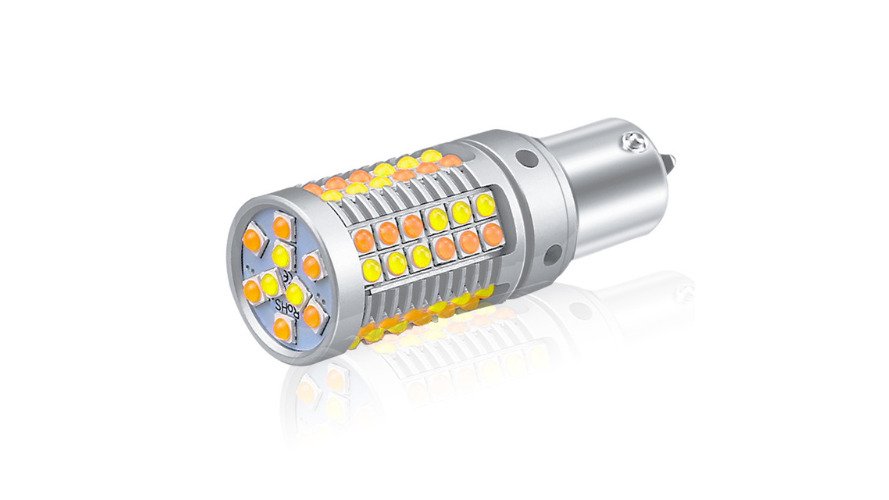
For vehicles using the 3157 base, the RMS Lighting 3157 Switchback CanBus bulbs offer the same dual-function intelligence. Each produces 1,000 lumens from a 46 SMD2835 array at 24 watts with a 9-30V range. Priced at $55.00 per pair with a 2-year warranty.

The 3157 and 1157 share a blade-style base but are not interchangeable, the indexing tabs differ, so confirm your application before purchasing. The 3157's CanBus circuitry prevents hyper-flash on most vehicles, though some may still require an upgraded flasher relay.
RMS Lighting 7443 Switchback CanBus White / Amber LED Bulbs
The 7443 socket uses a wedge-style base rather than blade connectors. The RMS Lighting 7443 Switchback CanBus bulbs deliver 1,000 lumens at 24 watts with a 46 SMD2835 array, priced at $55.00 per pair with a 2-year warranty.
The 7443 features "super canbus" circuitry to eliminate hyper-flash without additional components. It flashes amber-off-amber-off for maximum clarity, returning to white automatically once the signal is canceled.
LED Turn Signal Hyper-Flash Fix: Relays vs. Load Resistors
Hyper-flashing occurs because LEDs draw less load than filament bulbs, so the relay interprets it as a burned-out bulb and speeds up the flash rate, reducing signal clarity.
Two solutions exist, depending on your vehicle's architecture. A replacement flasher relay is cleaner: RMS Lighting offers 2-pin electronic relays starting at $8.00, with speed-adjustable options from 50 to 200 cycles per minute. Installation is plug-and-play.
Load resistors add resistance in parallel to simulate a filament's load, but generate significant heat and require careful mounting. They are necessary only when the flasher relay is integrated into a larger module.
3157 vs 7440 LED Bulb Differences: Which Socket Do You Need?
The 3157 vs 7440 question confuses DIY installers because both serve similar functions but use incompatible bases. The 3157 uses a blade-style dual-function connector; the 7440 uses a wedge-style single-function base.
| Bulb Base | Connector Type | Function | Typical Use | RMS Switchback Option |
|---|---|---|---|---|
| 1157 | Blade (dual-prong) | Dual-function | Parking + turn signal | Yes, $55.00/pair |
| 3157 | Blade (dual-prong) | Dual-function | Parking + turn signal | Yes, $55.00/pair |
| 7443 | Wedge | Dual-function | Parking + turn signal | Yes, $55.00/pair |
| 7440 | Wedge | Single-function | Turn signal only | No |
The 7443 is the dual-function version of the 7440. If your vehicle uses a 7440 for the turn signal and a separate bulb for parking, a switchback is not correct, it requires a single socket handling both duties.
DOT Compliance for Automotive LED Lighting on Public Roads
DOT compliance is surrounded by misinformation. FMVSS 108 governs lighting on public roads, specifying photometric performance standards tested in the vehicle's actual housing. There is no DOT sticker for individual bulbs; the manufacturer certifies compliance.
This regulatory framework is why bulb design matters more than raw brightness claims. A bulb that produces excessive intensity in the wrong direction can fail to meet the standard even if it appears bright to the human eye. The National Highway Traffic Safety Administration's lighting regulations establish these photometric requirements for all vehicle lighting. When selecting amber LED turn signals for street use, choose bulbs engineered with proper optical design rather than generic diodes arranged on a board.
What FMVSS 108 Actually Measures
FMVSS 108 specifies minimum and maximum candela values at test points: 200 candela at beam center, 125 candela at 10 degrees off-center, and a maximum of 750 candela. Measurements are taken in the specific housing, so a bulb can pass in one vehicle and fail in another.
The color requirement mandates that turn signal light fall within SAE-defined chromaticity coordinates for "amber." This is a precise measurement, a bulb appearing orange can still fail if its spectrum falls outside the amber region.
The Self-Certification Reality
Replacement bulbs do not receive government approval stickers; manufacturers self-certify compliance with FMVSS 108. This puts the burden on buyers to choose manufacturers who actually perform photometric testing, as many budget bulbs skip it entirely.
Some manufacturers claim "DOT compliant" without testing documentation or print fake DOT logos. The practical defense is to buy from established brands that publish testing methodology and warranty their products.
State-Level Enforcement and Inspection
Enforcement happens at the state level, with most states incorporating FMVSS 108 into vehicle codes. In states without annual inspections, enforcement is complaint-driven, an officer noticing a dim or wrong-colored signal can issue a citation.
The risk is not just a ticket, if your turn signal fails federal standards after an accident, your insurance company may deny or reduce your claim.
Off-Road vs. On-Road Products
Some LEDs are marketed for off-road use only, with extreme brightness or colors legal on private property but not public roads. Installing them on a street-driven vehicle violates FMVSS 108.
For turn signals, the amber color requirement is non-negotiable, white, red, or blue are not permitted. Switchback bulbs' white running light mode is legal for parking lights, but the turn signal function must switch to amber.
How to Verify Compliance Before Buying
Three steps protect you: check for FMVSS 108 compliance and wavelength specs, look for a return policy covering fitment issues, and search for user photos of the bulb in your specific vehicle model.
Which Amber LED Turn Signal Should You Choose?
Selecting the right amber LED turn signal comes down to matching the bulb base to your socket and confirming a dual-function application. The RMS Lighting 1157 Switchback is the strongest choice for classic cars and trucks built before the mid-2000s, with 2,800 lumens providing a dramatic visibility upgrade.
For newer vehicles using 3157 or 7443 bases, the switchback delivers the same benefits. All three options are $55.00 per pair, with a 2-year warranty on 3157 and 7443 models. For 1983-1987 Buick Regal or Grand National, RMS Lighting offers sequential LED front turn and park kits with 48 amber LEDs per side, starting at $159.00.
The environmental testing we put these bulbs through covers thermal cycling, vibration resistance, and voltage regulation across the 9-30V range. That testing matters because an LED that fails after three months of road vibration saves you nothing. The Society of Automotive Engineers lighting standards provide the industry benchmark for how automotive lighting should perform under real-world conditions, and we hold our products to that standard.
Choosing the right amber LED turn signal requires understanding your socket type, confirming the dual-function application, and selecting proper beam pattern engineering. RMS Lighting LLC builds switchback bulbs that deliver brightness without hyper-flash or scattered beams. Our 1157, 3157, and 7443 options are rigorously tested, with CanBus circuitry preventing error codes. Get started with RMS Lighting.
Frequently Asked Questions
Are amber LED turn signals street legal?
Yes, amber LED turn signals are legal on public roads in the United States. Federal Motor Vehicle Safety Standard 108 requires turn signals to emit either white or amber light to the front. The key is to select bulbs with a true amber hue, not a red or orange tint, and to ensure the bulb produces a proper beam pattern within your vehicle's existing reflector housing. RMS Lighting's switchback bulbs are designed for this dual-function purpose.
Do I need a load resistor when upgrading to LED turn signals?
Often, yes, but a load resistor is not the only fix. LEDs draw less electrical load than incandescent bulbs, which can trigger hyper-flash. A cleaner solution is to replace your vehicle's flasher relay with an electronic LED flasher, which is plug-and-play. As a last resort, a load resistor can be wired in-line. RMS Lighting's switchback bulbs are CanBus compatible, which reduces the chance of hyper-flash, but some vehicles may still require a relay.
What is the difference between CANbus and standard LED turn signal bulbs?
A CANbus LED bulb includes built-in circuitry designed to simulate the electrical load of a standard filament bulb. This prevents the vehicle's computer from detecting a 'bulb out' error and stops the rapid flashing, or hyper-flash, that often occurs when you install standard LEDs. Standard LED bulbs lack this circuitry and are more likely to trigger errors on vehicles with can-bus electrical systems. For a trouble-free install, a CanBus-compatible bulb is a safer choice.
How do I choose the right LED bulb size for my vehicle's turn signals?
First, check your owner's manual or the base of your old bulb for the part number, such as 1157, 3157, or 7443. You need a bulb that matches your socket type for proper fitment and electrical connection. Consider whether your light is dual-function, meaning it serves as both a parking light and a turn signal. If so, you will need a switchback bulb that produces white light for parking and switches to amber for the signal. Verify this before ordering.