

LED Conversion Kits for Trucks: 2026 Buyer's Guide

Table of Contents
- What to Look for in LED Conversion Kits for Trucks
- Top LED Conversion Kits for Trucks: Compared and Ranked
- Truck LED Headlight Upgrade: Truck-Specific Challenges to Know First
- HID vs LED Headlights for Trucks: Which Technology Wins?
- Truck LED Lighting Laws: DOT Compliance and Legal Requirements
- How to Install an LED Conversion Kit in Your Truck
- Durability, Heat Management, and Long-Term Reliability
- Which LED Conversion Kit Is Right for Your Truck?
Last Updated: July 30, 2026
Dim factory halogens are one of the most common complaints among truck owners, and the fix is simpler than most people realize. LED conversion kits for trucks have become the go-to upgrade for drivers who want dramatically better nighttime visibility without replacing the entire headlight assembly. RMS Lighting LLC brings you products that have been rigorously researched and tested, specializing in best-in-class LED headlamp conversion kits and bulbs that replace factory components with ease. Below, we'll show you exactly how to choose the right kit, avoid the most common installation mistakes, and stay on the right side of federal lighting regulations.
The most important thing most guides get wrong: raw lumen numbers are not the whole story. A poorly designed LED that scatters light in a reflector housing can actually reduce usable road illumination compared to a well-aimed halogen. Beam pattern quality matters as much as output.
Quick Picks:
- Best Overall: RMS Lighting LLC - precision-engineered, correct LHD beam pattern, OEM-style fitment
- Best Budget: Fahren LED Headlight Conversion Kit - bright output at an accessible price point
- Best Beam Pattern: HIKARI Ultra LED Bulbs - patented optics minimize glare scatter
- Best Active Cooling: Auxbeam S2 Series - high-output 72W with 12,000 RPM turbofan
- Best Brand-Name Option: Philips Ultinon Pro3101 - trusted name, consistent quality
What to Look for in LED Conversion Kits for Trucks
Choosing the right LED conversion kit starts with understanding three variables: socket compatibility, light output, and thermal management.
Socket Type and Fitment: 9004, 9007, H11, and Beyond
Socket type is the single most critical fitment factor for any truck LED headlight upgrade. Common socket types in American trucks include 9004 and 9007 for dual-beam applications, H11 for low beams on many late-model trucks, and 9005/9006 for high/low beam separation. The 9004 and 9007 connectors are NOT interchangeable: forcing the wrong socket causes connector damage and potentially shorts the wiring harness.
Before ordering any LED conversion kit, pull the existing halogen bulb and read the code stamped on the base. Cross-reference that code with your truck's owner manual or a verified fitment database. OEM-sized designs that match the physical footprint of the original halogen are essential for reflector housings: oversized LED bodies block light output and distort the beam.
Lumens, Kelvin, and Color Temperature Explained
Lumens measure raw light output. Kelvin measures color temperature. Most LED conversion kits for trucks target 6000K to 6500K, producing a crisp white light that improves contrast on road markings compared to the yellowish 3200K output of standard halogens. The 6000K sweet spot delivers the best balance of visibility and contrast without reducing depth perception in fog and rain.
Lumen claims in marketing materials vary wildly and are often measured at the LED chip rather than at the road surface. A kit claiming 12,000 lumens raw output might deliver far less usable light than a well-designed 8,000-lumen kit with superior optics.
Top LED Conversion Kits for Trucks: Compared and Ranked
| Kit | Best For | Color Temp | Cooling | Canbus Ready |
|---|---|---|---|---|
| RMS Lighting LLC | OEM fitment, classic trucks | Correct LHD pattern | Tested thermal management | Yes |
| Fahren LED | Budget-conscious buyers | 6500K | Efficient passive/active | 99% compatible |
| HIKARI Ultra | Beam pattern priority | 6000K | Ultra-thin heat sink | Optional decoder |
| Auxbeam S2 | High-output active cooling | Not specified | 12,000 RPM turbofan | Built-in |
| Philips Ultinon Pro3101 | Brand-name reliability | 6000K | Lumiled ZES chips | Varies by model |
RMS Lighting LLC: Precision-Engineered, OEM-Style Conversion Kits
The best overall pick for truck owners who want a correct, factory-matched result is RMS Lighting LLC. These kits emphasize correct LHD lens patterns: the light output is calibrated for left-hand drive vehicles, which means the beam cuts correctly at the horizon without throwing unwanted light into oncoming traffic. RMS Lighting LLC specializes in providing best-in-class LED headlamp conversion kits and bulbs that replace factory components with ease, ensuring you benefit from the latest in lighting technology. Options to upgrade to 90-Watt or 130-Watt bulbs are available.
Pros:
- Correct LHD beam pattern for US roads
- Original style conversion kits for easy installation
- 90W and 130W upgrade options available
- Vibrant illumination for turn signals and parking lights
Best for: Classic truck restorers, owners of older vehicles with original halogen setups, and anyone who's had bad experiences with generic kits.
Visit rmslighting.net for current fitment options and pricing.
Fahren LED Headlight Conversion Kit: Budget-Friendly Brightness
Fahren's conversion kits produce a 6500K cool white output with an IP68 waterproof rating. The 1:1 mini-size halogen bulb design fits most reflector housings without clearance issues. Fahren claims Canbus compatibility with 99% of vehicle systems, but sensitive trucks may still need an external Canbus decoder to eliminate error codes, a $10-$20 fix worth knowing about before purchase.
Pros: Strong brightness, IP68 rating, compact design, long rated lifespan Cons: Sensitive vehicles may need external decoder
HIKARI Ultra LED Bulbs: Beam Pattern Priority
HIKARI Ultra's ultra-thin heat sink design reduces the physical depth of the chip assembly, keeping the LED emitter closer to the reflector's focal point. This translates to a more uniform beam pattern and less astigmatism. HIKARI Ultra uses Philips Lumileds chips at 6000K with a two-year warranty.
Pros: Patented uniform beam pattern, Lumileds chips, two-year warranty Cons: Canbus decoders sold separately for some applications
Auxbeam S2 Series: High-Output Active Cooling
The Auxbeam S2 delivers 8,000 lumens per set at 72W with a 12,000 RPM turbofan and aviation-grade 6063 aluminum construction. The built-in Canbus system handles compatibility with 99% of vehicle computer systems, with a rated 30,000-hour lifespan.
Pros: High lumen output, effective active cooling, built-in Canbus Cons: Some sensitive brands still need additional decoders
Philips Ultinon Pro3101: Brand-Name Reliability
Philips Ultinon Pro3101 carries the brand's heritage into the LED conversion market. The 6000K output uses Philips Lumiled ZES LED chips for consistent color rendering, with availability in common socket types including 9005 and 9006. The trade-off is price: the Pro3101 sits at a higher price point than most aftermarket alternatives, but for fleet operators or buyers wanting a known-quantity brand with documented quality history, that premium is defensible.
Pros: Trusted brand, consistent quality, ZES chip technology Cons: Higher price point
Truck LED Headlight Upgrade: Truck-Specific Challenges to Know First
Trucks present unique electrical and physical challenges that sedans don't.
Canbus Compatibility and Error-Free Operation
Canbus is the vehicle communication network that monitors electrical loads across all circuits, including headlights. Many trucks built after 2005 use Canbus systems to detect burned-out bulbs by measuring current draw. Standard halogens draw 55-65W per bulb. Most LED conversion kits draw significantly less, which the Canbus system misreads as a failed bulb, triggering a dashboard warning light or causing hyper-flashing in turn signals.
Error-free LED kits address this through built-in load resistors or smart drivers that mimic the electrical signature of a halogen. When a kit claims "99% Canbus compatible," that remaining 1% typically covers trucks with highly sensitive body control modules. According to NHTSA vehicle electrical system guidance, maintaining correct circuit load is important for vehicle safety systems to operate as designed.
Beam Pattern Analysis: Avoiding Glare and Scatter in Reflector Housings
Reflector housings use a mirrored bowl to direct light from a specific focal point. Halogens have a filament at that focal point. LED chips have different geometry, and if the chip isn't positioned precisely at the reflector's focal point, light scatters in random directions rather than down the road. An LED kit with poor optics produces bright light that blinds oncoming drivers rather than illuminating the road surface.
Look for kits that explicitly describe OEM-matched chip placement, 360-degree no-dark-spot designs, or patented beam control optics.
HID vs LED Headlights for Trucks: Which Technology Wins?
LED technology has largely surpassed HID for truck conversion kits. LED kits offer instant-on operation with no warm-up delay and full brightness from the moment the switch is thrown. HID systems require ballasts and igniters that add complexity, cost, and additional failure points. LED thermal management has improved dramatically, with quality kits achieving 50,000-hour lifespans that outlast the truck itself in many cases.
Truck LED Lighting Laws: DOT Compliance and Legal Requirements
Federal Motor Vehicle Safety Standard 108, administered by the National Highway Traffic Safety Administration, governs headlamp performance requirements for vehicles sold and operated in the United States. Any headlamp or conversion kit used on public roads must comply with FMVSS 108 specifications for photometric output, beam pattern, and color.
Many LED conversion kits sold online are marketed as "DOT compliant" but are not actually SAE-certified or tested to FMVSS 108 standards. A product with a "DOT" stamp on the packaging does not automatically mean it has been independently tested. According to FMVSS 108 headlamp requirements, replacement bulbs for use in certified headlamp assemblies must meet specific performance criteria to be legal for road use.
Purchase kits from suppliers who can document compliance testing, and avoid kits that make only vague "DOT approved" claims without specifying the standard they meet.
How to Install an LED Conversion Kit in Your Truck
Total Time: 20-45 minutes depending on truck model Difficulty: Beginner to intermediate
What You'll Need:
- Correct LED conversion kit for your socket type
- Clean cotton gloves (avoid skin oils on LED components)
- Flathead screwdriver or trim removal tool
- Torque-free bulb removal technique for your specific housing
Step 1: Confirm Socket Type and Order the Correct Kit
Check your owner's manual or the existing halogen bulb code before ordering. Common truck socket types: 9004, 9007, H11, H13, 9005, 9006. Ordering the wrong socket type is the most common mistake and the easiest to avoid.
Step 2: Remove the Halogen Bulb and Prep the Housing
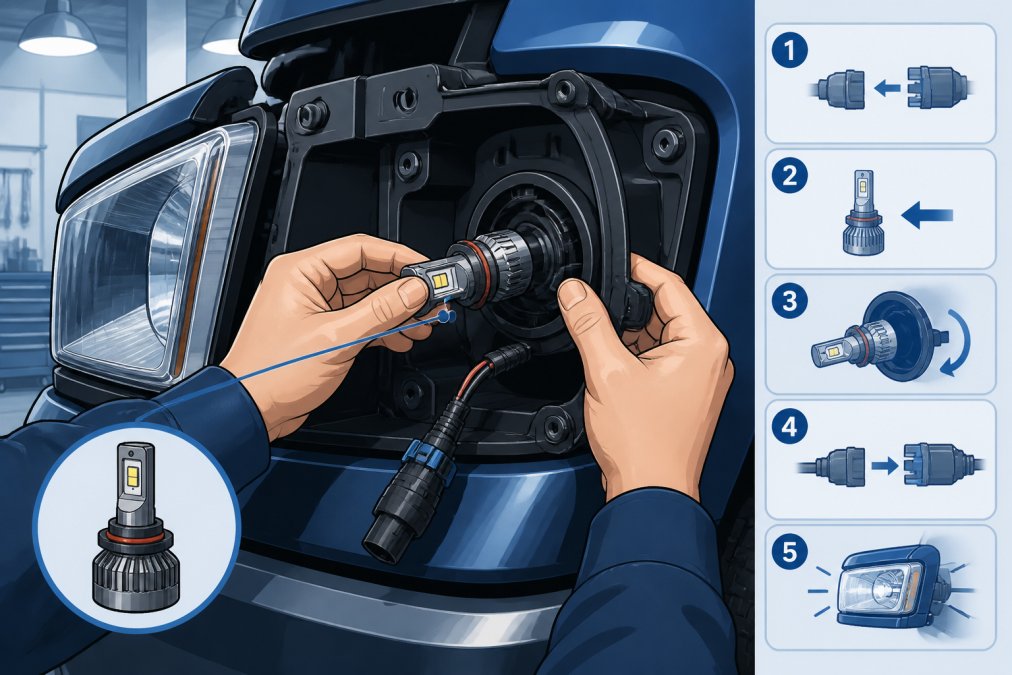
Access the headlight assembly from the engine bay on most trucks. Disconnect the wiring harness connector, rotate the bulb counterclockwise to release the locking rings, and pull the halogen straight out. Inspect the housing interior for moisture or corrosion.
Step 3: Seat the LED Bulb and Secure Locking Rings
Insert the LED bulb with the chip oriented correctly for your housing type. Reflector housings typically need the chip positioned horizontally to align with the reflector's focal axis. Rotate to lock using the locking rings. Do not overtighten: LED bases are often aluminum and can crack under excess torque.
Step 4: Connect the Wiring Harness and Test for Flicker
Reconnect the wiring harness. If the kit includes a Canbus decoder, connect it inline between the vehicle harness and the LED driver. Power on the headlights and observe for flicker, error codes, or hyper-flashing. A stable, flicker-free output confirms correct installation.
Durability, Heat Management, and Long-Term Reliability
Heat is the primary failure mode for LED conversion kits. LEDs themselves are highly efficient, but the driver electronics that regulate current are temperature-sensitive. A kit rated for 50,000 hours in controlled conditions may fall significantly short in a truck engine bay where ambient temperatures regularly exceed 200°F.
Thermal management design separates premium kits from budget options. Fanless designs use passive heat sinks, typically aluminum fins that radiate heat away from the driver. Active-cooled designs with turbofans move heat more aggressively and perform better in enclosed housings with limited airflow.
Buy from suppliers who conduct their own validation testing and back products with a meaningful warranty. IP67 and IP68 ratings indicate the driver and heat sink assembly can withstand water ingress during rain and washing. Trucks used off-road or in agricultural settings should prioritize IP68-rated kits.
Which LED Conversion Kit Is Right for Your Truck?
The right kit depends on your truck's socket type, housing style, and how you use the vehicle.
For classic truck restorers and owners of older vehicles with original halogen reflector housings, RMS Lighting LLC's original-style conversion kits, engineered with correct LHD lens patterns and available in 90W and 130W configurations, address exactly this use case.
For budget-focused daily drivers, Fahren and HIKARI Ultra both deliver solid real-world performance at accessible price points, with the caveat that Canbus decoders may be needed for newer trucks.
For trucks operating in demanding thermal environments, the Auxbeam S2's active cooling and aviation-grade aluminum construction provide the most durable thermal management.
For buyers who prioritize brand heritage and documented quality history, Philips Ultinon Pro3101 remains a credible choice despite its higher price point.
The common thread across all good LED conversion kits for trucks: correct socket fitment, verified beam pattern control, Canbus compatibility for your specific vehicle, and thermal management suited to your operating environment. Get those four factors right and the upgrade delivers a genuine, lasting improvement in nighttime visibility.
Frequently Asked Questions
Are LED conversion kits for truck headlights legal in the US?
Federal law under FMVSS 108 governs headlight standards in the US, and most aftermarket LED conversion kits are not DOT-certified as complete headlight assemblies. While many drivers use them without issue, technically compliant options are kits sold as DOT-compliant replacements. Always check your state's vehicle equipment laws, as enforcement varies. For classic trucks and off-road use, the rules may differ. When in doubt, look for kits that explicitly reference DOT compliance on their packaging or product listing.
Do LED conversion kits work with all truck headlight housings?
Not always. Older trucks with reflector-style headlight housings can cause LED chips to scatter light unpredictably, creating glare for oncoming drivers rather than a clean beam pattern. Projector housings generally perform better with LED conversions. Fitment also depends on socket type, common truck sizes include 9004, 9007, and H11. Always verify your truck's bulb socket type before ordering, and look for kits with OEM-sized designs that seat correctly without modification to the headlight assembly.
How do I prevent dashboard error codes and flickering after installing an LED conversion kit?
Dashboard error codes and hyper-flashing occur because your truck's computer detects lower electrical resistance from LED bulbs compared to halogens. The fix is a canbus-compatible or error-free kit that includes built-in resistors or a separate decoder module. Most quality LED conversion kits advertise 99% vehicle compatibility, but trucks with more sensitive body control modules may still need an additional canbus decoder. Confirm canbus readiness before purchasing, especially for trucks from 2005 onward with advanced electrical systems.
What color temperature is best for truck LED headlights?
Most truck owners choose between 5000K and 6500K. A 6000K cool white output is widely considered the sweet spot, it delivers crisp, daylight-like nighttime visibility without the blue tint of higher Kelvin ratings that can reduce contrast in fog or rain. Ratings above 6500K may look striking but often perform worse in adverse weather. For long highway drives or rural roads with minimal street lighting, 6000K hits the best balance of brightness and practical road illumination.
What is the difference between HID and LED headlights for trucks?
HID (high-intensity discharge) lights use a gas-filled arc to produce light and require a warm-up period of several seconds. LED headlights use semiconductor chips, producing instant full brightness with lower power draw and a longer lifespan. LEDs also offer more precise beam pattern control, making them better suited for retrofitting into existing truck headlight assemblies. HID systems can produce very high lumen output but involve higher voltage components and more complex wiring, making LED conversion kits the more practical truck LED headlight upgrade for most DIY installs.
How long do LED conversion kits for trucks typically last?
Quality LED conversion kits are commonly rated for 30,000 to 50,000 hours of operation, far exceeding the typical 1,000-hour lifespan of standard halogen bulbs. Actual longevity depends heavily on thermal management, kits with effective heat sinks or active cooling fans maintain LED chip temperatures within safe operating ranges, extending their service life. Fanless designs using large aluminum heat sinks can also achieve long lifespans while eliminating the risk of fan motor failure over time.
Poor nighttime visibility is a real safety issue, not just an inconvenience, and the wrong LED kit can make it worse rather than better. RMS Lighting LLC offers precision-engineered LED conversion kits built with correct LHD lens patterns, OEM-style fitment, and options up to 130 Watts for drivers who need serious output. Every product is rigorously researched and tested before it reaches your hands. Learn more at RMS Lighting LLC and find the right kit for your truck.
This article was written using GrandRanker