

LED Headlight Testing and Quality Standards: A 2026 Guide

Table of Contents
- Why LED Headlight Testing Standards Matter
- FMVSS 108 Regulations and DOT Compliance Requirements
- Photometric Testing: Beam Pattern and Light Distribution
- LED Headlight Color Temperature Legality in the US
- IIHS Headlight Safety Ratings and Performance Benchmarks
- OEM vs. Aftermarket LED Assembly Standards
- Industry Test Methods and Standardized Protocols
- Retrofit Performance vs. OEM Degradation
Last Updated: August 5, 2026
Why LED Headlight Testing Standards Matter
Poor visibility at night kills. The National Highway Traffic Safety Administration recognizes that inadequate lighting contributes to thousands of accidents annually, which is why federal standards for automotive lighting exist. Most DIY enthusiasts buy cheap LED conversion kits expecting plug-and-play simplicity, only to discover their new lights blind oncoming traffic, trigger dashboard error codes, or produce scattered light that doesn't illuminate the road effectively. The difference between a quality LED conversion and a problematic one comes down to rigorous testing and adherence to established standards. At RMS Lighting LLC, we've engineered our LED headlight conversion kits to meet these standards precisely because cutting corners on photometric compliance and optical alignment creates real safety risks.

Understanding LED headlight testing and quality standards is the foundation for making an informed upgrade decision.
FMVSS 108 Regulations and DOT Compliance Requirements
What FMVSS 108 Actually Requires
Federal Motor Vehicle Safety Standard 108 (FMVSS 108) is the regulatory backbone for all automotive lighting in the United States. Administered by the National Highway Traffic Safety Administration, this standard establishes minimum photometric performance requirements, beam pattern specifications, and optical alignment tolerances that any headlight must satisfy to be street-legal.
FMVSS 108 mandates specific beam cutoff patterns to prevent glare, defines acceptable color temperature ranges, specifies candela intensity at particular angles, and requires consistent performance across operating conditions. Critically, FMVSS 108 applies to the complete lighting assembly, not just the bulb. A high-performance LED bulb installed in an incompatible reflector housing will fail photometric testing. RMS Lighting LLC's conversion kits pair engineered LED bulbs with sealed beam assemblies specifically designed for photometric compliance, ensuring the entire system works as a unified optical unit.

Photometric Performance Thresholds
Photometric compliance centers on measurable light output and distribution. FMVSS 108 establishes minimum and maximum luminous intensity requirements at specific test points. Luminous flux (lumens) indicates total light output, while candela measures intensity in a particular direction. A light can produce high lumens but fail candela requirements if that light scatters instead of focusing where drivers need it.
The standard defines performance zones on a test grid. The high-beam zone requires minimum candela values for adequate road illumination. The low-beam zone has stricter requirements around the cutoff line to prevent glare while maintaining visibility. Exceeding maximum candela values in the glare zone fails compliance. Testing occurs under controlled conditions with fixed distance, standardized test surface, specific ambient lighting, and precise optical axis alignment. Many aftermarket LED kits skip this rigorous validation.
Photometric Testing: Beam Pattern and Light Distribution
Measuring Luminous Flux and Candela Output
Luminous flux (lumens) quantifies total visible light emitted across all directions. A 30,000-lumen LED bulb produces significantly more total light than a traditional 1,000-lumen halogen bulb, delivering noticeably improved visibility. However, lumens alone don't guarantee compliance or real-world performance.
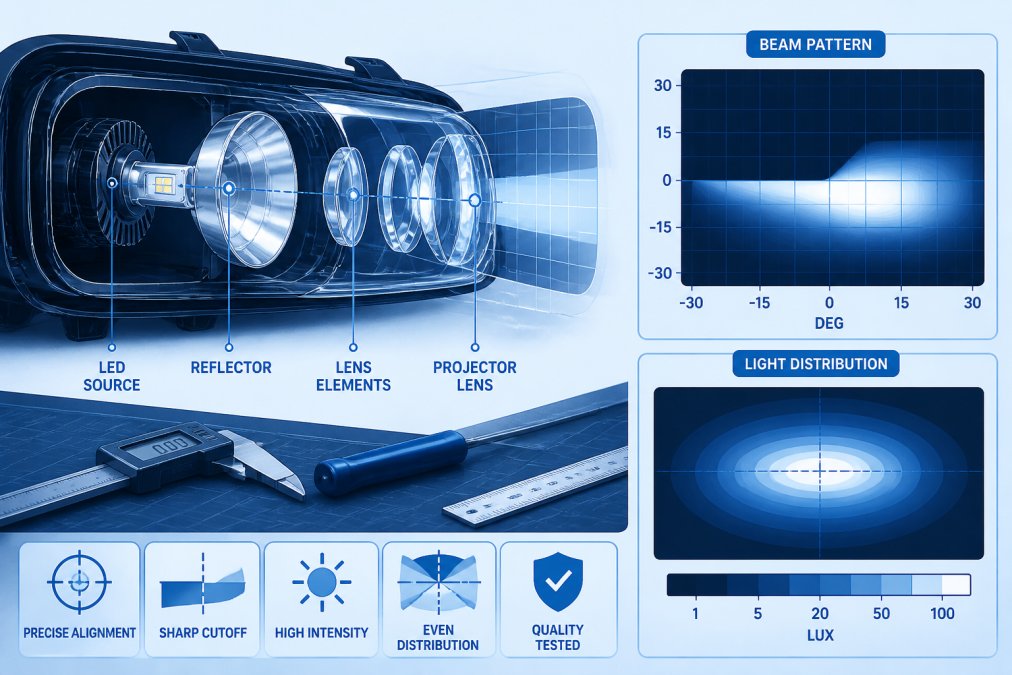
Candela (cd) describes light intensity in a specific direction. Headlight testing measures candela at specific angles defined by FMVSS 108. Testing equipment includes a photometer mounted on a standardized test rig at a fixed distance (typically 25 meters). The photometer measures light intensity at grid points representing different angles, generating a candela distribution map showing where light concentrates and where it falls off. A compliant beam pattern shows a sharp cutoff line with high candela below the cutoff and minimal candela above it.
RMS Lighting LLC's conversion kits undergo photometric measurement during development. The combination of engineered LED optics, reflector housing design, and lens geometry produces beam patterns satisfying FMVSS 108 intensity requirements while maintaining the sharp cutoff needed for safe nighttime driving.
Cut-Off Line and Glare Reduction
The cutoff line is the sharp boundary between the illuminated road area and the dark zone above it. In a compliant low-beam pattern, this line is distinct and well-defined. Light below the cutoff illuminates the road; light above it remains minimal to avoid blinding oncoming drivers.
Achieving a sharp cutoff requires precise optical design. The reflector housing must direct light downward without scattering. The lens must focus that light without creating stray beams. The LED source must be positioned at the exact focal point of the reflector. FMVSS 108 sets maximum candela values in upper zones specifically to prevent glare. Cheap LED kits often ignore this requirement, producing scattered light that blinds oncoming traffic, a serious safety hazard and regulatory violation.
LED Headlight Color Temperature Legality in the US
Approved Color Temperature Ranges
Color temperature, measured in Kelvin (K), describes the perceived color of light. FMVSS 108 requires chromaticity, the precise color coordinates of emitted light, to fall within defined boundaries on the CIE chromaticity diagram.
Headlights in the 5500K to 6500K range typically comply with chromaticity requirements and are street-legal across the United States. Light above 6500K (cooler, more blue) enters risky territory. HID and LED lights marketed as 8000K or higher often fail chromaticity compliance, producing visibly blue light that's technically non-compliant and actually less effective for nighttime visibility. Human eyes are most sensitive to light in the 5500-6500K range, which is why compliant headlights in this band deliver superior visibility.
Chromaticity Standards and Compliance
Chromaticity is the color coordinate of light independent of brightness. FMVSS 108 defines acceptable chromaticity ranges on the CIE 1931 chromaticity diagram. Testing involves a spectrophotometer that measures wavelength distribution and calculates chromaticity coordinates. If those coordinates fall outside the defined region, the lighting system fails compliance.
The chromaticity standard exists because color temperature affects visibility and safety. Excessively blue light scatters more in the atmosphere and through moisture, reducing contrast and visibility in adverse weather. Many cheap LED kits ignore chromaticity testing entirely, using LED chips with color temperatures far outside the compliant range.
IIHS Headlight Safety Ratings and Performance Benchmarks
The Insurance Institute for Highway Safety (IIHS) evaluates headlight performance using more stringent criteria than federal minimums. While FMVSS 108 establishes baseline legal requirements, IIHS testing measures visibility, glare, and beam pattern consistency across a wider range of test scenarios. IIHS ratings, ranging from Poor to Good, provide an independent assessment of real-world headlight performance.
IIHS testing includes measurements of visibility distance, glare intensity, and beam pattern consistency across different mounting angles and vehicle suspension positions. A headlight rated "Good" by IIHS typically outperforms federal minimums significantly. For consumers evaluating LED upgrades, IIHS ratings provide a useful benchmark. Federal compliance is a floor, not a ceiling.
OEM vs. Aftermarket LED Assembly Standards
Optical Alignment and Reflector Housing Design
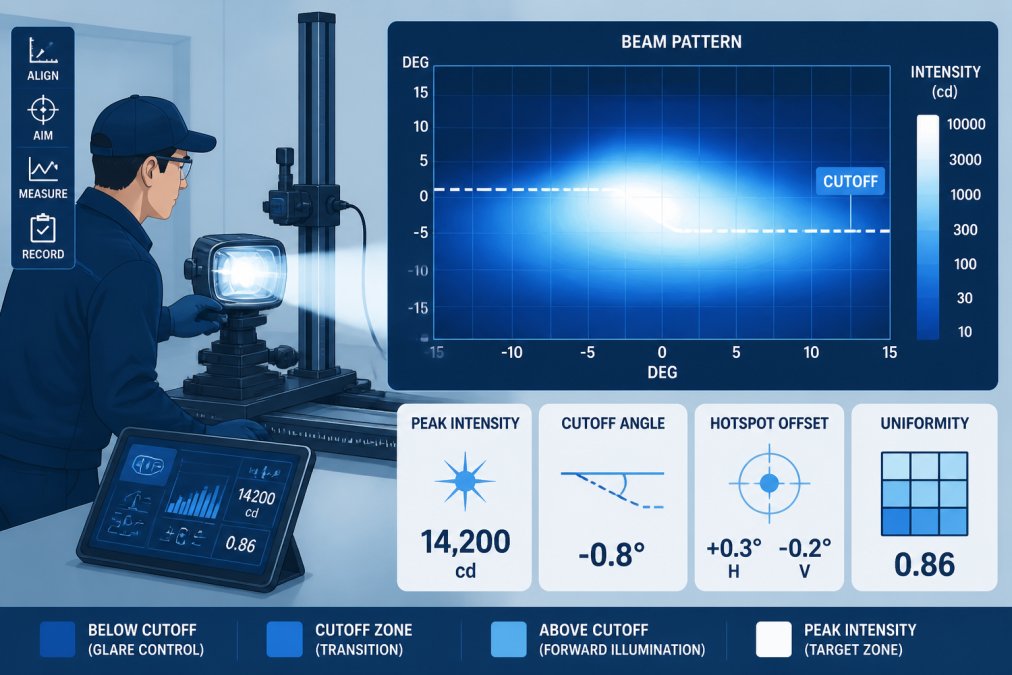
OEM LED headlights undergo extensive engineering to ensure optical components work in perfect harmony. The reflector housing is precision-molded to exact specifications. The LED module is positioned at the focal point of the reflector with tolerances measured in millimeters. The lens is optically designed to focus light and create a sharp cutoff.
Aftermarket conversion kits attempt to replicate this integration by pairing LED bulbs with existing reflector housings or new sealed beam assemblies. Many older vehicle reflector housings were designed for halogen sources, which have different light distribution characteristics than LEDs. Installing an LED bulb in a halogen-optimized reflector can produce acceptable results if the bulb is engineered for that specific housing, but mismatched combinations fail photometric compliance.
RMS Lighting LLC's approach addresses this directly. Our conversion kits pair engineered LED bulbs with sealed beam assemblies specifically designed for LED optics. Optical alignment tolerance is critical. A bulb misaligned by 3mm can shift the cutoff line enough to fail glare requirements.
Thermal Management and Ingress Protection
LEDs generate heat, and thermal management directly impacts longevity and performance. While LEDs are more efficient than halogen bulbs, they still produce significant heat that must be dissipated to prevent degradation. OEM LED systems include heat sinks, thermal interface materials, and sometimes active cooling to maintain safe operating temperatures.
Ingress protection (IP rating) measures how well the headlight assembly resists moisture and dust ingress. A sealed beam must maintain optical clarity despite exposure to road spray, humidity, and temperature cycling. OEM systems typically achieve IP67 or higher ratings. Budget aftermarket kits often lack adequate sealing, allowing moisture to condense inside the lens and degrade optical clarity over time. RMS Lighting LLC's conversion kits provide IP67-rated ingress protection with thermal management features that maintain safe operating temperatures.
Industry Test Methods and Standardized Protocols
SAE and Regulatory Testing Procedures
The Society of Automotive Engineers (SAE) develops testing procedures that manufacturers use to validate compliance with FMVSS 108. SAE testing procedures specify exact test setup geometry. The headlight is mounted at a defined height and angle. The photometer is positioned at a standardized distance (typically 25 meters). The test surface is a standard reflectance. Ambient lighting is controlled.
The testing sequence measures photometric data at grid points defined by SAE J1383. Data is collected in both low-beam and high-beam modes. Intensity values are recorded at specific angles corresponding to critical visibility zones and glare zones. This data is analyzed against FMVSS 108 thresholds to determine compliance. Regulatory testing also includes durability and environmental testing to verify that photometric performance doesn't degrade over the product's service life.
Consumer-Level Testing Tools and What to Look For
Professional photometric testing requires expensive equipment and controlled environments. However, several consumer-accessible tools provide useful performance insights.
Basic beam pattern assessment can be performed in a dark parking lot by aiming headlights at a wall and observing the projected pattern. A compliant beam shows a distinct cutoff line with a sharp transition from bright to dark. Lux meters measure illumination intensity at a specific distance and can approximate professional test conditions. Color temperature meters measure the Kelvin value of emitted light, verifying that LED color temperature falls within the 5500-6500K compliant range.
Consumer-level tools provide useful screening information but don't replace professional testing. Prioritize products from manufacturers who provide professional photometric test data rather than relying solely on visual assessment.
Retrofit Performance vs. OEM Degradation
Retrofit LED upgrades face a unique challenge: they must perform in reflector housings designed for halogen sources. Halogen bulbs emit light from a small filament with specific intensity distribution. LEDs emit light from a chip with different spatial characteristics. Installing an LED in a halogen-optimized reflector can produce acceptable results, but the optical mismatch often degrades performance compared to an OEM LED system designed for the LED source from the start.
Beam pattern quality suffers because the reflector geometry doesn't optimally focus LED light. Glare increases because light scatters differently in a halogen-designed housing. OEM LED systems avoid this problem through integrated optical design. Every component is optimized for the specific light characteristics of the LED.
RMS Lighting LLC's conversion kits bridge this gap by pairing LED bulbs with sealed beam assemblies specifically engineered for LED optics. Rather than forcing LEDs into halogen-designed housings, we've designed complete optical systems optimized for LED performance. If you're considering an LED upgrade, evaluate whether the kit includes a purpose-designed housing or simply a new bulb for your existing reflector.
Upgrading to LED headlights shouldn't mean compromising visibility or creating hazards for other drivers. The standards and testing protocols outlined above exist because lighting performance directly impacts safety. When you choose LED headlights engineered to meet FMVSS 108 compliance, photometric performance standards, and thermal durability requirements, you're investing in a system that delivers both improved visibility and responsible driving. RMS Lighting LLC's conversion kits are designed with these standards at the foundation, engineered LED bulbs paired with sealed beam assemblies optimized for photometric compliance, thermal management, and long-term reliability. Learn more about how our rigorously tested LED conversion kits can modernize your vehicle's lighting while maintaining safety and legal compliance.
| Testing Metric | What It Measures | Why It Matters | Compliance Standard |
|---|---|---|---|
| Luminous Flux (Lumens) | Total light output across all directions | Indicates overall brightness | FMVSS 108 minimum thresholds |
| Candela Intensity | Light intensity in specific directions | Determines visibility and glare | FMVSS 108 zonal requirements |
| Beam Pattern | Light distribution and cutoff line | Ensures visibility without blinding oncoming traffic | FMVSS 108 photometric zones |
| Color Temperature (Kelvin) | Perceived color of light | Affects visibility and chromaticity compliance | 5500-6500K compliant range |
| Ingress Protection (IP Rating) | Resistance to moisture and dust | Prevents optical degradation over time | IP67 or higher for sealed beams |
| Thermal Performance | Heat dissipation and operating temperature | Ensures longevity and reliability | Manufacturer specifications |
Frequently Asked Questions
Are 6500K LED headlights legal in the US?
In the United States, LED headlight color temperature is regulated under FMVSS 108, which specifies that headlights must fall within a chromaticity range that typically corresponds to 4100K to 5900K for standard compliance. A 6500K LED headlight exceeds this upper limit and is generally not DOT-approved for road use. However, legality depends on whether your specific kit carries DOT certification. Always verify that any LED conversion kit meets FMVSS 108 requirements before installation to avoid legal issues and ensure safe light distribution.
Do aftermarket LED headlight kits meet DOT standards?
Not all aftermarket LED kits meet DOT standards. Only those that have undergone rigorous photometric testing and received FMVSS 108 certification are legally compliant. Quality kits test beam pattern, luminous flux, glare reduction, and optical alignment to ensure they perform safely on public roads. When selecting an aftermarket kit, look for evidence of standardized testing, certification documentation, and a warranty. Cheap kits often skip proper testing and can cause dashboard error codes, hyper-flashing, and poor beam pattern performance.
What parameters are tested for LED headlight quality standards?
LED headlight testing evaluates multiple parameters: luminous flux (total light output measured in lumens), candela (light intensity in a specific direction), beam pattern (light distribution), cut-off line (the sharp boundary between lit and unlit road sections), chromaticity (color temperature compliance), glare reduction, thermal management, ingress protection (IP rating), and optical alignment. These metrics ensure the headlight meets FMVSS 108 requirements, provides safe visibility, doesn't blind oncoming drivers, and maintains performance over time. Professional testing uses standardized SAE protocols and photometric measurement equipment.
How do I know if an LED headlight kit will work with my older vehicle?
Compatibility depends on your vehicle's headlight housing type: sealed beam (round or rectangular), projector, or reflector design. RMS Lighting offers conversion kits in multiple sizes (4x6, 5x7, 7-inch round, and 5.75-inch small round) to match factory housings without modification. Before purchasing, verify your vehicle's original headlight dimensions and housing style. Quality kits like RMS Lighting's Gen2 models are engineered for correct LHD lens patterns and optical alignment, ensuring proper beam pattern and performance in older housings. Plug-and-play harness adapters eliminate most wiring complexity for DIY installation.
This article was written using GrandRanker