


LED Parking Light Bulb Alternatives: 2026 Guide

Table of Contents
- Why Standard Parking Light Bulbs Fall Short
- LED Parking Light Alternatives Compared
- CANbus LED Bulb Error Codes Explained
- How to Install LED Parking Lights Step by Step
- Automotive Lighting Regulations DOT Compliance
- Thermal Management and Long-Term Durability
- Cost Breakdown: What You'll Pay
- Frequently Asked Questions
Last Updated: September 15, 2026
Why Standard Parking Light Bulbs Fall Short
Incandescent 1157 and 194 bulbs lose brightness as they age, draw far more current than LEDs, and fail at the worst possible moment. That dim, amber glow you remember from your first drive is the filament slowly burning off tungsten. A standard 1157 bulb pulls roughly 8 to 27 watts depending on the filament stage, and most of that energy leaves as heat rather than light (Purchasing Energy-Efficient Light Bulbs).
Filament bulbs also produce a warm, yellow light in the 2700K to 3000K range (Purchasing Energy-Efficient Light Bulbs). Against modern traffic, that color reads as muddy and low-contrast, especially in rain or at dusk. When the filament finally breaks, you often do not notice until a state inspection or a warning from another driver.
At RMS Lighting LLC, we hear the same complaint from classic car owners: the factory housing is fine, the lens is fine, but the light output is not. The housing and lens are rarely the problem. The bulb is.
LED Parking Light Alternatives Compared
LED parking light bulbs replace the factory incandescent with a semiconductor light source that draws less current, runs cooler, and reacts instantly. The table below summarizes the main options in the RMS Lighting catalog, from simple plug-and-play pairs to full panel kits.
| Option | Price | Output | Best For |
|---|---|---|---|
| 1157 Super Bright 1000LM | $55.00 | 1000 lumens, 6500K | Simple white/white upgrade |
| 1157 Switchback CanBus | $55.00 | 2800 lumens, white/amber | Dual-function DRL and turn signal |
| 1157 150W CanBus High-Powered | $59.00 | 40,000 lumens | Maximum output builds |
| Panel Kits (G-Body) | $159.00-$229.00 | 48 amber LEDs per side | Classic Regal and Grand National |
1157 Super Bright 1000LM LED Bulbs
The 1157 Super Bright 1000LM White/White LED Bulbs are the straightforward starting point. Each bulb produces up to 1000 lumens of crisp 6500K white light. They are dual-function, so they work in parking light, turn signal, tail light, and brake light positions that use the 1157 base.

The draw here is simplicity. Plug-and-play for compatible applications, no wiring changes, and a crisp white look that modernizes the front of an older vehicle without touching the housing.
Pros: Clean 6500K output, dual-function design, sold as a matched pair. Cons: Not CanBus-compatible, so bulb-out monitoring systems may trigger a dash warning. Turn-signal use may need a flasher relay or resistor to prevent hyper-flashing.
1157 Switchback CanBus LED Bulbs
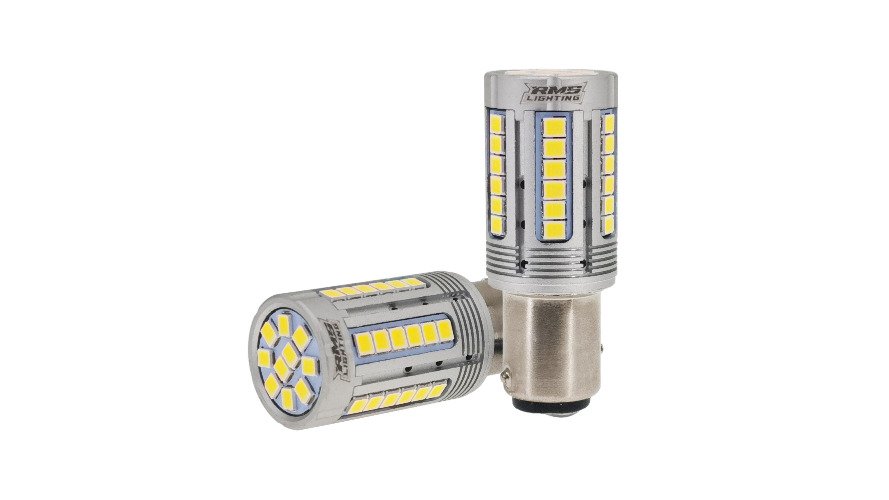
The 1157 Switchback CanBus White/Amber LED Bulbs solve the dual-function problem elegantly. They run white during parking and daytime running light operation, then switch to flashing amber the instant the turn signal engages.

CanBus compatibility is the headline. These bulbs are built to work with vehicles that monitor bulb resistance, which cuts down on the error codes that plague cheap LED conversions.
Pros: True switchback behavior, CanBus compatible, high LED count for even light spread. Cons: Designed only for dual-function sockets. In a single-function socket, the switchback function does nothing. Some vehicles still hyper-flash and need an LED flasher relay.
1157 150W CanBus High-Powered LED
For builds where output matters more than subtlety, the 1157 150W CanBus LED is the heavy hitter. It is rated at 40,000 lumens with a 150W CanBus chip, sold as a set of two.

This is the option for brake and tail light positions on trucks and restorations where you want unmistakable rear visibility. CanBus compatibility keeps error codes in check on monitored systems.
Pros: Extreme output, CanBus compatible, dual-filament design for brake and tail functions. Cons: Overkill for a parking light position. Verify the housing can handle the physical size before ordering.
Panel Kits for Classic G-Body Vehicles
Bulb swaps work until they do not. On 1983-87 Regal, Grand National, and GNX front ends, the factory reflector was never designed for a drop-in LED, and the beam pattern can scatter. The 2 Panel LED Front Turn/Park Kit replaces the bulb entirely with 48 amber LEDs per side on a precision-fit panel that drops into the existing housing and lens.
The $159.00 kit includes two panels, a pigtail harness kit, crimp terminals, an optional 1157 adapter, instructions, and a mounting template. The sequential version at $229.00 adds an inside-to-outside sweeping turn signal, a look that suits these cars perfectly.
Pros: Correct beam placement, no scattered light, retains the factory lens and housing. Cons: Model-specific, so it only fits the listed G-Body years. Professional installation is recommended for the sequential kit.
CANbus LED Bulb Error Codes Explained
CANbus LED bulb error codes appear when a vehicle's bulb-out monitoring system detects a resistance reading outside its expected range. Incandescent bulbs draw a predictable current, and the car's computer watches for that load. An LED draws far less, so the system reads it as a burned-out bulb and lights up the dash.
The fix comes in two forms. CanBus-compatible bulbs like the switchback and 150W options above include circuitry that mimics the expected load. For non-CanBus bulbs, a load resistor or an LED flasher relay does the same job. A 2-pin electronic flasher, priced at $8.00, replaces the OEM relay directly and eliminates the need to splice resistors into the harness.
Hyper-flashing, where the turn signal blinks at double speed, is the same problem wearing a different hat. It happens when the flasher unit senses the lower LED load. Swapping in an LED-compatible flasher fixes it at the source.
How to Install LED Parking Lights Step by Step
Installing LED parking lights takes about 15 to 30 minutes per side on most vehicles, with no special tools beyond a trim panel tool and a flathead screwdriver. The process is the same whether you are swapping a bulb or fitting a panel kit.
What you'll need:
- Replacement LED bulbs or panel kit
- Trim panel removal tool
- Flathead screwdriver (for adjustable flasher relays)
- Clean microfiber cloth
- Disconnect the battery. Pull the negative terminal before touching any lighting circuit. This prevents a short if a socket contacts metal.
- Access the housing. On most vehicles, reach behind the front bumper or remove the housing's retaining screws. Panel kits may require removing the lens.
- Remove the old bulb. Twist the socket counterclockwise and pull it free. Note the orientation of the locking tabs.
- Check polarity. LED bulbs are polarity sensitive. If the bulb does not light after installation, remove it and rotate 180 degrees in the socket.
- Seat the new bulb or panel. Push in firmly and twist clockwise until it locks.
Automotive Lighting Regulations DOT Compliance
Thermal Management and Long-Term Durability
Cost Breakdown: What You'll Pay
| Item | Price | Notes |
|---|---|---|
| 1157 White LED Bulbs (discontinued) | $10.00 | Non-CanBus, limited availability |
| 2-Pin LED Flasher Relay | $8.00 | Fixes hyper-flashing |
| 2-Pin Hyper Flash Flasher with Ground Wire | $10.00 | Adds a ground wire for stubborn systems |
| BLOWOUT 1157 CanBus Switchback | $20.00 | Sold as is, no warranty |
| 1157 Super Bright 1000LM | $55.00 | Standard white/white pair |
| 1157 Switchback CanBus | $55.00 | White/amber dual function |
| 1157 150W CanBus High-Powered | $59.00 | Maximum output pair |
| 2 Panel LED Front Turn/Park Kit | $159.00 | G-Body specific |
| 2 Panel Sequential LED Kit | $229.00 | G-Body specific, sweeping signal |
Frequently Asked Questions
What type of bulb is used for parking lights?
Most vehicles use miniature wedge or bayonet bulbs for parking lights. Common sizes include 194, 3157, and 1157. The 1157 is a dual-filament bayonet bulb found in many classic cars, trucks, and G-body vehicles. Check your owner's manual or pull the existing bulb to confirm the size before ordering an LED replacement.
Is it legal to replace standard parking bulbs with LEDs?
Yes, LED replacements are legal if they meet Federal Motor Vehicle Safety Standard 108, which covers lighting equipment. The key requirements are correct color (white or amber for front parking lights), proper intensity, and a beam pattern that doesn't glare oncoming traffic. DOT-compliant LED bulbs from reputable sellers meet these standards. Avoid cheap uncertified bulbs that scatter light.
Do LED parking light bulbs require a load resistor?
Not always. CANbus-compatible LED bulbs like the 1157 Switchback CanBus models include built-in circuitry that prevents error codes and hyper-flashing in many vehicles. If your car still shows a bulb-out warning or flashes too fast, a 2-pin LED flasher relay is a cleaner fix than tapping in load resistors. Resistors generate heat and require splicing, while a flasher relay is plug-and-play.
Are LED replacement bulbs compatible with all parking light housings?
Most LED bulbs fit standard 1157, 194, and 3157 sockets, but housing depth matters. High-output bulbs with heatsinks or fans may not fit shallow housings. For classic cars with sealed or tight housings, panel-style kits designed for specific models (like the 1983-87 Regal kits) are a better option because they replace the reflector assembly without modifying the housing.
How do I determine the correct bulb size for my parking lights?
Check your owner's manual for the bulb chart, or remove the existing bulb and read the number stamped on the base. Common parking light sizes are 194, 168, 3157, and 1157. If the bulb serves both parking and turn signal functions, you need a dual-filament or dual-function LED. Verify the socket type (bayonet vs wedge) before ordering.