

LED vs Halogen Headlight Brightness Test

Table of Contents
- LED vs Halogen Headlights: Key Brightness Differences
- Lumens vs Lux in Headlights: What the Numbers Mean
- Beam Pattern and Light Distribution: Reflector vs Projector Housing
- Color Temperature and Nighttime Visibility
- Heat Dissipation, Energy Efficiency, and Lifespan
- Glare and Oncoming Traffic Safety
- DOT Headlight Regulations and Installation Compatibility
- LED vs Halogen: Real-World Performance and Practical Considerations
Last Updated: August 10, 2026
LED vs Halogen Headlights: Key Brightness Differences
Halogen bulbs work by heating a filament until it glows, while LED headlights use semiconductor diodes to emit light directly. This core difference drives brightness output, energy consumption, heat generation, and how light travels down the road.
Brightness comparison isn't as simple as looking at wattage. A 130-watt LED bulb doesn't produce the same light output as a 130-watt halogen because they convert electrical energy into visible light at different efficiencies. LED technology converts more energy into usable light, which is why modern LED conversion kits often outperform factory halogen setups despite using similar or lower wattage.

At RMS Lighting LLC, we've tested both technologies extensively. What matters most isn't wattage rating, it's the actual light reaching the road and how that light is distributed. A properly engineered LED headlight can deliver superior nighttime visibility compared to halogen, but only when the beam pattern is correctly designed for your vehicle's housing type.
Lumens vs Lux in Headlights: What the Numbers Mean
Lumens measure the total amount of light a bulb produces in all directions. Lux measures the intensity of light at a specific point on the road ahead. For headlights, lux matters far more than lumens because you care about illumination distance and clarity, not total light output scattered everywhere.
A 30,000-lumen LED bulb sounds impressive until you realize that number includes light bouncing off the housing and spreading in directions that don't help you see the road. The lux reading, measured at specific distances like 25 meters ahead, tells you what actually reaches the pavement where your tires will be.
A reflector housing concentrates light differently than a projector lens. One might deliver 800 lux at 25 meters while the other delivers 1,200 lux from the same bulb. The projector design focuses light more efficiently onto the road surface, reducing wasted light that creates glare for oncoming traffic.
When evaluating headlight brightness, ask for lux measurements at standard distances rather than relying on lumen claims. Professional testing equipment like the Morimoto MotoMeter measures luminous intensity at precise points, giving you objective data instead of marketing numbers.
Beam Pattern and Light Distribution: Reflector vs Projector Housing
The difference between reflector and projector housing fundamentally changes how the same LED bulb performs. A reflector housing bounces light off curved mirrors behind the bulb, spreading it across a wide area. A projector lens focuses light through a lens assembly, concentrating it into a tighter, more controlled beam.
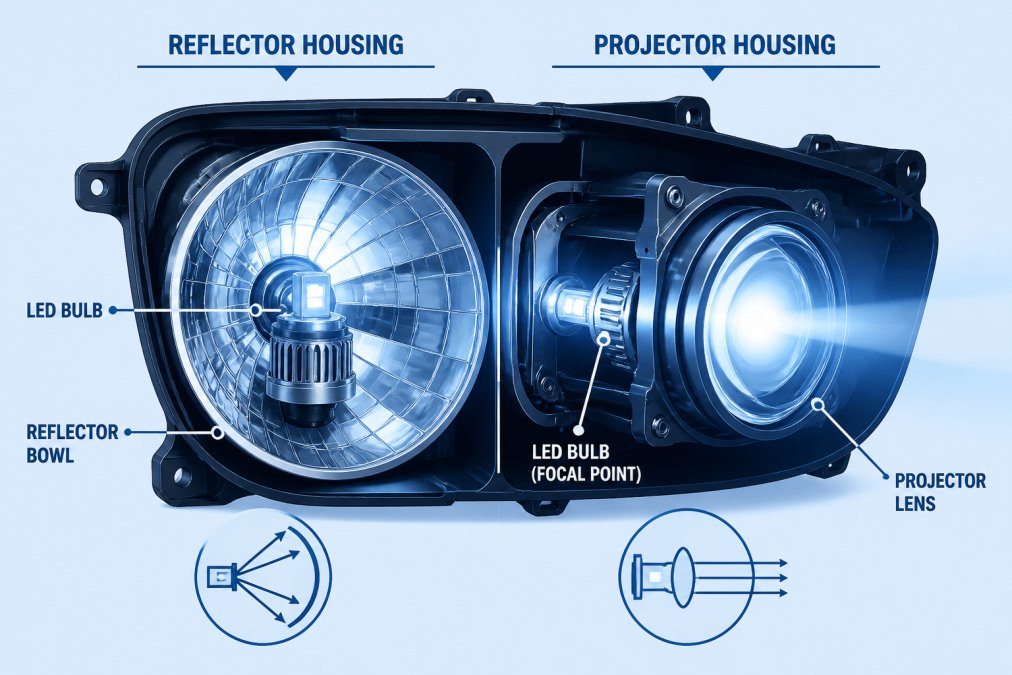
Projector housings deliver superior beam control. They create a sharp cutoff line between illuminated and dark areas, preventing light from shining directly into oncoming drivers' eyes. Reflector housings produce a gradual light falloff without a defined cutoff, which can scatter light upward and sideways, causing glare problems.
When you install LED bulbs in older reflector housings, you often get uneven light distribution and potential glare issues because LEDs emit light from a different point than the halogen filament they're replacing. This is why proper LED conversion kits include housings engineered specifically for LED geometry.
Projector-based conversions work better with LED because the lens design is more forgiving of slight variations in light source position. The real-world impact: a projector housing with LED delivers focused illumination that helps you see farther and more clearly, while a reflector housing with LED might produce scattered light that illuminates the sides of the road but leaves the center darker.
Color Temperature and Nighttime Visibility
Color temperature, measured in Kelvin, defines whether your headlights produce warm yellowish light or cool bluish light. Factory halogen bulbs typically run at 3,000-3,500K, producing warm light that cuts through fog and rain effectively. Most LED conversion kits use 6,500K, which appears brighter to the human eye but actually penetrates fog less effectively than warmer light.
Your eyes perceive 6,500K LED light as brighter because it's closer to daylight spectrum. But in rain, fog, or dust, the shorter wavelengths of cool light scatter more readily, reducing actual visibility distance. Warm light cuts through precipitation better because longer wavelengths scatter less.
The RMS Lighting LLC 6500K LED bulbs deliver that perception of brightness drivers want, with excellent visibility in clear conditions. If you live in an area with frequent fog or heavy rain, a warmer color temperature (4,500-5,500K) might serve you better, though you'll sacrifice the "bright white" appearance.
Real-world nighttime visibility depends on multiple factors beyond color temperature: beam pattern quality, lux intensity, cutoff line definition, and proper aiming. A poorly aimed 6,500K LED can actually reduce visibility compared to a properly aimed 3,500K halogen.

Heat Dissipation, Energy Efficiency, and Lifespan
Halogen bulbs waste enormous amounts of energy as heat. A 55-watt halogen headlight generates temperatures exceeding 500°F at the filament, with most energy becoming infrared radiation rather than visible light.
LED bulbs convert approximately 80% of electrical energy into visible light, compared to roughly 5% for halogen. The remaining 20% becomes heat, but that heat is distributed across a heat sink rather than concentrated at a tiny filament. Modern LED conversion kits include active cooling to dissipate heat away from the bulb and housing.

This efficiency difference explains why LED bulbs last 30,000-50,000 hours compared to 400-1,000 hours for halogen. The lower operating temperature means less material degradation. LED conversion kits draw less current, reducing electrical load on your vehicle's alternator and battery, especially during extended nighttime driving.
The lifespan advantage compounds over years of ownership. You'll replace halogen bulbs multiple times during your vehicle's life. LED conversion kits from RMS Lighting LLC are designed to outlast your vehicle's headlight housing, eliminating repeated replacements and maintenance.
Glare and Oncoming Traffic Safety
Many LED conversion kits fail in practice by creating glare that blinds oncoming drivers. The problem isn't the LED technology itself, it's improper installation, poor beam control, or misaligned aiming.
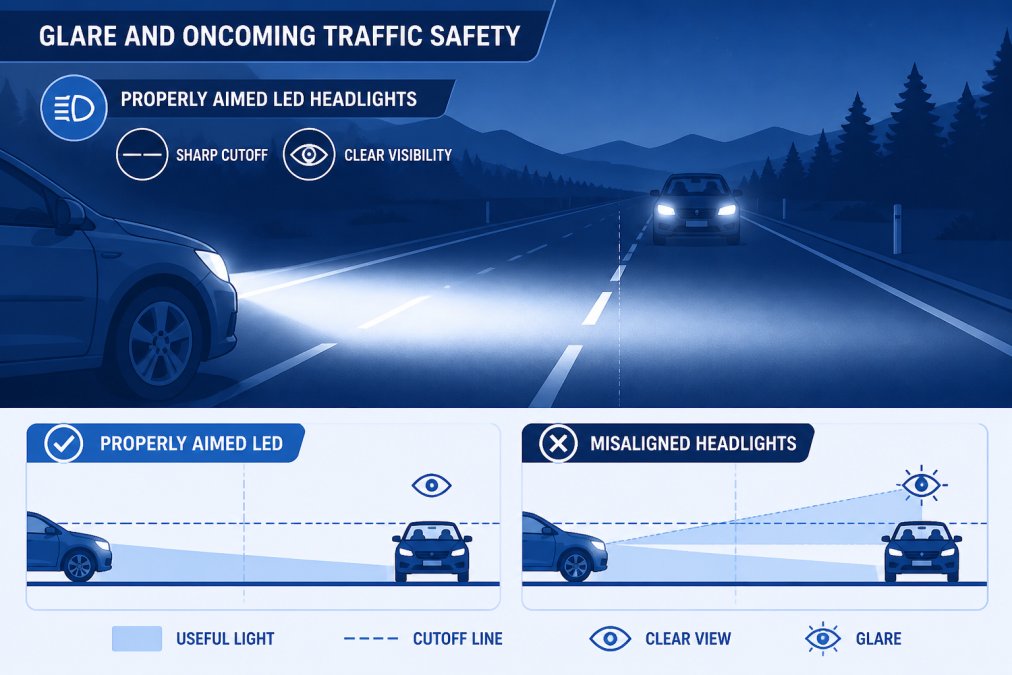
Glare happens when light reaches a driver's eyes directly rather than illuminating the road. Oncoming drivers see a bright wall of light instead of the road, reducing their ability to see hazards and maintain lane position. Poorly designed LED conversions create glare because the light distribution doesn't match the housing's optical design.
Proper LED headlights include a precise cutoff line that prevents light from shining above the horizontal plane where oncoming traffic travels. This requires either a projector housing with a built-in cutoff shield, or a reflector housing specifically engineered for the LED bulb's light distribution. A headlight testing device can verify this cutoff line, ensuring your installation meets safety standards.
Aiming matters as much as design. Even a well-designed LED headlight creates glare if aimed too high. Most vehicles have headlight adjustment screws or bolts that allow vertical and horizontal aim adjustment. Proper aiming positions the beam so the cutoff line sits just below the horizontal plane, illuminating the road ahead without reaching oncoming drivers' eyes.
The Federal Motor Vehicle Safety Standards (FMVSS) Section 108 defines specific requirements for headlight beam patterns, intensity, and cutoff lines. Many cheap LED conversion kits ignore these requirements entirely, prioritizing brightness over safety compliance.
DOT Headlight Regulations and Installation Compatibility
The Department of Transportation enforces Federal Motor Vehicle Safety Standards (FMVSS) 108, which specifies exact requirements for headlight brightness, beam pattern, cutoff line, and color. Not every LED conversion kit meets these standards, and installing non-compliant headlights can result in vehicle inspection failures or police citations.
FMVSS 108 requires that headlights produce specific lux intensities at defined distances and angles, with a sharp cutoff line at the horizontal plane. Light color must fall within defined ranges (typically 4,000-6,000K for most applications). Most vehicles have specific headlight housings designed for halogen bulbs, and direct LED bulb replacements often violate FMVSS 108 because the light distribution doesn't match the original design specifications.
Installation compatibility depends on your vehicle's year, make, and model. Older vehicles with sealed-beam reflector headlights need complete housing replacements. Modern vehicles with projector headlights might accept LED bulb upgrades if designed for that specific housing. Some vehicles have complex electrical systems with CAN-bus networks that detect bulb failures and adjust lighting automatically, triggering error codes with incompatible bulbs.
RMS Lighting LLC's conversion kits are engineered for specific vehicle applications, ensuring compatibility with your vehicle's electrical system and compliance with FMVSS 108. Before installing any LED conversion kit, verify that it's compatible with your specific vehicle and meets federal headlight standards.
LED vs Halogen: Real-World Performance and Practical Considerations
When you test LED versus halogen headlights in real-world conditions, several practical differences emerge. The first thing you notice is the immediate brightness perception, LED headlights feel noticeably brighter the moment you turn them on, partly because of the 6,500K color temperature and partly because of the light distribution design in quality conversion kits.
The second difference is consistency. Halogen bulbs dim gradually as they age, becoming noticeably dimmer after 500 hours of use. LED bulbs maintain consistent brightness throughout their lifespan, only gradually degrading after 20,000+ hours of use.
The third difference is reliability. Halogen bulbs fail suddenly. LED conversion kits fail more gracefully, with redundant diode arrays preventing complete failure.
Installation complexity varies significantly. A simple LED bulb replacement takes minutes. Full conversion kits with new housings take longer and might require drilling, wiring, and careful alignment. For classic cars and trucks, conversion kits offer the advantage of maintaining the original aesthetic while delivering modern performance.
The cost difference is substantial. A basic LED bulb pair costs less than a quality conversion kit, but works only if your vehicle's housing is compatible. Conversion kits cost more upfront but deliver superior performance, proper beam control, and compliance with safety standards.
Real-world visibility improvements depend on your baseline. Upgrading from original factory halogen bulbs in a 20-year-old vehicle shows dramatic improvement. Modern LED conversion kits deliver significantly better nighttime visibility, reduced glare, and more consistent beam patterns. The practical decision comes down to your priorities: budget, vehicle compatibility, desired brightness level, and whether you want to maintain original appearance or modernize completely.
Upgrading to LED headlights transforms your nighttime driving experience, but only when you choose properly engineered conversion kits designed for your specific vehicle. Poor visibility and glare issues plague cheap alternatives that ignore beam pattern design and safety standards. RMS Lighting LLC's LED conversion kits and bulbs are engineered and tested to deliver superior brightness, proper beam control, and long-lasting reliability. Our H4 LED bulbs reach 30,000 lumens with precision-engineered optics, and our conversion kits include correct lens patterns for safe, compliant installation. Learn More about upgrading your headlights with components built to the highest standards.
Frequently Asked Questions
How much brighter are LED headlights than halogen headlights?
LED headlights typically produce 2 to 3 times more lumens than factory halogen bulbs. A standard halogen bulb generates 800-1,200 lumens, while quality LED conversion kits deliver 15,000-40,000 lumens. However, raw lumen output doesn't tell the whole story. Lux (light intensity at a specific distance) and beam pattern matter more for actual road visibility. RMS Lighting's 130-watt LED bulbs produce 30,000 lumens with optimized beam patterns designed for safe nighttime driving without blinding oncoming traffic.
Are LED headlight conversion kits legal in the United States?
LED conversion kits are legal in the US if they meet DOT (Department of Transportation) standards and FMVSS 108 regulations. Your headlights must produce the correct beam pattern, color temperature (between 4,000K and 6,500K), and light distribution to avoid blinding other drivers. Many aftermarket kits fail these standards. RMS Lighting's conversion kits are engineered to meet DOT compliance with proper LHD lens patterns and tested beam cutoff lines, ensuring your upgrade is both legal and safe.
Will LED conversion kits cause dashboard error codes or can-bus flicker issues?
Poor-quality LED kits often trigger dashboard warnings because they don't communicate properly with your vehicle's electrical system. This causes hyper-flashing or error codes. RMS Lighting's CANBUS-enabled LED bulbs are specifically designed to eliminate this problem by matching your vehicle's power draw expectations and preventing false fault signals. If you've had issues with cheap kits before, CANBUS compatibility is the feature that prevents those dashboard errors.
Do LED headlights produce more heat than halogen bulbs?
LED bulbs generate significantly less heat than halogen bulbs. Halogen bulbs convert most energy into heat (about 90%), while LEDs convert more energy into light and produce heat primarily at the base of the bulb. However, quality LED kits include heat sinks and cooling fans to manage thermal buildup and prevent premature diode failure. RMS Lighting's LED bulbs feature thermal management systems that maintain safe operating temperatures even during extended use, extending bulb lifespan to 50,000+ hours.
Will your LED kits fit my older vehicle without modification?
Fit depends on your vehicle's headlight housing type (sealed beam, reflector, or projector) and connector style. RMS Lighting offers multiple conversion kits designed for different applications: 7-inch round, 5x7 large square, and 4x6 small square housings. Each kit includes proper H4 connectors and harness adapters for plug-and-play installation. Before purchasing, verify your vehicle's headlight housing dimensions and connector type. If you're unsure, contact RMS Lighting's team to confirm compatibility for your specific year and model.
This article was written using GrandRanker