

How to Decide on Projector Headlight Upgrades

Last Updated: October 30, 2026
Quick Summary
Projector headlights focus light through a lens and cutoff shield, giving a sharper beam edge and a more concentrated hot spot than reflector headlights. They help most on unlit roads, but only when the housing, bulb and aim are matched and the setup is road-legal where you drive.
- Projector headlights use a lens and cutoff shield to create a sharper beam pattern than reflectors.
- IIHS reports 46% of tested model-year 2026 headlight systems earned a Good rating.
- Mismatched bulbs and housings can throw the pattern off, even when the base fits.
- Check that the bulb and housing combination is approved for road use in your state.
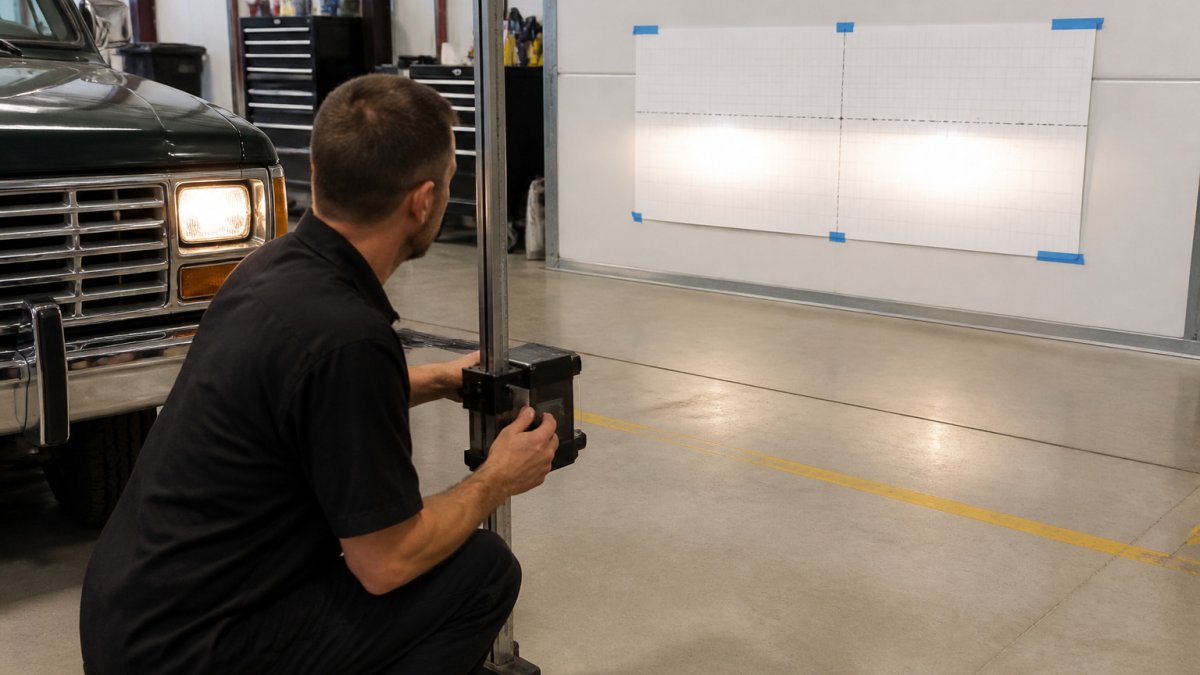
- After installation, park about 25 feet from a wall and aim to the manufacturer's cutoff height.
Table of Contents
- What Projector Headlights Do Differently
- Projector vs Reflector Headlights: The Real Difference
- The Main Benefits of Upgrading to Projector Headlights
- Projector Headlight Retrofit: Keeping the Classic Look
- LED Bulbs in Projector Headlights: What to Check
- Honest Limits: When a Projector Upgrade Falls Short
- Headlight Aiming After Upgrade and Next Steps
- Frequently Asked Questions
Projector headlights can make an older car see the road far better at night, but the upgrade only pays off when the right housing, bulb and aim come together.
Headlight performance varies widely across vehicles. The Insurance Institute for Highway Safety (IIHS) reports that 46% of headlight systems tested on model-year 2026 vehicles earned a Good rating, while about 17% were rated marginal or poor (IIHS headlight ratings for model-year 2026 vehicles).
What Projector Headlights Do Differently
A projector headlight uses a lens to gather light from a source and focus it into a controlled beam. A reflector headlight bounces light off a curved bowl, which spreads it more broadly.
Projector designs are promoted for focused beam patterns and reduced glare. Headlight Revolution describes them as offering sharper beam control, less glare and better nighttime visibility, though its source does not provide a numerical comparison (Headlight Revolution guide to projector headlights).
Projector vs Reflector Headlights: The Real Difference
The practical difference shows up in the beam. A projector uses a lens and a cutoff shield to bend light from the source into a focused cone with a defined upper edge.
| Feature | Projector headlight | Reflector headlight |
|---|---|---|
| Light control | Lens plus cutoff shield focuses a defined beam | Bowl spreads light broadly; pattern depends on bowl shape |
| Cutoff line | Sharp, with a stepped pattern on many designs | Softer or absent |
| Glare control | Generally more controlled when aimed correctly | Depends heavily on design and bulb match |
| Hot spot | Concentrated, brighter center | Broader, dimmer center |
| Upgrade path | Often needs matched housing and bulb | Simpler bulb swaps, but easy to degrade the pattern |
| Sensitivity to bulb position | Moderate | High |
Here is the catch. A projector-style upgrade is not proof of performance on its own. The cutoff shield, lens quality, bulb focal point and aim all have to work together.
How the Beam Is Built
In a projector, light leaves the bulb, passes through a condenser lens, gets trimmed by the cutoff shield, and is projected by the outer lens.
That mechanism explains the trade-off. Projectors give you a sharper cutoff and a more concentrated hot spot, which is useful on unlit roads. Reflectors give a wider, softer spread that can feel more forgiving in town but scatters more light upward and sideways as the housing ages or the bulb is swapped.
Bulb Type Changes the Comparison
The housing is only half the story. Halogen, LED and HID sources each behave differently inside the same housing:
- Halogen bulbs are inexpensive and widely available, but they run hot and produce less light per watt. Their filament position is predictable, which is why they work in housings designed around them.
- LED bulbs run cooler at the emitter but need heat management at the base, and their chip placement varies by brand. A chip that sits at the wrong depth throws the beam off.
- HID systems produce high output but need a ballast and warm-up time, and retrofitting them into a housing not designed for them is a common source of glare and legality problems.
A common pattern is that a projector housing paired with a bulb designed for its focal point gives the cleanest cutoff, while mixing a high-output bulb into a reflector housing trades pattern quality for raw brightness.
What This Means for Your Upgrade
If your goal is a sharp cutoff and controlled glare, a matched projector housing and bulb is the safer path. If you only want a modest bump in output and your reflector housing is in good condition, a quality bulb swap may be enough, but check the pattern afterward, because a brighter bulb in a reflector can amplify scatter. Either way, judge the result by the beam on a wall, not by the spec sheet.
The Main Benefits of Upgrading to Projector Headlights
The strongest case for a projector upgrade rests on beam control, road coverage and a cleaner look on a classic car. But the benefits only show up when the housing, bulb and aim are matched, and when the setup is legal where you drive. Here is what each gain actually looks like, plus the compatibility and performance checks that decide whether you get it.
Focused Beam and Sharper Cutoff
A focused beam keeps light on the pavement and off oncoming windshields. The result is more usable light for the driver and less wasted spill. Our Gen3PRO 5.75" kit, for example, uses an H4 Mini Projector LED bulb designed to produce a cleaner, more controlled pattern with a sharper cutoff line than conventional reflector-style LED bulbs.
Watch out: an unaimed projector can throw its sharp cutoff in the wrong place. A beam aimed too high dazzles oncoming drivers, while one aimed too low wastes the reach you paid for.
Better Road Coverage Without Blinding Others
Better coverage means seeing farther down the road without raising glare for others. Our Gen3 7" round kit, for instance, pairs OE-style glass housings with H4 Mini Projector bulbs rated at 10,000 lumens per bulb.
But lumens are not the whole story. What matters is how much light lands on the road at a useful distance and how sharp the cutoff is above it.
RMS3301PRO - 5.75 (Gen3) Small Round Headlight Conversion Kit with 10,000 LM H4 →
Compatibility and Legality: The Benefit Nobody Mentions
A projector upgrade only counts as a benefit if the parts are compatible and the result is road-legal. Three things decide that:
- Housing design. A projector housing is built around a specific bulb focal point. A bulb that sits too deep or too shallow throws the pattern off, even if the base fits.
- Bulb type. Halogen, LED and HID sources behave differently. HID retrofits in particular often require a ballast and can run afoul of rules in states that restrict non-OEM HID conversions.
- Beam pattern and aim. Even a legal bulb can fail a roadside check if the cutoff is too high or the pattern scatters.
Real-World Performance, Not Just Brightness
Brightness is the easiest thing to market and the hardest thing to judge from a spec sheet. A more useful way to think about the upgrade is by driving condition:
- Unlit roads. A sharp cutoff and a concentrated hot spot let you see farther without flooding the trees. This is where a matched projector setup earns its keep.
- Rain and fog. High output can reflect back at you. A controlled pattern with less upward spill tends to be more usable than raw brightness in wet or hazy conditions.
- Curves and hills. A wider spread helps on curves, while a sharp cutoff can leave the inside of a turn dark. Some projector designs address this with a stepped pattern; others do not.
A practical check after installation: park on level ground about 25 feet from a wall, mark the cutoff, and compare the pattern to what the manufacturer specifies. Then drive a familiar route at night and note where the light lands, that is the performance that matters, not the lumen rating.
The Classic-Look Bonus
For classic-car owners, the upgrade also preserves the factory appearance. Our Gen3PRO 4x6 kit, for example, retains the outward look of traditional quad rectangular sealed beam headlights while adding H4 Mini Projector LED technology. That combination, modern beam control behind an original-looking lens, is one of the benefits of the kit.
Projector Headlight Retrofit: Keeping the Classic Look
Many owners of classic cars want modern light without a modern look. A retrofit keeps the factory glass lens and body shape while changing what happens behind the glass.
Our Gen3PRO 4x6 kit, for example, retains the outward appearance of traditional quad rectangular sealed beam headlights while adding H4 Mini Projector LED technology.
Check fitment before ordering, and confirm your vehicle uses the sealed beam size the kit is built for.
LED Bulbs in Projector Headlights: What to Check
Not every LED bulb suits every housing. Before buying, confirm four things: bulb base type, bulb orientation, cooling clearance and the housing's intended design. A bulb sized for one housing can sit at the wrong focal point in another.
Our RMSPL03H48K H4 Mini Projector bulbs are designed for RMS Lighting Gen1 4x6 Small Square and 5.75" Small Round housings. They include an adjustable rotating base for alignment and an active cooling fan.
Confirm your connector layout before you buy.
Honest Limits: When a Projector Upgrade Falls Short
A projector upgrade is not the right answer for every vehicle. Here are the situations where you should slow down.
- Poor housing condition. Cracked or fogged lenses scatter light no matter what bulb sits behind them.
- Wiring and connector mismatch. A harness that does not match your factory plug can cause fitment trouble, so verify before you order.
- Incorrect installation. Health and safety guidance on upgrades emphasizes proper installation and alignment, and poor setup removes most of the benefit.
Our team's advice is simple: a matched kit usually beats mixing parts from different sources.
Headlight Aiming After Upgrade and Next Steps
After installation, aim the headlights. Park the car on level ground about 25 feet from a wall, mark the beam cutoff, and adjust each lamp until the cutoff sits at the height the manufacturer specifies for your vehicle. Recheck after the first few drives, since mounts can settle.
Frequently Asked Questions
How do I know if I have projector headlights?
Look at the lens of each headlight. Projector headlights usually show a round, lens-like element at the center of the housing that focuses light forward, often with a visible cutoff shield behind it. Reflector headlights rely on a bowl-shaped reflector and typically show a scattered, multi-faceted pattern inside the lens. If you are unsure, check the vehicle's original specification or the headlight part number, and compare it with the housing you plan to replace. Fitment should be verified before ordering any conversion kit.
Do projector headlights need to be aimed after installation?
Yes. Any headlight replacement changes the position of the beam, and a projector design depends on accurate aim to deliver its sharp cutoff line. Park the vehicle on level ground about 25 feet from a wall, measure the headlight height, and adjust until the cutoff sits at or just below that height. Recheck after the first few drives, because bulbs and housings can settle slightly.
Can you put LED bulbs in projector headlights?
Many projector headlights are designed for halogen or HID bulbs, so an LED swap is not always a simple drop-in. The bulb's light source must sit where the projector lens expects it. RMS Lighting's H4 Mini Projector LED bulbs are sold for use with compatible RMS Lighting Gen1 4x6 Small Square and 5.75 inch Small Round housings, and the Gen3 kits include matched bulbs. Check compatibility before purchase rather than assuming a generic LED will focus correctly.
Is it worth having projector headlights?
For many drivers of older vehicles with dim halogen factory lighting, a properly fitted projector upgrade can improve visibility. Benefits depend on the specific housing, bulb, and aim, so the value comes from a correct installation rather than the projector design alone. Classic owners who want a factory look may find the glass-lensed Gen3 kits, priced at $249.00 for 7 inch and 5x7 square and $289.00 for 5.75 inch round and 4x6 small square, a practical option to evaluate against their budget.
Upgrading to projector headlights is worth it when the housing is sound, the bulb is matched and the beam is aimed correctly. RMS Lighting LLC offers conversion kits built for classic vehicles, including Gen3PRO glass-lens kits with H4 Mini Projector LED bulbs. Start by confirming your sealed beam size, then pick the kit that fits your car and get it aimed right.
