

5 3157 Switchback LED Bulb Comparisons for Turn Signals

Last Updated: October 24, 2026
Quick Summary
A 3157 switchback LED bulb emits white light during parking or daytime running light operation, then automatically switches to flashing amber when the turn signal is activated, unlike standard halogen bulbs which produce a single fixed color. The bulb's internal logic cuts the white LEDs and activates amber ones, creating a clean amber flash that reads faster to following drivers and meets Federal Motor Vehicle Safety Standards.
- 3157 and 7443 bulbs are not interchangeable due to different bayonet base sizes and pin arrangements.
- CanBus-compatible 3157 switchback LED bulbs eliminate hyperflash by mimicking an incandescent bulb's electrical signature.
- RMS Lighting's 3157 Switchback CanBus bulbs deliver 1,000 lumens across 46 SMD2835 LED chips and operate at 9-30V AC.
- Installation takes 15-30 minutes per pair and requires verifying white light on parking mode and amber flash on turn signal.
- Beam distribution and switchback timing matter more than raw lumen output for real-world visibility and legal compliance.
Table of Contents
- What Makes 3157 Switchback LED Bulbs Different from Standard Bulbs
- 3157 vs 7443 Bulb Compatibility and Socket Size
- Understanding 3157 LED Turn Signal Hyperflash and CanBus Solutions
- Do You Need a 3157 LED Load Resistor for Your Vehicle
- Switchback LED Bulb Installation Steps and Fitment Verification
- Brightness, Color Temperature, and Real-World Visibility
- Choosing the Right 3157 Switchback LED Bulb for Your Vehicle
- Frequently Asked Questions
What Makes 3157 Switchback LED Bulbs Different from Standard Bulbs
A 3157 switchback LED bulb emits white light during parking or daytime running light operation, then automatically switches to flashing amber when the turn signal is activated, unlike standard halogen or incandescent bulbs, which produce a single fixed color.
When power flows through the parking light circuit, the white LEDs illuminate.
Signal clarity directly impacts safety: a crisp amber flash reads faster to following drivers than a mixed amber-and-white pattern, and the amber turn signal meets Federal Motor Vehicle Safety Standards.
At RMS Lighting LLC, our 3157 switchback LED bulbs have CanBus compatibility built in, eliminating the hyperflash problem that plagued early LED conversions. They deliver 1,000 lumens across 46 SMD2835 LED chips and operate across 9-30V AC.
3157 vs 7443 Bulb Compatibility and Socket Size
The 3157 and 7443 are both dual-filament, dual-contact bayonet bulbs, but they are not interchangeable. A 3157 uses offset, unequal-height index pins on a 15 mm bayonet base; a 7443 uses a smaller 9 mm wedge-style bayonet base with a different pin arrangement. The pins physically block insertion before the contacts ever meet.
| Specification | 3157 | 7443 |
|---|---|---|
| Base style | 15 mm dual-contact bayonet, offset index pins | 9 mm dual-contact wedge bayonet |
| Filaments / functions | Dual (park + turn/brake) | Dual (park + turn/brake) |
| Typical bulb diameter | ~25 mm glass envelope | ~20 mm glass envelope |
| Common applications | Sedans, compact cars, some crossovers | Trucks, SUVs, larger housings, some motorcycles |
| Switchback availability | Yes | Yes |
The 3156 looks like a 3157 but is single-contact and single-filament, so a 3157 switchback will not work correctly in a 3156 application because it expects two independent circuits. Confirm the stamped number on the original bulb base before ordering, the owner's manual is sometimes wrong for mid-cycle trims.
How to verify fitment on your specific vehicle before buying
- Pull the original bulb. The stamped number on the base (3157, 3157K, 3157NA, 7443, 7443LL, etc.) is the ground truth. Photograph it.
- Count the contacts in the socket. Two contacts = dual-function (3157/7443 family). One contact = single-function (3156/7440 family).
- Check housing clearance. A switchback LED with a projecting heatsink or fan can be 5-15 mm taller than the halogen it replaces; in a shallow housing it will bottom out or the lens will not seal.
- Confirm polarity. Many 3157 LED bulbs are polarity-sensitive. If the bulb does not light in one orientation, flip it in the socket before assuming the bulb is defective.
- Check DRL behavior. Some vehicles pulse the DRL circuit at reduced duty cycle. A switchback bulb may flicker or show a dim amber tint on the white circuit if the vehicle uses pulse-width modulation (PWM) for DRLs. A CanBus-ready bulb or an anti-flicker module resolves this.
If the housing is tight or the DRL circuit is PWM-driven, choose a low-profile switchback with an integrated driver rather than a separate resistor harness.
Understanding 3157 LED Turn Signal Hyperflash and CanBus Solutions
Hyperflash occurs when an LED turn signal bulb flashes faster than the factory flasher relay expects.
Beyond confusing other drivers about your intent, hyperflash can trigger dashboard error codes on vehicles with onboard diagnostics, leaving warning lights on even though the bulbs work.
CanBus technology embeds load-compensation circuitry in the LED bulb, mimicking the incandescent bulb's electrical signature so the relay detects no difference, no hyperflash, no error codes, no resistors.
Our 3157 Switchback CanBus White / Amber LED Turn Signal Bulbs (Pair) use Super CanBus compatibility and work with most modern vehicles out of the box, though some older vehicles with non-standard electrical systems may still need supplementary solutions.

You can test your flasher relay for turn signals to diagnose whether hyperflash is a flasher-relay issue or a bulb-compatibility issue.
Do You Need a 3157 LED Load Resistor for Your Vehicle
A load resistor is an external component that mimics an incandescent bulb's power draw, preventing hyperflash where CanBus compensation alone isn't sufficient.
Not every vehicle needs one. Modern CanBus-compatible vehicles typically work fine with CanBus LED bulbs alone; older vehicles with mechanical flasher relays or non-standard architectures often require resistors.
Most installers take the wait-and-see approach: install the CanBus bulbs first, and add resistors only if hyperflash or error codes appear. This saves cost and complexity where the bulbs work perfectly without them.
Installing a load resistor requires soldering or crimp connectors and basic electrical knowledge.
Learn about anti-flicker resistors for truck LEDs to understand the full installation process and when they're actually necessary for your specific vehicle type.
3157 Switchback CanBus White / Amber LED Turn Signal Bulbs (Pair) →
Switchback LED Bulb Installation Steps and Fitment Verification
Installing a 3157 switchback LED bulb takes roughly 15-30 minutes per pair, depending on housing accessibility; some models require removing trim panels or reaching the bulb from the engine bay.
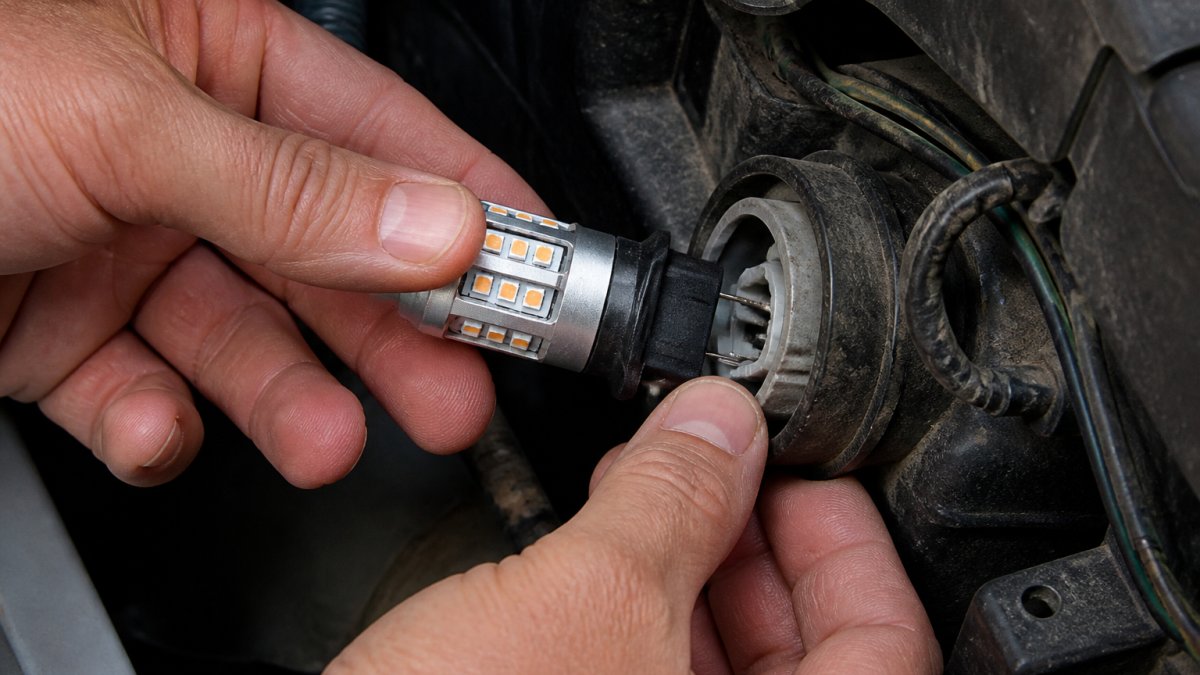
Before reassembling anything, test the lights. Turn on your parking lights and confirm white illumination. Activate the turn signal and confirm amber flashing.
Fitment verification is the step most DIYers skip. The bulb should sit flush with the housing opening, not protruding or sitting too deep; aftermarket housings can have different internal dimensions.
Test all functions before closing up the housing. White light on parking mode. Amber flash on turn signal. No hyperflash or error codes. If everything checks out, reassemble your trim panels and you're done.
Brightness, Color Temperature, and Real-World Visibility
Most 3157 switchback listings quote a single lumen figure and a single Kelvin number, which is not enough to compare bulbs. What matters is how much light reaches the housing, how evenly it is distributed, and whether the color and flash pattern are legal and readable in daylight.
What the numbers actually mean
- Lumens measure total light output at the source. A 3157 halogen typically produces roughly 300-400 lumens on the turn-signal filament; a switchback LED may claim 800-1,200 lumens. But a projector or reflector housing designed for a filament bulb will not always focus an LED chip the same way, so the on-road gain is usually smaller than the raw ratio suggests.
- Color temperature (Kelvin) describes the white light's tint. 6000K reads as cool white; 2700-3000K reads as amber. The amber turn-signal color is regulated, FMVSS 108 requires turn signals to be amber (or red for rear) and to flash 60-120 times per minute. A bulb that shifts too far toward yellow or too far toward red can draw attention from law enforcement.
- Beam distribution is the spec nobody publishes. A bulb with a single high-output chip on one side can create a hot spot that looks bright head-on but nearly disappears from an angle. A multi-chip arrangement (e.g., 46 SMD2835 emitters arranged radially) tends to fill the reflector more evenly, which is what actually improves visibility to a following driver.
A controlled side-by-side method you can run yourself
You do not need a lab to compare two bulbs fairly, use the same vehicle, housing, camera settings, and distance:
- Park facing a plain wall at a measured distance (25 ft is a common reference).
- Lock the camera's exposure and white balance manually.
- Photograph each bulb in three states: white DRL only, amber turn only, and the switchback transition (burst mode or 60 fps video captures the white-to-amber handoff).
- Compare frames side by side for hot spots, fill, and color shift.
- Repeat at dusk and after dark, a bulb that looks great at night can wash out in direct sun.
Legal and real-world visibility considerations
FMVSS 108 governs turn-signal color, intensity, and flash rate for vehicles sold in the United States. Aftermarket LED bulbs are not individually certified the way a complete lamp assembly is, so the practical rule is: the bulb must produce amber light of sufficient intensity, flash at 60-120 times per minute, and not create excessive glare. Two failure modes to watch for:
- Too much white bleed. If the white DRL circuit stays partially lit during the amber flash, the signal reads as amber-white-amber-white, which is both less legible and arguably non-compliant. A true switchback cuts white completely.
- Housing mismatch. A clear-lens housing with a reflector designed for a filament bulb may scatter LED light into oncoming traffic. A projector housing focuses it better but can also create a sharp cutoff that hides the signal from some angles.
If you want a starting point, our 3157 Switchback CanBus White / Amber LED Turn Signal Bulbs (Pair) are built around a radial multi-chip layout and a hard white-to-amber cutoff, which is the combination that tends to hold up best in the side-by-side method above.
Choosing the Right 3157 Switchback LED Bulb for Your Vehicle
Start by confirming your vehicle uses 3157 dual-function bulbs (not 3156, 3457, or other variants) via the owner's manual or the original bulb.
CanBus compatibility is essential for most vehicles manufactured after 2010.
Older vehicles with mechanical flasher relays sometimes work fine with non-CanBus bulbs, and CanBus compatibility never hurts, the worst case is that it simply works.
Brightness matters for visibility, but more brightness isn't always better if it creates glare or confuses other drivers.
LED bulbs run cooler than halogen, reducing stress on housings and wiring. Our bulbs are engineered with thermal management in mind.
Upgrading your turn signals with switchback LED technology improves both safety and aesthetics.
Frequently Asked Questions
What does switchback LED mean?
Switchback LED bulbs change color based on function. A 3157 switchback LED bulb illuminates white for parking lights and daytime running lights, then automatically switches to flashing amber when the turn signal activates. This dual-color operation eliminates the need for separate bulbs and creates a cleaner, more noticeable amber signal that flashes amber-off-amber-off instead of the mixed amber-white pattern some competitors use.
Will a 3157 bulb work in a 7443 socket?
No. The 3157 and 7443 bulbs have different socket designs and physical dimensions. The 3157 uses a 15 mm dual-contact bayonet base, while the 7443 uses a 9 mm dual-contact wedge bayonet base. Installing a 3157 bulb in a 7443 socket will not fit properly and could damage both the bulb and the socket. Always verify your vehicle's original bulb number in the owner's manual before purchasing a replacement.
Do 3157 LED turn signal bulbs need a load resistor?
CanBus-compatible 3157 LED bulbs like RMS Lighting's models are engineered to work without load resistors on most vehicles. However, some vehicles with older electrical systems may still require a load resistor to prevent hyperflashing. If your LED bulbs flash rapidly instead of at normal speed, a load resistor or LED flasher relay can solve the issue. Check your vehicle's specifications or contact RMS Lighting for fitment confirmation.
How do you verify fitment before installing a 3157 switchback LED bulb?
Always check your vehicle's owner's manual or examine the original bulb number on the bulb itself. The bulb number will be printed on the glass or base. If it reads 3157, your vehicle uses a dual-function socket where the same bulb handles both parking and turn signal duties. Confirm this matches your application, as some vehicles use single-function sockets where switchback bulbs will not operate correctly.
