

Are Aftermarket LED Headlights Street Legal? 2026 Guide

Table of Contents
- The Short Answer: When Aftermarket LED Headlights Are Street Legal
- FMVSS 108 and DOT Compliance: What Federal Law Actually Requires
- DOT Compliant LED Headlight Bulbs: How to Spot the Real Thing
- LED Headlight Conversion Kit Legality: Housings, Optics, and Beam Pattern
- How to Aim LED Headlights Correctly (And Why It Matters for Legality)
- State-by-State Enforcement: What Police and Inspectors Actually Check
- Conclusion: Making the Legal Choice for Your Vehicle
- Frequently Asked Questions
Last Updated: September 29, 2026
The Short Answer: When Aftermarket LED Headlights Are Street Legal
Aftermarket headlights street legal in the United States only when the complete headlamp assembly meets Federal Motor Vehicle Safety Standard 108 and carries DOT compliance certification. Swapping an LED bulb into a housing never designed for it is where most legality problems start. This guide from RMS Lighting LLC covers what federal law requires, why beam pattern matters more than brightness, and what police and inspectors look for: headlights street legal status depends on the whole system, not just the bulb.

FMVSS 108 and DOT Compliance: What Federal Law Actually Requires
FMVSS 108 is the federal standard that governs every lighting device on a vehicle sold in the United States, and it sets photometric requirements for light output, beam cutoff, and glare limits. The National Highway Traffic Safety Administration enforces it through NHTSA's Federal Motor Vehicle Safety Standards overview, and manufacturers must self-certify that their equipment conforms. A lamp that meets the standard can legally be sold and installed; one that doesn't cannot, no matter how good it looks on the road.
The Replaceable Light Source Rule That Trips Up Most Buyers
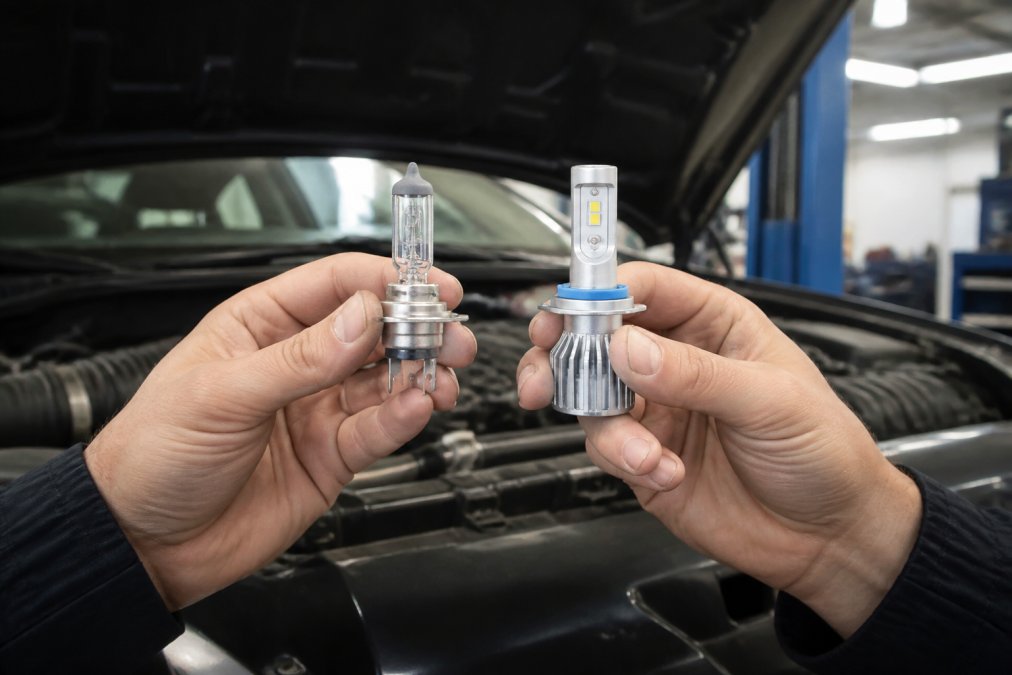
Under FMVSS 108, a headlamp is certified as a complete system: housing, optics, and a specific replaceable light source. Install a bulb the housing wasn't certified with, and the assembly is no longer compliant, the legal basis behind the "off-road use only" labels on generic LED bulbs.
DOT Compliant LED Headlight Bulbs: How to Spot the Real Thing
DOT compliant LED headlight bulbs are sold as part of a certified assembly or a housing engineered specifically for LED optics, not as a bare bulb marketed for "any housing." Real compliance shows up in the paperwork, not the lumen claim on the box.
Check for these before you buy:
- A DOT marking on the housing or lens itself, not just the marketing copy
- Documentation tying the assembly to FMVSS 108 photometric requirements
- A stated beam pattern for left-hand drive roads
- A housing material that holds its optics over time, such as glass rather than plastic
LED Headlight Conversion Kit Legality: Housings, Optics, and Beam Pattern
LED headlight conversion kit legality comes down to optical alignment. A legal conversion pairs an LED bulb with a housing designed around it, so the light source sits at the correct focal point and the optics shape the beam. Matched, you get a defined cutoff; mismatched, you get scatter.
The Focal Point Problem: Why Halogen Reflectors Can't Focus LED Diodes
The explanation is optical, and it's why no amount of aiming can rescue an LED bulb dropped into a halogen housing.
An LED bulb breaks that assumption in three ways:
- The emitting surface is not a point. LED retrofit chips mount on a flat substrate, so emitters spread across a plane rather than concentrating at a single focal point. Light leaving the reflector from a plane does not converge into the designed beam, it spreads.
- The emitting axis is wrong. A halogen filament radiates roughly 360 degrees around its axis; an LED chip radiates forward in a 120-degree cone. The reflector was designed to catch the full 360-degree output, so it only catches part of the LED's output, and the rest goes wherever it wants.
- The chip stack height is off. The distance from the bulb's base flange to the light-emitting surface is a fixed spec for each halogen bulb type. Most LED retrofits approximate it, but even a millimeter of error moves the apparent light source off the focal point, magnified into visible scatter.
What a Properly Engineered LED Housing Does Differently
A housing designed for LED from the start inverts the process: instead of adapting a reflector to a light source it was never meant for, the reflector or projector is calculated around the LED's actual emission geometry, chip placement, cone angle, and stack height.
How to Aim LED Headlights Correctly (And Why It Matters for Legality)
Aiming is the step most people skip, and it decides whether a compliant setup stays compliant. Even a correctly built assembly fails a beam pattern check if pointed too high.
- Park on level ground facing a wall 25 feet away
- Confirm tire pressure and remove heavy loads from the trunk or bed
- Mark the vertical centerline of each headlamp on the wall
- Turn on low beams and note where the top edge of the beam cutoff lands
- Adjust vertically so the cutoff sits slightly below the lamp's mounting height
- Adjust horizontally so the beam centers on the marked vertical line
- Recheck from the driver's seat with the vehicle at curb weight
State-by-State Enforcement: What Police and Inspectors Actually Check
Enforcement varies by state. Every state adopts FMVSS 108 in some form, but practical checks differ: some run periodic safety inspections with a photometric or aiming check, others rely on officers issuing equipment violations during traffic stops, and a few have no periodic inspection at all, which does not make a non-compliant setup legal, only less likely to be caught until it matters.
RMSH4M2S - 60W 10K Lumens LED Bulb's →
The Three Enforcement Models You'll Actually Encounter
Periodic safety inspection states. States such as Pennsylvania, New York, Virginia, and New Hampshire require a recurring safety inspection, and lighting is a line item. A non-compliant retrofit is a scheduled failure point: Pennsylvania requires headlamps to be aimed and produce the correct beam pattern, and an inspector with an aiming machine flags a scattered cutoff in seconds. New York's annual inspection includes a headlamp aim and function check.
What Inspectors Physically Look For
When a state does inspect, the checklist is mechanical. Inspectors aren't judging whether your lights look bright or modern, they check a short list of pass/fail items:
- DOT or SAE marking on the lens or housing itself. Not on the box, not on the bulb, not on a sticker the seller applied. The marking has to be molded or etched into the lamp.
- Presence of the correct replaceable light source. If the housing was certified for an HB2 or H4 halogen and now contains an LED bulb, the assembly no longer matches its certification.
- Beam cutoff on an aiming screen or machine. The inspector looks for a defined horizontal cutoff with the correct step-up on the passenger side for left-hand drive. A fuzzy or absent cutoff is an automatic fail.
- Aim height at 25 feet. The cutoff should sit at or slightly below the lamp's mounting height. Beam pointed above that line fails.
- Glare check. Some shops walk in front of the vehicle or use a photometer to confirm the lamp is not throwing light above the cutoff into oncoming lanes.
- Housing condition. Cracked lenses, hazy plastic, or moisture inside the housing can fail independently of the bulb, because they scatter light.
What Officers Look For on a Traffic Stop
From a law enforcement perspective, the check is faster and more subjective than an inspection station. An officer approaching at night sees one of two things: a beam with a defined cutoff, or a wash of light spilling upward. The second gets you pulled over. Many departments also treat a lifted or modified vehicle with misaimed lights as a separate equipment violation, so one stop can generate multiple citations.
| What Gets Checked | How It's Verified | Common Failure Point |
|---|---|---|
| DOT marking | Visual inspection of housing | Marking only on packaging, not the lamp |
| Beam cutoff | Aiming machine or wall test | No defined horizontal cutoff line |
| Aim height | 25-foot wall measurement | Beam pointed above lamp height |
| Glare | Oncoming visibility test | Scatter from mismatched optics |
| Housing type | Visual and fitment check | LED bulb in a halogen reflector |
| Lens condition | Visual inspection | Cracks, haze, or moisture scattering light |
Insurance and Liability When Your Lights Aren't Compliant
This is the part most guides skip, and it has real financial consequences. Your insurance policy requires your vehicle to be in a legal, roadworthy condition. A non-compliant lighting modification gives an insurer a documented reason to question a claim, particularly if glare or visibility is cited as a contributing factor in an accident.
Compliance isn't just about avoiding a ticket. It's about keeping your insurance claim intact and your liability exposure contained after an incident.
Conclusion: Making the Legal Choice for Your Vehicle
The gap between a legal LED upgrade and a problem comes down to matching the bulb to a housing built for it. Get that pairing right, aim it properly, and you have better nighttime visibility with no legal exposure.
Frequently Asked Questions
Can I get pulled over for LED headlights?
Yes, you can be pulled over if your LED headlights violate state equipment laws. Officers typically stop vehicles for excessive glare, improper beam color (blue or purple tints), or lights that are too bright for oncoming traffic. Even if your bulbs are DOT compliant, misalignment or use in a halogen housing can trigger a stop. Enforcement varies by state, but any light that blinds other drivers or fails to meet beam pattern requirements gives an officer probable cause to pull you over.
Are aftermarket LED bulbs DOT compliant?
Only some are. DOT compliance for LED bulbs requires the bulb to meet FMVSS 108 photometric requirements when installed in a compliant housing. Most aftermarket LED bulbs sold online are not certified because they are designed as replacements for halogen bulbs in housings not engineered for LED optics. To verify, look for a DOT marking on the bulb or packaging and confirm the manufacturer provides test data for beam pattern and light output. Without that, the bulb is likely not street legal.
Are LED headlights legal in Pennsylvania?
Pennsylvania follows FMVSS 108 for vehicle lighting and requires annual safety inspections. Aftermarket LED headlights are legal only if they meet DOT standards and pass inspection for beam aim, color, and glare. Pennsylvania inspectors check headlight alignment and may reject lights that scatter light or exceed height requirements. Many drivers fail inspection because their LED bulbs were installed in halogen housings without proper optics. Check with a licensed inspection station before upgrading.
How do I know if my LED headlight conversion kit is street legal?
A street-legal LED headlight conversion kit includes a housing designed for LED optics with a proper beam cutoff and DOT-compliant bulbs. Look for kits that specify LHD (left-hand drive) beam patterns for North American roads, glass lenses that resist yellowing, and adjustable bulb bases for optical alignment. Avoid kits that only replace the bulb without addressing the housing. If the kit does not mention FMVSS 108 compliance or provide aiming instructions, treat it as off-road use only.
Upgrading your lighting shouldn't mean gambling on a ticket or a denied claim. RMS Lighting LLC offers rigorously tested LED headlamp conversion kits with correct LHD lens patterns, adjustable bulb bases for proper beam alignment, and glass housings that hold their optics over time. Learn More about which kit fits your vehicle, and make the upgrade the legal way.