

Benefits of Anti-Reflective Coating for Driving Glasses

Quick Summary
Anti-reflective coating is a thin, transparent layer on the front and back of eyeglass lenses that cuts down light bouncing off the lens surface. For drivers, it reduces ghost images and halos from headlights and streetlights, which matters most after dark, and it makes the road ahead easier to read.
- Coat both the front and back surfaces, since back reflections often distract most at night.
- Coated lenses transmit more light, so road edges and signs are easier to see.
- The coating cannot fix dirt or scratches, and it does not correct an outdated prescription.
- Avoid paper towels and dry wiping; clean with microfiber and lukewarm water.
- Replace the lenses when the coating shows visible wear, because worn coatings lose their effect.
Table of Contents
- What Anti-Reflective Coating Does for Driving Glasses
- Reducing Headlight and Streetlight Glare at Night
- Clearer Vision, Light Transmission and Reduced Eye Strain
- Pros and Cons of Anti-Reflective Coating on Glasses
- Best Anti-Reflective Coating for Night Driving: Standard vs. Premium
-
Choosing Glasses With Anti-Reflective Coating for Night Driving
- Start with an up-to-date prescription and a night-driving conversation
- Confirm the coating covers both lens surfaces
- Compare coating tiers on the specs, not the marketing name
- Check warranty terms before you commit
- Match the lens tint to the driving condition
- Clean coated lenses without damaging them
- Set realistic expectations for night driving
- Caring for Your Coated Lenses and Setting Realistic Expectations
- Getting Driving Glasses Fitted With the Right Coating
- Frequently Asked Questions
What Anti-Reflective Coating Does for Driving Glasses
Last Updated: November 5, 2026
Anti-reflective coating is a thin, transparent layer applied to the front and back of eyeglass lenses to cut down on light bouncing off the lens surface.
Anti-reflective coating, often called AR coating or anti-glare coating, is the layer that reduces unwanted reflections.
Watch out: A coating can't make a dirty or scratched lens clear. Dirt, oil and fingerprints on the surface will still scatter light.
How anti-reflective coatings work on the lens surface
Light hits the lens and some of it bounces back toward your eyes instead of passing through. The coating uses thin layers of material whose thickness is tuned so that light waves reflecting off the front and back surfaces partly cancel each other out. Less reflected light means more light reaches your eyes.
Reducing Headlight and Streetlight Glare at Night
Headlight glare is one of the most common complaints drivers have after dark. An uncoated lens can reflect oncoming headlights back into your field of view, which makes the road harder to read.
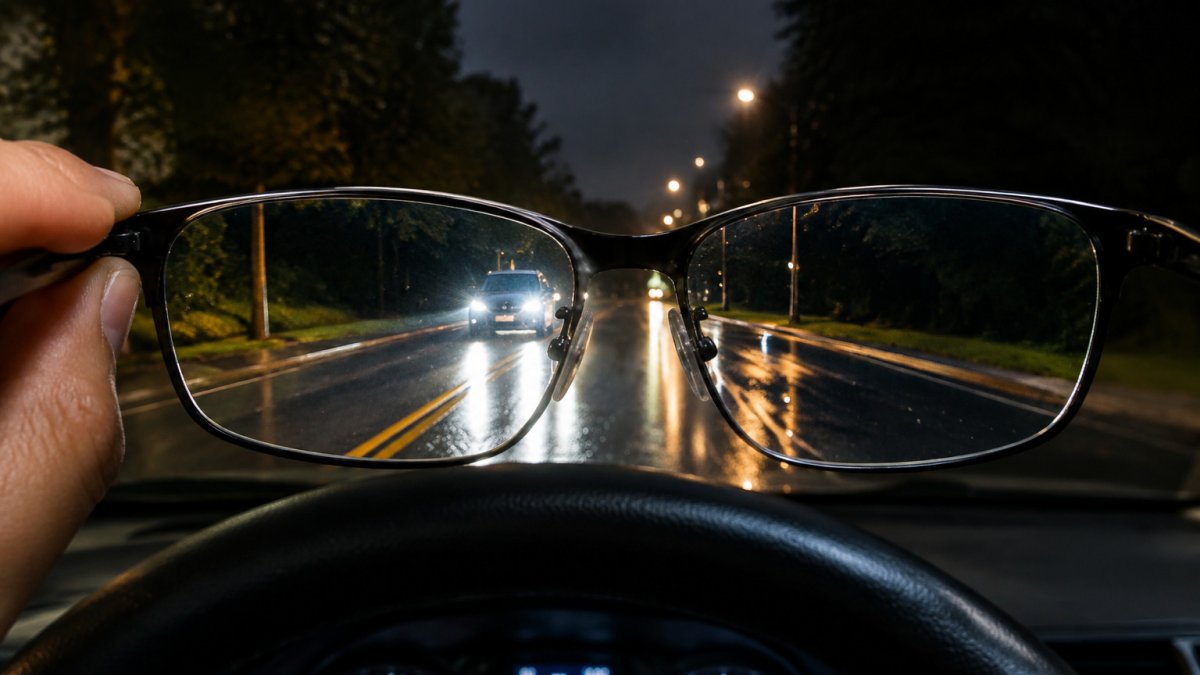
A coating reduces those reflections, so the road ahead looks cleaner. It won't stop glare from oncoming headlights entering your eyes, but it does reduce the reflections happening on your lenses.
- Fewer reflections off the front and back of the lens
- Less light bouncing back from the lens into your eyes
- Softer halos around streetlights and headlights
- Easier reading of signs and lane markings at night
Clearer Vision, Light Transmission and Reduced Eye Strain
Because a coated lens reflects less and transmits more light, more of the scene reaches your eyes. Many drivers notice that night scenes look brighter and more detailed, and that their eyes feel less tired over a long drive.
Light transmission is the share of light that passes through the lens. Coated lenses transmit more light than uncoated ones, which helps when visibility is already poor.
Pros and Cons of Anti-Reflective Coating on Glasses
Anti-reflective coating has real advantages for drivers, but the trade-offs are specific enough that they deserve more than a bullet list.
Pros that matter behind the wheel:
- Fewer lens-surface reflections. The coating cuts the light that bounces off the front and back of the lens back toward your eyes, which is the main source of ghost images and halos at night.
- More usable light in low light. Because less light is reflected, more of the scene reaches your eyes, which can make road edges, lane markings and signs easier to pick out at dusk and after dark.
- Less visual fatigue on long drives. Reduced reflections mean your eyes are not constantly working around glare bouncing off your own lenses, which many drivers notice on multi-hour trips.
- Clearer appearance and better eye contact. Coated lenses look nearly invisible, which helps in photos, video calls and face-to-face conversation.
- Easier cleaning in some cases. A good AR coating with a hydrophobic top layer sheds water and oil more readily than bare lens plastic, so smudges wipe away with less effort.
Cons and real-world trade-offs:
- Scratch sensitivity. AR coatings are softer than the lens substrate. Paper towels, dry wiping and gritty microfiber cloths can leave fine scratches that scatter light and undo part of the benefit.
- Visible smudges. Because the coating suppresses reflections, fingerprints and skin oil show up more clearly on the surface. You will clean coated lenses more often than uncoated ones.
- Added cost. AR coating is an add-on to the lens price, and premium tiers with better scratch resistance and repellency cost more than standard tiers.
- Delamination and crazing over time. Heat, harsh cleaners and repeated exposure to sun can cause the coating to crack or peel at the edges, especially on older lenses.
- No fix for a wrong prescription. A coating improves how light behaves at the lens surface; it does not correct refractive error, astigmatism or an outdated prescription.
Watch out: A premium coating is not automatically the right choice. If your lenses are frequently exposed to heat (a car dashboard in summer, for example) or you are rough on your glasses, the coating may degrade faster than the added cost justifies.
For driving specifically, the pros tend to outweigh the cons when you drive at night or in rain, because lens-surface reflections are most distracting in low light. When low-light reflections make night driving more demanding, pairing anti-reflective lenses with other ways to improve night driving visibility can help keep the road ahead easier to see.
The main trade-offs are easier to compare side by side.
| Factor | Benefit | Drawback |
|---|---|---|
| Lens reflections | Fewer ghost images and halos at night | Coating must stay intact to work |
| Scratches | Hydrophobic top layer sheds water and oil | Softer than the lens; dry wiping can scratch it |
| Smudges | Coating suppresses reflections | Fingerprints and oil show up more clearly |
| Cost | Adds value to the lens | Premium tiers cost more than standard |
| Heat and cleaners | Lasts well with proper care | Can crack or peel over time |
| Prescription | Improves light at the lens surface | Does not correct refractive error |
Best Anti-Reflective Coating for Night Driving: Standard vs. Premium
Coatings generally come in standard and premium tiers. Standard coatings handle basic glare reduction and are a sensible starting point for most drivers. Premium coatings usually add better scratch resistance, stronger oil and water repellency and more consistent performance across the lens.
For most drivers who drive mostly at night or in harsh conditions, a premium coating may be worth the extra cost. For mainly daylight driving, a standard coating is often enough.
Choosing Glasses With Anti-Reflective Coating for Night Driving
The practical steps below help determine whether the coating helps you at night.
Start with an up-to-date prescription and a night-driving conversation
Book an eye exam if your prescription is more than a year old or if you have noticed more difficulty with night glare than usual. Tell the optometrist or ophthalmologist specifically that you drive at night and ask whether your prescription, including any astigmatism correction, is optimized for low-light conditions. A coating cannot compensate for an uncorrected refractive error, and persistent night glare can also be a sign of cataracts or other conditions that warrant examination rather than a lens add-on.
Confirm the coating covers both lens surfaces
Anti-reflective coating should be applied to the front and the back of the lens. A back-surface reflection is the one that bounces light from behind you into your eye, and it is often the most distracting at night. Ask the dispenser to confirm both surfaces are coated and whether the coating is applied at the lab or is a factory-applied stack.
Compare coating tiers on the specs, not the marketing name
Coating names vary by lab and retailer, so compare the actual layers. A standard AR coating typically includes the anti-reflective stack and a scratch-resistant hard coat. Premium tiers usually add a hydrophobic and oleophobic top layer for water and oil repellency, and sometimes an anti-static layer to reduce dust attraction. Ask which layers are included, whether the scratch coat is under or over the AR stack, and what the expected service life is.
Check warranty terms before you commit
Coating warranties vary widely. Ask what the warranty covers (scratching, crazing, delamination, peeling), how long it runs, whether it is prorated, and whether it requires proof of purchase or registration. Some practices offer a one-time replacement within a set period; others exclude scratches entirely. Get the terms in writing, because coating defects are the most common reason drivers end up replacing lenses early.
Match the lens tint to the driving condition
For night driving, clear lenses or a very light tint work best. Dark tints reduce the light reaching your eyes and can make night vision worse, and many states restrict tinted lenses for night driving. If you want a tint for daytime, consider a separate pair or photochromic lenses rather than a dark tint you wear after dark.
Clean coated lenses without damaging them
Rinse the lenses under lukewarm water to float off grit, then clean with a clean microfiber cloth and a lens-safe cleaner. Avoid paper towels, tissues, clothing and dry wiping, all of which can grind dust into the coating.
Watch out: A coating that is scratched, crazed or peeling will scatter light and can make night glare worse than an uncoated lens.
Set realistic expectations for night driving
AR coating reduces reflections from your lenses; it does not eliminate glare from oncoming headlights, and it does not correct night vision problems. A clean windshield, properly aimed headlights, an up-to-date prescription and reduced speed on dark roads still do most of the work. If glare remains severe after you have addressed those factors, an eye exam is the right next step, not a more expensive coating.
Caring for Your Coated Lenses and Setting Realistic Expectations
Coated lenses need gentle care. Rinse them under lukewarm water, clean them with a microfiber cloth and avoid paper towels, which can scratch the surface. Never wipe a dry lens.
Set realistic expectations too. Anti-reflective coating improves how light behaves at your lenses, but it does not replace good headlight alignment, a clean windshield or slowing down on dark roads. Your eyes, the road and your vehicle still matter most.
Getting Driving Glasses Fitted With the Right Coating
Coated lenses are typically obtained through an optical shop or eye care practice. Bring your recent prescription, describe your night driving habits and ask the fitter to explain the coating options.
Once you have the right lenses, check the coating periodically and replace it if you see visible wear, because a worn coating loses its effect. For a broader look at how lighting choices affect your nighttime view, you can also explore our guide to choosing glasses for night driving.
Frequently Asked Questions
Is anti-reflective coating on glasses worth it?
For many drivers, yes, particularly for night driving. An anti-reflective coating reduces the light bouncing off the front and back surfaces of a lens, which cuts reflections from headlights, streetlights and dashboard displays. The benefit is most noticeable when driving after dark. Coatings do not change how well your prescription works, but they do reduce visual distraction. Whether the cost is justified depends on how often you drive at night and how much glare bothers you. Ask your eye care professional to show you the difference on your own lenses before deciding.
What are the disadvantages of anti-reflective coating?
The main drawbacks are cost, durability and maintenance. Premium coatings typically add to the price of the lenses, and cheaper coatings can scratch or craze over time if not cared for. Coated lenses also show smudges, oil and fingerprints more readily than uncoated lenses, so regular cleaning with a microfiber cloth and lens-safe cleaner is needed. Some coatings can also show a faint colored reflection under certain lighting. The coating does not replace good night driving habits such as keeping the windshield clean and adjusting speed to conditions.
Can anti-reflective coating reduce glare from headlights?
Yes. Anti-reflective coating reduces reflections from light sources that enter the lens at an angle, which lowers the veil of reflected light that makes headlight glare feel harsh. It does not block light from the headlights themselves, and it cannot eliminate glare caused by a dirty windshield or a misaligned headlight. For the most benefit, pair the coating with a clean windshield and eye exams that confirm your prescription is current for night driving.
Are anti-glare driving glasses worth it for seniors?
They can be, especially for drivers whose eyes are more sensitive to glare and low-light conditions with age. Anti-glare coatings help reduce the discomfort and visual fatigue caused by oncoming headlights and streetlights. Because needs vary, schedule an eye exam to discuss night vision and ask for a demonstration of the coating on lenses that match your prescription. Choose a coating with a warranty and plan for periodic replacement or recoating as the lens surface wears.
