


LED Flasher Relays vs Resistors: Pros and Cons

Table of Contents
- Why LED Turn Signals Hyperflash and What Causes It
- How a Conventional Flasher Relay Detects Bulb Load
- LED Flasher Relay Compatibility and Installation
- Load Resistor for LED Turn Signals: How It Works
- LED Flasher Relays vs Load Resistors: Direct Comparison
- LED Turn Signal Hyperflash Fix: Choosing the Right Solution
- Correcting Fast or Irregular Turn-Signal Flashing
- Conclusion
- Frequently Asked Questions
Last Updated: October 6, 2026
Why LED Turn Signals Hyperflash and What Causes It
When you upgrade factory incandescent turn signal bulbs to LED bulbs, your turn signals often flash much faster than normal. This rapid flashing is called hyperflash, and it's one of the most common problems DIY enthusiasts encounter when converting to LED turn signals.
The root cause is simple: your vehicle's factory flasher relay was designed to detect bulb load. Incandescent bulbs draw significant electrical current. When the flasher relay detects this current draw, it knows the bulb is working and flashes at the correct rate. LED bulbs, by contrast, draw far less current because they're more efficient (Purchasing Energy-Efficient Light Bulbs).
This happens because conventional flasher relays use a bimetallic strip that heats up based on the current flowing through it. When current is low, the strip doesn't heat enough, so the relay cycles faster. It's an elegant mechanical solution for detecting failed incandescent bulbs, but it wasn't designed for the efficiency of solid-state LED technology.
The good news: hyperflash is fixable. Understanding LED flasher relays vs resistors helps you choose the right solution, as both approaches work but come with different trade-offs in installation complexity, heat management, and long-term reliability.

How a Conventional Flasher Relay Detects Bulb Load
Understanding how your vehicle's factory flasher relay works is essential to understanding why LED bulbs cause problems in the first place.
A conventional flasher relay is an electromagnetic device that uses a bimetallic strip, two different metals bonded together. When electrical current flows through the strip, it heats up. As the temperature rises, the metals expand at different rates, causing the strip to bend. This bending opens a contact point, interrupting the circuit and stopping the current flow.
The flash rate depends entirely on how much current is flowing through the relay. More current means more heat, which means the bimetallic strip bends faster and the relay cycles quicker. Less current means less heat and a slower cycle. The relay is calibrated to expect the current draw of a standard incandescent bulb.
When you install LED bulbs, the current draw drops dramatically, sometimes by 80% or more. The relay still tries to do its job, but with so little current flowing through the bimetallic strip, it doesn't heat up enough to trigger the normal bending cycle.
The relay itself isn't broken. It's working exactly as designed. It's just designed for a world where turn signal bulbs draw a lot of power.

LED Flasher Relay Compatibility and Installation
An LED-compatible flasher relay solves the hyperflash problem by changing how the relay detects bulb load. Instead of relying on heat from electrical current, modern LED flasher relays use solid-state electronics, transistors, capacitors, and integrated circuits, to monitor the circuit and maintain a consistent flash rate regardless of the bulb type.

This approach has a major advantage: it works with both LED and incandescent bulbs. You don't need to choose one or the other. If you're restoring a classic vehicle and want to keep some original incandescent bulbs while upgrading others to LED, an LED-compatible relay handles both without modification.
Installation is straightforward on most vehicles. You locate your factory flasher relay, usually in the fuse box under the dashboard or engine bay, remove it, and plug in the replacement. No wiring changes needed. The relay sits in the exact same socket and does the same job, just with updated electronics.
RMS Lighting offers several LED-compatible flasher relay options depending on your vehicle's electrical system. The EP27 LED Flasher Relay is designed for vehicles that use EP27-style flashers and costs $17.99. For vehicles with 2-pin flasher sockets, the 2-Pin Speed Adjustable LED Flasher Turn Signal Relay offers adjustable flash rates from 50 to 200 cycles per minute for $8.00. There's also the 2 Pin Flasher, 20A 12V LED Flasher Relay at $8.00.
Before ordering, verify your vehicle's flasher type. Different vehicles use different relay styles. Check your owner's manual or look at the relay itself to confirm whether you need an EP27, 2-pin, or another style. Installing the wrong type won't damage anything, but it won't fit in the socket.
Load Resistor for LED Turn Signals: How It Works
A load resistor takes a different approach to solving hyperflash. Instead of replacing the flasher relay, you add an external component that simulates the electrical load of an incandescent bulb.
Resistors are passive electrical components that oppose current flow and convert electrical energy into heat. The relay heats up normally, the bimetallic strip cycles at the correct rate, and your turn signals flash at normal speed.
The resistor is mounted somewhere in the engine bay or behind the bumper, anywhere there's space and a solid ground connection.
Load resistors are inexpensive, typically $15 to $40 per pair, and they work with your existing flasher relay. No replacement parts needed. However, installation requires running wires from your turn signal circuit to the resistor and back to ground.
The resistor is also always dissipating power, even when your turn signals are flashing. This adds a small continuous load to your vehicle's electrical system. For most vehicles, this is negligible. But on older vehicles with marginal charging systems or weak batteries, the extra load can be noticeable.
LED Flasher Relays vs Load Resistors: Direct Comparison
Here's where the two solutions diverge most clearly. Each has genuine advantages and real limitations.
EP27 LED Flasher Relay – Hyper Flash Fix →
| Aspect | LED Flasher Relay | Load Resistor |
|---|---|---|
| Installation | Plug-and-play, no wiring | Requires wire tapping and routing |
| Cost | $8-$18 per relay | $15-$40 per pair |
| Works with incandescent bulbs | Yes, both LED and incandescent | Yes, but you're adding unnecessary load |
| Heat dissipation | Minimal, solid-state electronics | Significant, resistor gets hot |
| Ongoing electrical load | None when not flashing | Continuous draw during use |
| Compatibility | Vehicle-specific relay type required | Universal, works on most vehicles |
| Troubleshooting | Fewer variables; easier to diagnose | More wiring points, more failure modes |
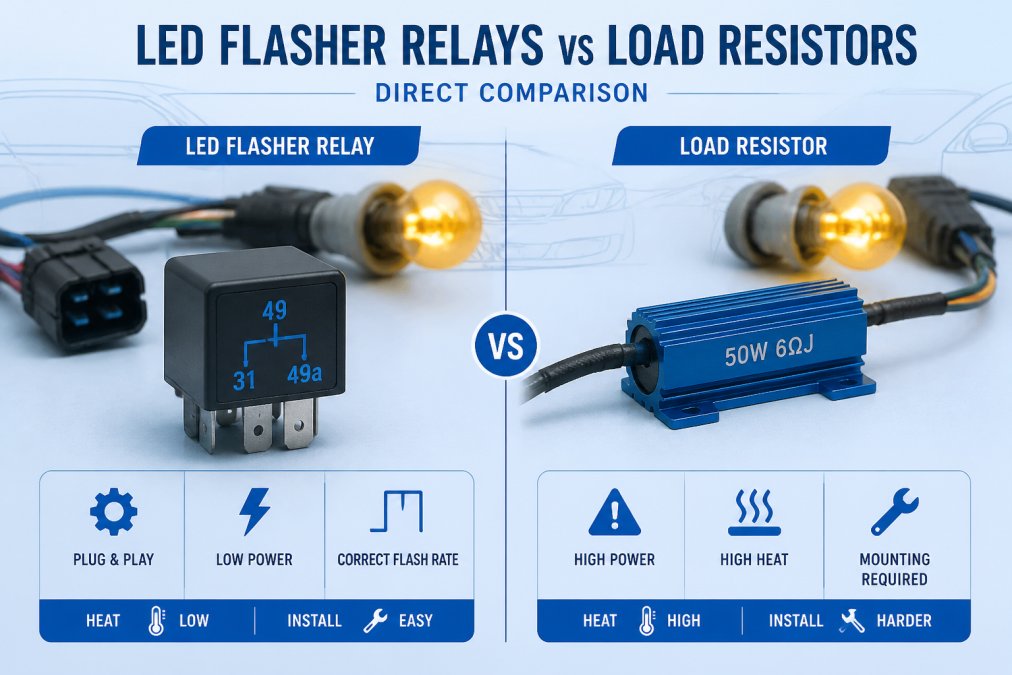
LED flasher relays win on simplicity and long-term reliability. You're replacing one component with another. There's no ongoing heat to manage, no continuous electrical drain, and no extra wiring to maintain. The solid-state electronics are designed to last the life of the vehicle.
Load resistors win on flexibility and upfront cost. They work on virtually any vehicle because they don't depend on a specific relay socket type. If your vehicle uses an uncommon flasher relay that no aftermarket LED version addresses, a resistor is often your only option.
The real trade-off is installation complexity versus electrical load. A relay requires finding the right part for your vehicle. A resistor requires running wires and managing heat. For most DIY enthusiasts, the relay is worth the extra verification step because installation is genuinely simpler.
LED Turn Signal Hyperflash Fix: Choosing the Right Solution
Deciding between LED flasher relays vs resistors comes down to three factors: your vehicle's electrical system design, how much wiring work you're comfortable doing, and whether you want to maintain compatibility with incandescent bulbs.
Choose an LED flasher relay if:
- Your vehicle uses a common relay type (EP27, 2-pin, 3-pin, or 5-pin are the most common)
- You want a true plug-and-play installation with zero wiring modifications
- You might mix LED and incandescent bulbs in different circuits
- You want to minimize ongoing electrical load on your charging system
- You're restoring a classic vehicle and want to keep the engine bay looking original
Choose a load resistor if:
- Your vehicle uses an uncommon or proprietary flasher relay with no LED-compatible replacement available
- You have existing wiring experience and don't mind running new circuits
- You want the cheapest upfront solution
- You're only converting to LED and won't use incandescent bulbs again
- You have space in your engine bay or bumper area for the resistor to dissipate heat safely
For most owners upgrading a classic car, truck, or modified vehicle, RMS Lighting's LED flasher relays are a strong choice. They eliminate the guesswork and the ongoing maintenance. The 2-pin relays at $8.00 work on a huge range of vehicles, and the adjustable versions let you fine-tune the flash rate if needed.
Correcting Fast or Irregular Turn-Signal Flashing
If you've installed LED turn signals and your signals are still flashing too fast or flashing irregularly, sometimes fast, sometimes normal, you need to diagnose what's happening.
Hyperflash (consistently fast flashing) means your flasher relay is detecting low electrical load. This is the standard problem, and it's fixed by either replacing the relay or adding a load resistor.
Irregular flashing (sometimes fast, sometimes normal) usually indicates a loose connection somewhere. Check every wire connection at the relay, at the bulbs, and at the resistor (if using one).
No flashing at all means the circuit is broken. Verify that your LED bulbs are installed correctly, polarity matters on some LED bulbs.
Flashing too slowly suggests too much electrical load in the circuit. If you're using a load resistor, it might be oversized for your circuit.
Test your fix by turning on the turn signals and observing the flash rate. Normal is roughly 60 to 120 flashes per minute. If it's noticeably faster or slower, adjust accordingly.
According to the Society of Automotive Engineers, standard turn signal flash rates are defined in vehicle lighting specifications, though most drivers notice anything outside the 60-120 range as abnormal.
Conclusion
LED turn signals are a smart upgrade for any classic car, truck, or modified vehicle. They're brighter, more efficient, and they last longer than incandescent bulbs. But they require a change to your flasher system to work correctly.
RMS Lighting's LED flasher relays solve this problem with a simple, reliable swap. Our EP27 LED Flasher Relay and 2-pin adjustable relay options eliminate hyperflash without adding external components or ongoing electrical drain. They're designed to work with both LED and incandescent bulbs, giving you flexibility as you upgrade your vehicle. Installation is plug-and-play on compatible vehicles, and the cost is minimal compared to the improvement in visibility and reliability you'll get from quality LED turn signals. Explore our full range of LED flasher relay solutions and find the right fit for your vehicle today.
Frequently Asked Questions
What is the difference between an LED flasher relay and a load resistor?
An LED flasher relay replaces your vehicle's factory flasher module with an electronic unit that recognizes LED bulbs' lower electrical load, restoring normal flash rates without external wiring. A load resistor simulates incandescent bulb current draw by dissipating power as heat across the turn-signal circuit. Relays eliminate hyperflash through solid-state detection; resistors add resistance to fool the original relay into thinking a standard bulb is installed.
Can an LED flasher relay fix turn signal hyperflash?
Yes. LED bulbs draw significantly less current than incandescent bulbs, causing conventional flasher relays to detect a burned-out bulb and trigger rapid flashing. An LED-compatible flasher relay detects the actual LED load and maintains a normal flash rate without modification. The RMS Lighting EP27 LED Flasher Relay is designed for vehicles using EP27-style flashers and eliminates hyperflash through electronic load detection.
Do load resistors get hot, and is that a safety concern?
Yes, load resistors generate heat as they dissipate electrical power to simulate bulb load. Resistors rated for turn-signal circuits (typically 25-50 watts) reach 150-200°F during operation. Heat dissipation requires proper mounting away from plastic, wiring, and fuel lines. Installation behind bumpers, in wire looms, or in tight spaces can cause overheating and fire risk. Correct placement and thermal management are critical for safety.
Will an LED flasher relay work with my vehicle?
LED flasher relay compatibility depends on your vehicle's flasher socket type (EP27, 2-pin, 3-pin, or proprietary) and electrical architecture. Some vehicles use solid-state or CAN-bus turn-signal circuits. Before purchasing, verify your flasher type and check compatibility with your year, make, and model. RMS Lighting relays are available for common socket types, but verification is essential to avoid installation issues.