

Legal Requirements for Aftermarket Automotive Lighting

Table of Contents
- Understanding Federal Standards for Aftermarket Automotive Lighting
- LED Headlight Conversion Kit Legality Explained
- Legal Headlight Colors and Brightness Limits
- Headlight Aim and Glare: Staying Within Legal Limits
- State and Local Regulations: Beyond Federal Rules
- Step-by-Step: Pre-Purchase and Installation Best Practices
- Off-Road Use and Customized Vehicle Lights
- Frequently Asked Questions
Last Updated: October 20, 2026
Understanding Federal Standards for Aftermarket Automotive Lighting
When you upgrade your vehicle's lighting, federal law governs every bulb, housing, and beam pattern. The rules are straightforward once you know where to look.
Legal requirements for aftermarket automotive lighting upgrades center on one core standard: FMVSS 108, the federal motor vehicle safety standard covering all lighting equipment on public-road vehicles, from headlight brightness to turn signal colors.
FMVSS 108 and What It Means for Your Upgrade
FMVSS 108 specifies brightness limits, beam patterns, color requirements, and aiming standards. Meet it and your upgrade is legal for road use; fail it and you risk inspection failure or a citation.
The standard requires:
- Headlights to produce a controlled beam pattern with a sharp cutoff line
- Brightness levels that improve visibility without creating dangerous glare
- Specific color temperatures for different light functions
- Proper aiming to prevent blinding oncoming drivers
Here's what most people miss: FMVSS 108 doesn't ban LED or HID upgrades. A high-quality LED conversion kit designed for your specific housing can meet or exceed federal standards.

DOT Approval and Marking Requirements
DOT approval means the Department of Transportation has tested and approved a specific lighting product.
Look for the DOT mark before you buy, usually a small circle with "DOT" inside, proving the product passed federal testing for that application.
Products without DOT marking may still be legal if they meet FMVSS 108 standards, but the marking provides proof of compliance.
LED Headlight Conversion Kit Legality Explained
The question isn't whether LED headlights are legal, but whether your specific kit is legal for your specific vehicle.
Complete Lamp Assemblies vs. Replacement Bulbs
The law draws a clear line: LED headlight conversion kits come in two forms, treated differently.
Complete lamp assemblies replace the entire headlight housing with one with built-in LED bulbs.

Replacement bulbs go into your existing housing.
The practical difference: A complete assembly gives you control over beam pattern. A replacement bulb leaves you at the mercy of a housing designed for different technology.
Our 7" Gen2 Round Headlight Conversion Kit is a complete assembly with 10,000 lumens of controlled output, replacing your factory sealed beam with a modern LED housing engineered for proper beam control.
Housing Compatibility and Beam Pattern Control
A proper beam pattern has three elements:
- A sharp cutoff line that prevents light from shining above the horizontal plane
- Controlled spread that lights the road without scattering light everywhere
- Proper intensity at the center to maximize visibility
Your factory housing was engineered for a halogen filament at a specific focal point.
A purpose-built LED housing solves this: the reflector is designed around the LED chip position, so the beam pattern is controlled and tested, giving you visibility without glare.
When evaluating any aftermarket automotive lighting upgrade, ask the seller: is this a complete assembly designed for my vehicle, or just a replacement bulb?
Legal Headlight Colors and Brightness Limits
FMVSS 108 is specific about color and brightness. These aren't suggestions. They're requirements for road-legal lighting.
White Light and Color Temperature Standards
Headlights must produce white light. FMVSS 108 defines white as 4,750K to 6,500K Kelvin, cool white to daylight white.
RMS Lighting LLC's LED bulbs are rated at 6,500K, placing them at the bright end of the legal range.
Brightness has legal limits too: headlights must light the road 350 feet ahead at 60 mph without creating dangerous glare.
The practical rule: If your headlights blind oncoming drivers, they're too bright.
Turn Signal and Taillight Color Requirements
Turn signals must be amber and taillights must be red, non-negotiable under federal law.
Amber turn signals are required on the front and sides.
Taillights and brake lights must be red; other colors are illegal, and red tells other drivers you're braking or turning.
RMS Lighting LLC offers 1157 switchback LED bulbs that solve this elegantly: they produce white light as parking lights, then automatically switch to flashing amber when the turn signal is activated.
Headlight Aim and Glare: Staying Within Legal Limits
Proper aiming is where many LED upgrades fail. You can have the perfect beam pattern, but if it's aimed wrong, you're still violating the law.
Proper Aiming and Cutoff Line Standards
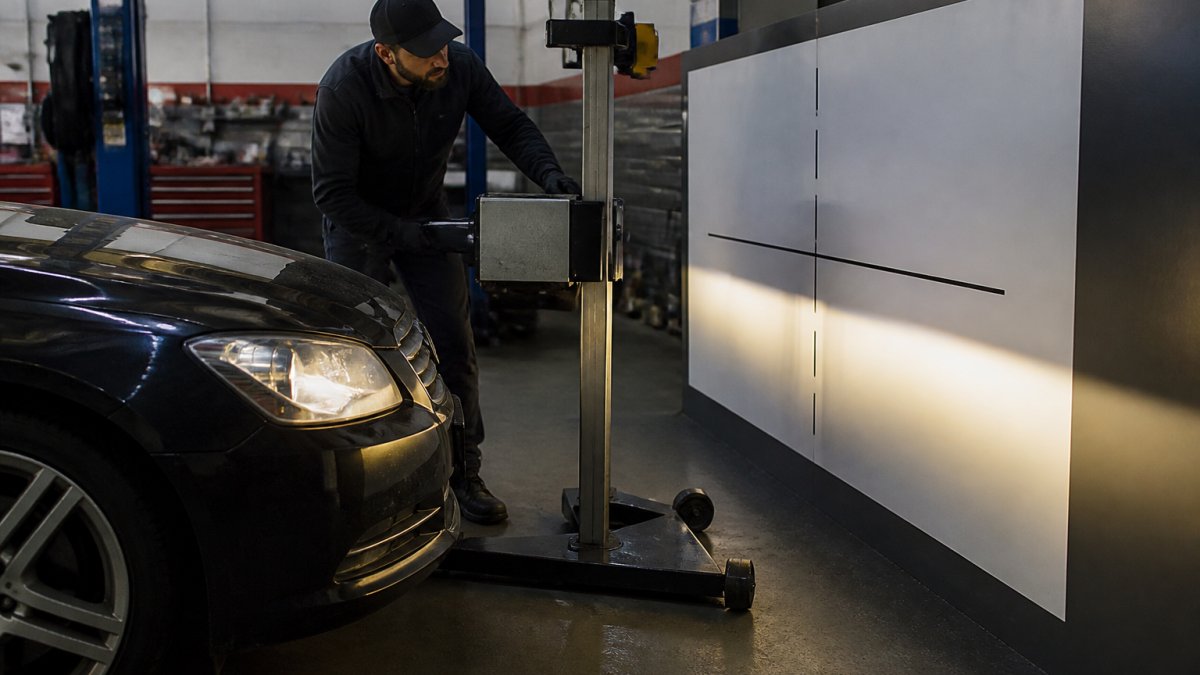
Your headlights must aim slightly downward and to the right (in left-hand-drive vehicles) so light doesn't shine into oncoming drivers' eyes. FMVSS 108 specifies roughly 0.5 degrees downward.
The cutoff line is the boundary between lit and unlit road: everything below is illuminated, everything above is dark, protecting oncoming traffic.
Many LED kits include adjustable bulb bases.
Testing for Glare and Visibility
Here's how to check if your headlights are legal:
- The visibility test: On a dark road with no other lights, can you see the road clearly 300 feet ahead? If yes, you have adequate brightness.
- The glare test: Park facing another vehicle 100 feet away with headlights on. Can the other driver see you clearly without squinting? If yes, your aim is good.
- The beam pattern test: Shine your headlights on a wall at night. Look for a sharp cutoff line. If the light scatters above the horizontal, your beam pattern is wrong.
These informal tests give you a quick sense of compliance. A professional headlight aiming station measures exact angles; most tire shops and inspection stations offer this service for a small fee.
RMS3321M2S- 7" (Gen2) Round Headlight Conversion Kit with 10,000 LM H4 LED →
State and Local Regulations: Beyond Federal Rules
Federal standards set a floor. States and municipalities can impose stricter rules. You need to know both.
Jurisdiction-by-Jurisdiction Compliance Checklist
Federal law applies everywhere, but your state may have additional requirements.
Some states prohibit any non-original lighting equipment on public roads; others allow LED upgrades that meet FMVSS 108, and a few have specific color temperature or brightness rules.
Before you install any legal requirements for aftermarket automotive lighting upgrades, check your state's vehicle code. Look for:
- Aftermarket lighting restrictions: Does your state allow LED conversions on public roads?
- Color requirements: Does your state specify color temperature ranges?
- Brightness limits: Does your state impose maximum brightness standards?
- Inspection standards: What does your state's vehicle inspection check for?
| Consideration | What to Check | Where to Find It |
|---|---|---|
| State lighting code | Vehicle equipment regulations | State DMV website |
| Local ordinances | Municipal vehicle codes | City/county clerk office |
| Inspection requirements | What inspectors test | State inspection manual |
| Enforcement practices | How strictly rules are enforced | Local police or inspection station |
| Off-road allowances | What's permitted off public roads | State regulations or ranger station |
Your state's DMV website typically has a vehicle equipment section where lighting requirements live. Print it out and bring it with you if you get stopped.
Vehicle Inspection and Enforcement
Most states require annual or biennial inspections that check headlight aim, brightness, color, and beam pattern. Noncompliant lighting is a common reason for failure.
Fail for lighting and you get a notice to correct the problem, usually within 30 days, then return for re-inspection.
Road enforcement varies: some departments actively ticket improper lighting, others focus on vehicles that demonstrably blind other drivers.
Step-by-Step: Pre-Purchase and Installation Best Practices
Before you buy any upgrade, verify it will work for your vehicle and situation. After you install it, do basic checks to ensure it's legal.
Verifying Product Compliance Before You Buy
Start with your vehicle's original specifications:
- Year, make, and model of your vehicle
- Original headlight type: sealed beam, reflector housing, or projector housing
- Bulb type: H4, H7, 9005, or other designation
- Voltage: 12V or 24V (most vehicles are 12V)
Next, verify the upgrade matches your vehicle. Does the product listing specifically name your vehicle? If it says "fits most vehicles," that's a red flag, lighting is application-specific.
Third, confirm the product includes or produces a proper beam pattern. Look for:
- Complete lamp assembly (not just a bulb)
- Purpose-designed housing for your vehicle
- DOT marking or FMVSS 108 compliance statement
- Controlled beam pattern with sharp cutoff line
- Adjustable aiming provisions
Finally, check for potential electrical issues. LED bulbs draw less power than halogen bulbs. This can cause hyper-flashing (rapid turn signal flashing) on some vehicles. Look for products that address this:
- CanBus-compatible design
- Built-in load resistors
- Compatibility with LED flasher relays
RMS Lighting LLC products are designed with these considerations built in. Our Gen2 and Gen3 conversion kits include proper beam control. Our switchback bulbs are CanBus-compatible to minimize hyper-flashing issues.
Installation Considerations and Common Pitfalls
Most LED conversion kits are plug-and-play, no rewiring, but you still need to install them correctly.
Common mistakes:
- Forcing components: LED housings are engineered for specific fitment. If something doesn't fit easily, stop. Don't force it.
- Skipping the aiming step: After installation, aim your headlights. This is not optional.
- Ignoring polarity: Some LED bulbs are directional. Installing them backward won't work.
- Forgetting the adjustable base: Many LED bulbs have rotating bases. Position the light source correctly before tightening.
Addressing Hyper-Flashing and Electrical Issues
Hyper-flashing is rapid turn signal flashing. When you replace incandescent bulbs with LEDs, the factory flasher relay sees the lower electrical load and thinks a bulb is burned out.
Solutions:
- CanBus-compatible LEDs: Built-in electronics mimic the load of incandescent bulbs
- LED flasher relay: Replace the factory relay with one designed for LED loads
RMS Lighting LLC offers the EP27 LED Flasher Relay for vehicles that need it. It's a simple plug-and-play fix.

Other electrical issues are rare with quality products. Flickering usually means a loose connection. Check all connectors and ensure they're fully seated.
Off-Road Use and Customized Vehicle Lights
Federal standards apply only to vehicles on public roads; off-road vehicles have no federal lighting requirements.
This opens possibilities: brighter lights, non-standard colors, or beam patterns that would be illegal on the street. Many classic car builders and off-road enthusiasts take advantage of this freedom.
The catch: The moment you drive on a public road, federal standards apply.
If you're building a vehicle that will never see public roads, you have complete freedom.
Upgrading your vehicle's lighting doesn't have to mean sacrificing legality for performance.
At RMS Lighting LLC, we design every product around compliance.
FMVSS 108 Federal Motor Vehicle Safety Standard
Vehicle Lighting Equipment Requirements
State-by-State Vehicle Inspection Standards
Frequently Asked Questions
Are LED headlight conversion bulbs legal for street use?
LED headlight conversion bulbs are legal for street use only if they meet FMVSS 108 standards and are installed in a DOT-approved complete lamp assembly or housing designed to work with LED bulbs. Aftermarket replacement bulbs installed in factory halogen housings often fail to meet beam pattern and glare requirements, making them illegal for road use. The key is ensuring the bulb and housing work together to produce a proper cutoff line and controlled beam pattern that does not blind oncoming drivers.
What does DOT marking on an automotive light mean?
DOT marking indicates that a lighting component has been tested and approved by the Department of Transportation to meet federal vehicle lighting standards (FMVSS 108). The marking shows the manufacturer, part number, and approval code. When shopping for aftermarket lighting upgrades, look for DOT markings on the complete lamp assembly to confirm it meets federal requirements. This marking is your assurance that the light has passed brightness, color, beam pattern, and durability tests required for legal road use.
Can you get pulled over for aftermarket tail lights or turn signals?
Yes, you can be pulled over for noncompliant aftermarket tail lights or turn signals. Taillights must be red, and turn signals must be amber, these colors are federal requirements under FMVSS 108. Aftermarket lights that fail to meet brightness standards, produce the wrong color, or flash at an incorrect rate can result in a traffic citation. Some states also require vehicle inspections that specifically check lighting compliance, so noncompliant upgrades may cause your vehicle to fail inspection.
What should I check before installing an LED headlight conversion kit?
Before installation, verify that the kit includes a complete DOT-approved lamp assembly designed to work with LED bulbs, not just replacement bulbs for factory housings. Check that the kit matches your vehicle's headlight type (5.75-inch round, 7-inch round, rectangular, etc.). Review the beam pattern specifications to confirm it includes a proper cutoff line. If the kit uses switchback turn signal bulbs, confirm your vehicle does not require an LED flasher relay to prevent hyper-flashing. Finally, check your state and local regulations to ensure the specific upgrade is permitted in your jurisdiction.