

Reflector vs Projector Housing for LEDs

Table of Contents
- How Reflector Headlights Work
- How Projector Headlights Work
- Reflector vs Projector Beam Pattern and Light Distribution
- LED Bulbs in Reflector Headlights: Performance and Compatibility
- LED Bulbs in Projector Headlights: Performance and Compatibility
- LED Headlight Beam Pattern: Cutoff Line, Brightness, and Glare Control
- How to Aim LED Headlights After Installation
- Reflector vs Projector: Which Should You Choose for LED Conversion?
- Frequently Asked Questions
Last Updated: October 16, 2026
How Reflector Headlights Work
A reflector headlight uses a curved mirror surface behind the bulb to bounce light forward into a wide beam pattern, and understanding reflector vs projector housing design is essential for LED upgrades.
The challenge is beam control: light scatters off the curved surface, spilling upward and sideways.
At RMS Lighting LLC, we've tested countless LED conversions in reflector housings, and the results are predictable: without the right optical design, you get poor beam focus or excessive glare.
How Projector Headlights Work
A projector headlight uses a lens and internal shield to focus light precisely, like a film projector.
The projector design gives you two advantages: controlled beam focus and intentional glare management. The cutoff shield blocks upward light that would blind oncoming drivers, and the lens concentrates light on the road ahead.
When comparing reflector vs projector housing options, projector housings cost more to manufacture but deliver superior beam control.
Reflector vs Projector Beam Pattern and Light Distribution
The fundamental difference is how light travels after leaving the bulb.
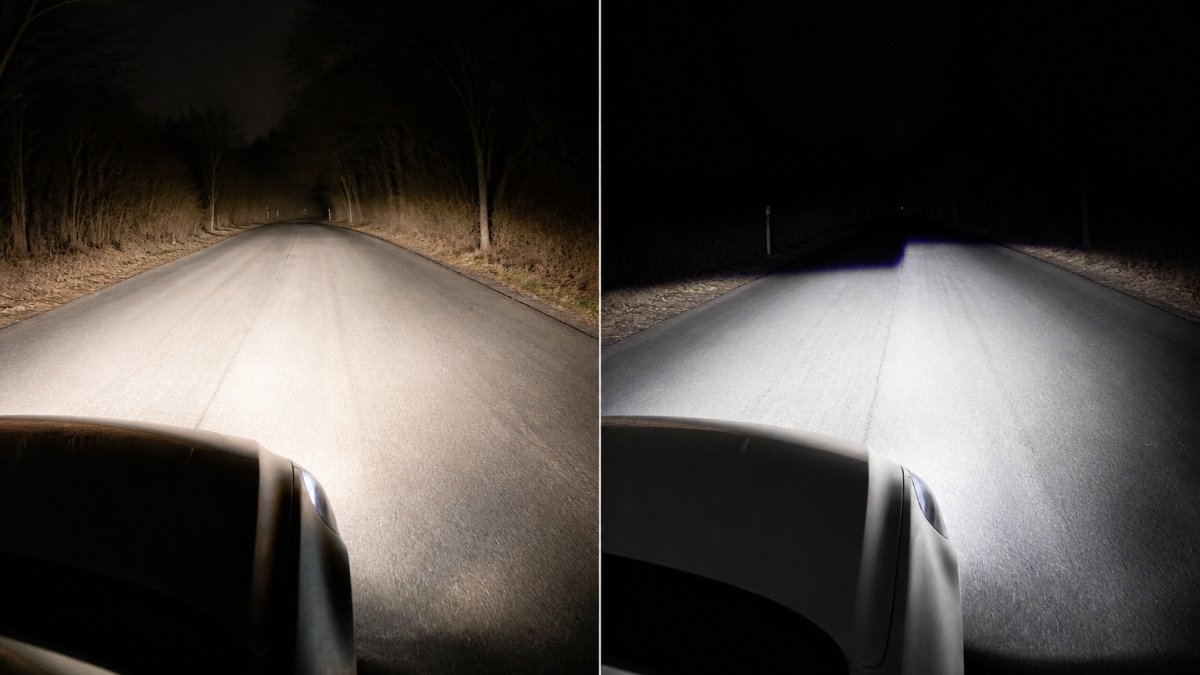
In practice, a reflector beam spreads light across a wider area at lower intensity, so you see more periphery but less brightness ahead.
With LED upgrades, the difference becomes more pronounced. LED bulbs in reflector housings often produce uneven illumination because LEDs emit from a small point source unlike halogen filaments.
LED Bulbs in Reflector Headlights: Performance and Compatibility
Installing LED bulbs in reflector housings is mechanically straightforward but optically challenging.
The result is often a bright center surrounded by dimmer zones.
Compatibility also depends on bulb size and connector type. Many aftermarket LED bulbs are taller or wider than their halogen equivalents, causing fitment issues.
The best approach with reflector housings is choosing LED bulbs specifically designed for reflector optics.
LED Bulbs in Projector Headlights: Performance and Compatibility
Projector housings are far more forgiving with LED upgrades because the lens and shield control the beam, not the bulb's exact shape. An LED bulb designed for projector use positions the light source at the focal point, which is why projector conversions consistently outperform reflector conversions.
The key is emitter placement: a projector LED bulb must sit precisely at the lens's focal point, and even a few millimeters off ruins the beam pattern. Quality projector LED bulbs have adjustable bases or engineered mounting to ensure correct positioning, which is why RMS Lighting's H4 Mini Projector LED bulbs work so effectively in our Gen3 conversion kits.

Projector housings also accommodate higher light output without glare problems. Because the cutoff shield controls stray light, you can run brighter LEDs without bothering oncoming drivers; reflector housings lack this control, so increasing brightness increases glare proportionally.
LED Headlight Beam Pattern: Cutoff Line, Brightness, and Glare Control
The cutoff line is the sharp boundary between the illuminated road and the dark sky above. Projector headlights create a defined cutoff because the internal shield blocks upward-traveling light; reflector headlights produce a gradual falloff with no sharp cutoff.
For LED upgrades, cutoff control is critical for legal compliance and driver courtesy. Most state inspection programs require low beams not project above a specified angle.
Why lumens mislead and candela tells the truth
Brightness in lumens tells you total light output, not how it's distributed. A 10,000-lumen reflector beam spread across a wide area can feel dimmer than a 10,000-lumen projector beam focused into a tight pattern, because the projector concentrates intensity even when total lumens are identical.
What actually predicts what you see is illuminance at a distance, expressed in lux, and the source intensity that produces it, expressed in candela.
How to run a wall test that separates good beams from bad
A wall test is the cheapest way to see what a beam pattern actually does and exposes the difference between reflector and projector optics faster than any spec sheet.
RMS3301PRO - 5.75 (Gen3) Small Round Headlight Conversion Kit with 10,000 LM H4 →
- Park on level ground with the front of the vehicle 25 feet from a flat wall or garage door, tires straight and fuel tank at a normal level.
- Measure the height of each headlamp lens center from the ground and mark that height on the wall with tape, along with the vehicle centerline.
- Turn on the low beams and photograph the pattern straight-on. A projector beam should show a defined horizontal cutoff with a step or kick-up toward the passenger side; a reflector beam shows a soft, rounded pool with no clean upper edge.
- Look for failure signatures: a bright hot spot floating above the cutoff, a dark hole directly in front of the vehicle, or two overlapping pools that fight each other. Any of these means the LED emitter isn't sitting where the housing's optics expect it.
- Repeat at 10 feet and 50 feet. A beam that looks acceptable at 10 feet but blows past the cutoff at 50 feet will glare at oncoming drivers even though it looks fine in a parking lot.
Glare is a geometry problem, not a brightness problem
Glare is unwanted light reaching a driver's eyes at angles that hit the oncoming windshield. Projector housings minimize it by design, since the cutoff shield blocks most light above the horizontal plane.
Adding brightness to a reflector housing usually adds glare proportionally, while adding it to a projector housing mostly adds usable forward light because the shield still controls the upper edge.
How to Aim LED Headlights After Installation
After installing LED conversion kits, proper aiming is essential for performance and legal compliance.
Park on level ground 25 feet from a wall or garage door.
For horizontal aim, the beam should be centered on the vehicle's centerline.
After aiming, test drive in darkness on a quiet road to confirm visibility and check that oncoming drivers aren't flashing their lights (a sign of glare).
Reflector vs Projector: Which Should You Choose for LED Conversion?
For most drivers upgrading to LEDs, projector housings deliver superior results. The focused beam, sharp cutoff, and glare control make projector conversions safer, more legal, and more visually impressive.
Reflector housings work for LED upgrades but require more careful bulb selection and often deliver less impressive results. If your vehicle uses reflector housings, you have two paths: install high-quality reflector-optimized LED bulbs, or convert the full housing to projector-style units.
The choice also depends on your vehicle's original design.
| Factor | Reflector Housing | Projector Housing |
|---|---|---|
| Beam Focus | Wide, diffuse | Tight, concentrated |
| Cutoff Line | Gradual falloff | Sharp, defined |
| Glare Control | Poor | Excellent |
| LED Compatibility | Moderate | Excellent |
| Brightness Perception | Spread across area | Focused intensity |
| Ease of Aiming | Difficult | Easy |
| Legal Compliance | Often problematic | Native compliance |
| Cost | Lower | Higher |
| Best For | Budget conversions | Performance, safety |
Complete LED assembly versus replacement bulb: a distinction that decides legality
Before comparing reflector and projector, separate two very different products. A complete LED headlamp assembly is designed around an LED light source, with optics, driver electronics, and lens engineered together and sold as a sealed unit. A replacement LED bulb is an aftermarket part dropped into a housing designed for a halogen filament.
The distinction matters because compliance is tied to the assembly, not the bulb alone.
How to check the rules that actually apply to you
Headlight legality in the United States is layered, depending on your state, vehicle class, and whether the lamp is original equipment or an aftermarket conversion.
- Federal layer: The National Highway Traffic Safety Administration administers Federal Motor Vehicle Safety Standard 108, which sets headlamp performance requirements and requires regulated lighting equipment to be marked as compliant, including replacement equipment sold for regulated uses.
- State layer: State vehicle codes and inspection programs set their own requirements for aim, color, and allowable modifications. Some states inspect headlight aim directly; others only check function. A conversion that passes in one state can fail in another.
- Local layer: Some municipalities add equipment or inspection ordinances that touch on lighting. When in doubt, the state motor vehicle agency is the authoritative source for your registration address.
A practical check is to look for the DOT marking on the lens or housing and keep the product documentation with the vehicle. If a bulb or assembly has no marking and no compatibility documentation, treat it as unverified regardless of wall-test performance.
Matching the upgrade to how you actually drive
Beam pattern isn't universally better in one direction. Match the housing to how you drive.
- Suburban and city driving: A projector's sharp cutoff and controlled foreground light reduce glare for other drivers and make lane markings easy to read. This is where projector conversions feel most transformative.
- Rural and unlit roads: A wider reflector-style spread puts more light on shoulders, driveway entrances, and roadside hazards. A narrow projector beam can feel like a spotlight that misses the periphery, so look for a projector pattern with a broad low-beam spread rather than a tight pencil beam.
- Rain, fog, and snow: A sharp cutoff can reflect off precipitation and create a wall of glare. A softer falloff is sometimes easier on the eyes in bad weather, which is one reason fog lamps are separate from low beams.
The decision in one pass
Choose a projector-based conversion when you want a defined cutoff, strong glare control, and predictable LED results, and your vehicle's look allows it.
RMS Lighting's Gen3 conversion kits pair projector-style H4 Mini Projector LED bulbs with glass housings, delivering modern projector performance behind the classic appearance of sealed-beam headlights. The Mini Projector design creates a focused beam with a sharp cutoff line and superior glare control while maintaining the factory look restoration enthusiasts value.
Frequently Asked Questions
Can I put LED bulbs in reflector headlight housings?
Yes, but with important caveats. Standard LED replacement bulbs can physically fit reflector housings, but they often produce poor results. Reflector housings rely on the bulb's filament position and the bowl-shaped reflector surface to direct light. LED bulbs have a different light source geometry, which can cause hot spots, uneven illumination, or excessive glare. For better performance, look for LED bulbs specifically designed for reflector housings, or consider a conversion kit with mini projector LED bulbs like RMS Lighting's Gen3 kits, which deliver a controlled beam pattern without replacing your factory appearance.
What is the difference between reflector and projector headlight housings?
Reflector housings use a curved bowl-shaped surface behind the bulb to bounce light forward, relying on the bulb's position and filament shape for beam control. Projector housings use a lens with a built-in projector mechanism to focus light, producing a tighter, more defined beam with a sharper cutoff line. Projector housings provide better glare control and more usable light output on the road. Reflector housings are simpler and cheaper to manufacture but scatter more light to the sides and upward. For LED upgrades, projector designs typically perform better because they're optimized for point-source light control.
Do LED bulbs in reflector housings cause glare to oncoming drivers?
Standard LED replacement bulbs in reflector housings often do cause excessive glare. Because reflector bowls weren't designed for LED emitter placement, the light scatters unevenly, sending unwanted light upward and to the sides where oncoming drivers can see it. This creates the bright, unfocused glare that gives LED retrofits a bad reputation. Mini projector LED bulbs, which include their own focusing lens, solve this problem by controlling the beam with a sharp cutoff line. RMS Lighting's H4 Mini Projector bulbs are designed specifically to eliminate this glare while maximizing road illumination.
Why does the same LED bulb look different in reflector versus projector housings?
LED bulbs produce light from a small, fixed point (the LED emitter), which is very different from the glowing filament of a halogen bulb. Reflector housings expect light from a specific position and angle to bounce properly off the bowl surface. When an LED emitter sits in a different spot than the original filament, the reflected light scatters unpredictably. Projector housings, by contrast, have a lens that focuses whatever light source is behind it. This makes projectors far more forgiving of LED emitter placement. The same bulb will produce a sharp, controlled beam in a projector housing but a chaotic, scattered beam in a reflector housing.
How do you aim LED headlights after installing new bulbs?
Most LED headlight conversion kits, including RMS Lighting's Gen3 kits, feature an adjustable rotating bulb base that allows you to rotate the projector lens for proper alignment. To aim correctly, park your vehicle 25 feet from a wall in a dark space, turn on the headlights, and adjust the beam so the cutoff line is level with the center of the wall. The adjustable base lets you rotate the bulb until the beam pattern is symmetrical and the cutoff line is sharp. If your kit includes harness adapters, ensure they're fully seated before testing. Proper aiming takes only a few minutes and ensures you're not blinding oncoming drivers while maximizing your own visibility.