


Sealed Beam vs LED Conversion for Vintage Trucks

Table of Contents
- Sealed Beam vs LED Conversion: Core Differences
- Visibility and Light Output Comparison
- Best Plug and Play LED Headlight Kits for Classic Trucks
- DOT Compliance for Vintage Truck Headlights
- Electrical System Compatibility and Power Consumption
- How to Install LED Headlights on Classic Trucks
- Durability, Lifespan, and Long-Term Performance
- Beam Pattern and Glare: Safety Considerations
- Frequently Asked Questions
Last Updated: September 20, 2026
Sealed Beam vs LED Conversion: Core Differences
When restoring a vintage truck, the choice between sealed beam vs LED conversion balances authenticity, performance, and practicality.
Sealed beam headlights are self-contained units with reflector, lens, and filament in one housing; you replace the entire unit when the bulb dies. LED conversion kits keep the original appearance while swapping to modern LED technology, modernizing visibility without losing period-correct looks.
The key differences are light output, electrical demand, and installation complexity.
How Sealed Beam Headlights Work
A sealed beam is a complete optical system: a reflector bowl directs light from the filament forward, and the lens focuses it onto the road.
The advantage is simplicity: original wiring connects directly with no adapters needed. The disadvantage is output, traditional halogen sealed beams max out around 1,000-1,500 lumens, limiting visibility on unlit roads.
Sealed beams generate significant heat.
How LED Conversion Kits Work
An LED conversion kit replaces the internals while keeping factory appearance, including a new housing with glass lens, H4 LED bulbs, and harness adapters for your truck's wiring.

The LED bulbs sit in a reflector that shapes light into a proper beam pattern, with an adjustable rotating base for precise positioning. A built-in driver converts 12V power to the specific voltage and current the LEDs need.
LED bulbs produce 10,000 to 15,000 lumens at 6500K cool white, mimicking daylight and improving low-light visibility.
LEDs convert most energy to light, not heat. An active cooling fan extends bulb life to 50,000+ hours.
Visibility and Light Output Comparison
A sealed beam produces 1,000-1,500 lumens; an LED conversion kit produces 10,000-15,000 lumens.

Sealed beams illuminate 100-150 feet ahead; LED kits light up 250-300 feet or more.
Sealed beams produce yellowish 3,000K light. LED bulbs at 6500K feel brighter and improve road contrast.
LED output depends on housing design. A conversion kit housing is engineered for LEDs with a reflector shaped for LED light, not halogen. Dropping an LED into a sealed beam housing produces scattered light instead of a focused beam.
Best Plug and Play LED Headlight Kits for Classic Trucks
RMS Lighting LLC offers five plug-and-play conversion kit configurations for different vintage truck headlight sizes.
7-Inch Round Glass Conversion Kit
The RMS3321M2S 7" Round Headlight Conversion Kit includes two Gen2 glass housings and 10,000-lumen H4 LED bulbs at 6500K. The adjustable rotating bulb base enables perfect beam alignment. $179.00 with 2-year warranty.
5x7 Large Square Glass Conversion Kit
The RMS3322M2S 5x7 Conversion Kit fits 5x7 rectangular sealed beams on 1970s-1980s Ford trucks and some Toyota models. Includes two housings, bulb covers, and 10,000-lumen H4 LED bulbs. $179.00 with 2-year warranty.
4x6 Small Square Conversion Kit with Standard Output
The RMS3323M2S 4x6 Kit includes four housings, four 10,000-lumen H4 bulbs, and harness adapters for plug-and-play installation. $269.00 with 2-year warranty. Fits GM vehicles, Caprices, Camaros, Firebirds, and 1980s square body trucks.

4x6 Small Square Conversion Kit with High Output
The RMS3323S130 4x6 High Output Kit features 15,000-lumen H4 LED bulbs. $299.00 with 3-year warranty. Engineered for 1979-1986 Ford Mustang Fox Body and GM quad headlight vehicles.
5.75-Inch Round Conversion Kit
The RMS3301M2S 5.75" Round Kit includes four Gen1 housings with glass lenses and metal backs, four 10,000-lumen H4 bulbs, and harness adapters. $219.00 with 2-year warranty.
| Kit | Size | Output | Price | Best For |
|---|---|---|---|---|
| 7" Round | 7-inch round | 10,000 LM | $179 | Classic trucks with round sealed beams |
| 5x7 Square | 5x7 rectangular | 10,000 LM | $179 | 1970s-80s Ford and Chevy trucks |
| 4x6 Standard | 4x6 quad (4 units) | 10,000 LM | $269 | GM vehicles, Camaros, square body trucks |
| 4x6 High Output | 4x6 quad (4 units) | 15,000 LM | $299 | Maximum visibility, Fox Body Mustangs |
| 5.75" Round | 5.75-inch round (4 units) | 10,000 LM | $219 | Classic GM quad headlight setups |
DOT Compliance for Vintage Truck Headlights
The Department of Transportation sets standards for headlight brightness, beam pattern, and color temperature.
RMS3321M2S- 7" (Gen2) Round Headlight →
Cheap LED kits using halogen-designed reflectors scatter light instead of focusing it.
RMS Lighting conversion kits feature proper LHD beam patterns for North American roads with housings designed for LEDs. Check local regulations before installing, some states have stricter rules than federal DOT standards.
Electrical System Compatibility and Power Consumption
LED conversions draw 2-4 amps versus 5-7 amps for sealed beams, which can cause "bulb out" error codes or hyper-flashing if your truck's load-sensing relay doesn't recognize the lower amperage as a valid load.
A proper LED driver or load equalizer maintains a load signature your truck's electrical system recognizes. Standard kits work with most vintage trucks without additional components.
Check your truck's alternator capacity before installing high-output LED headlights, especially if running multiple accessories.
How to Install LED Headlights on Classic Trucks
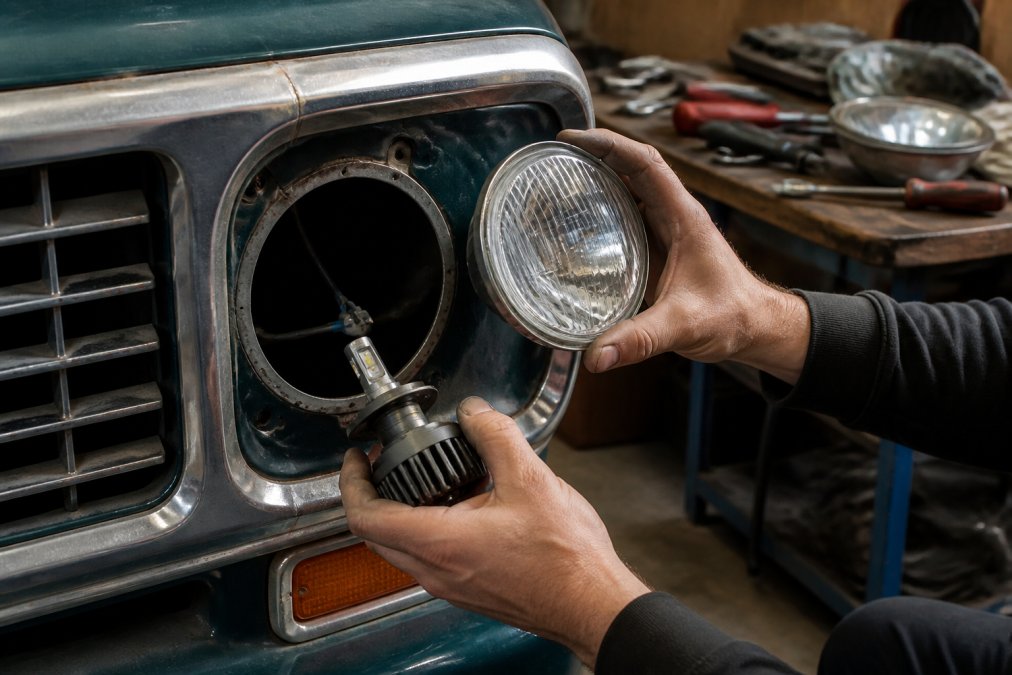
The installation process varies slightly depending on your truck's headlight configuration, but the basic steps are the same. A true plug-and-play kit should take 30-45 minutes per side.
Step 1: Verify Fitment and Gather Tools
Before you start, confirm that your truck uses the headlight size your kit is designed for. Check your owner's manual or the factory headlight housing. Measure the headlight opening if you're unsure.
Gather basic hand tools: a screwdriver set, a wrench or socket set, and possibly a trim removal tool if your truck has plastic trim around the headlights. You won't need a soldering iron or wire crimper for a true plug-and-play kit.
Disconnect the negative battery terminal before you start. This prevents accidental shorts and protects your truck's electrical system.
Step 2: Remove Factory Sealed Beam Headlights
Open your truck's hood and locate the headlight assembly. Most sealed beam headlights are held in by a trim ring or a retaining ring that screws into the frame.
Look for the retaining ring around the sealed beam.
Step 3: Install New Housing and Bulbs
Slide the new conversion kit housing into the same opening where the sealed beam was. It should fit snugly. If it's tight, you may need to adjust the retaining ring slightly, but forcing it can crack the new glass lens.
Step 4: Connect Wiring and Test
If your truck has a simple 2-prong factory connector and the kit includes harness adapters, plug the adapter into your truck's wiring first. Then connect the LED bulb's 3-prong connector to the adapter.
Common Installation Mistakes to Avoid
The biggest mistake is forcing the new housing into the opening. Vintage truck headlight bezels can be tight. If the housing doesn't slide in smoothly, stop and check the fit. Forcing it can crack the glass lens, which is expensive to replace.
Durability, Lifespan, and Long-Term Performance
A sealed beam halogen bulb lasts 500-1,000 hours. An LED bulb lasts 50,000+ hours.
Beam Pattern and Glare: Safety Considerations
A sealed beam produces a broad, scattered light pattern with a soft, undefined cutoff line. An LED conversion kit with proper housing produces a sharp, defined cutoff line with focused light and minimal scatter.
Frequently Asked Questions
Are LED conversion kits worth the investment for classic vehicles?
LED conversion kits offer improvements in nighttime visibility and durability compared to aging sealed beam headlights. The 10,000-lumen output of modern kits provides better road illumination, and LED bulbs last much longer than halogen sealed beams. For vintage truck owners who drive at night regularly, the safety and reliability gains justify the upfront cost, especially when choosing plug-and-play kits that require no permanent modifications.
Do LED conversion kits require modifications to the factory wiring?
Quality LED conversion kits are designed as true plug-and-play upgrades that connect directly to factory wiring without cutting, splicing, or permanent modifications. Many kits include harness adapters that convert H4 3-prong LED bulb connectors to factory 2-prong high beam connectors. This preserves the original wiring integrity and allows for easy reversal if needed. Always verify adapter compatibility with your specific vehicle year, make, and model before ordering.
What is the downside of LED headlights on vintage trucks?
The main downsides include potential compatibility issues with older electrical systems (some vehicles experience dashboard error codes or hyper-flashing), initial cost higher than replacement sealed beams, and the need to choose kits with proper Left-Hand Drive beam patterns to avoid blinding oncoming drivers. Selecting a reputable conversion kit with proper beam pattern engineering and built-in drivers minimizes these risks.
Are sealed beam headlights still manufactured and used today?
Sealed beam headlights are no longer installed on new vehicles but are still manufactured as replacement parts for classic and vintage trucks. Many owners keep original sealed beams for authenticity, though they produce dimmer light (typically 800-1,200 lumens) compared to modern LED conversions (10,000-15,000 lumens). LED conversion kits preserve the sealed beam appearance while delivering modern performance, making them an ideal compromise for restoration and restomod projects.
How do LED conversion kits handle beam pattern and glare reduction?
Modern LED conversion housings are engineered with proper reflector geometry and adjustable rotating bulb bases to position LED chips for optimal beam alignment. A well-designed housing produces a defined cutoff line that prevents glare from reaching oncoming drivers while concentrating light on the road ahead. Kits using real glass lenses with Left-Hand Drive optics (not Right-Hand Drive) and built-in driver circuits deliver superior beam control compared to cheap conversions that simply drop LED bulbs into unmodified sealed beam housings.