


Are Expensive LED Kits Worth the Price in 2026?

Table of Contents
- Why Price Varies So Much in LED Kits
- LED Chip Quality and Efficiency: The Foundation of Performance
- Best High Performance LED Headlight Bulbs: What Sets Them Apart
- LED vs. Halogen Headlight Performance: The Real Differences
- LED Headlight Conversion Kit Installation Guide: What You're Paying For
- Safety Certifications and Flicker-Free Technology
- Upfront Cost vs. Total Cost of Ownership
- Common Mistakes With Budget LED Kits
Last Updated: August 18, 2026
Why Price Varies So Much in LED Kits
The difference between a $50 LED bulb and a $109 kit isn't arbitrary. Budget LED kits cut corners on three core components: the semiconductor, thermal management, and driver circuit. A cheap LED uses generic chips that degrade quickly under heat. The driver, which converts your vehicle's electrical system into stable power for the LEDs, is often undersized, causing voltage fluctuations that trigger CANBUS errors. The heat sink is thin aluminum or plastic, causing premature failure.

Premium kits invest in each layer. They use CREE or similar high-grade semiconductor chips that maintain consistent light output over thousands of hours. The driver is oversized for the application, delivering rock-solid voltage regulation. The heat sink is substantial aluminum designed to dissipate thermal energy aggressively. This is why RMS Lighting LLC's RMSH4S130 - 130W Canbus LED Bulb costs more than entry-level alternatives, the engineering is fundamentally different.
The price difference also reflects testing. Premium manufacturers test beam patterns in actual vehicle housings to ensure light distribution doesn't blind oncoming drivers. They stress-test drivers across temperature extremes and voltage swings. Budget manufacturers skip this work.
LED Chip Quality and Efficiency: The Foundation of Performance
Everything downstream depends on the semiconductor at the heart of the bulb. A high-quality LED chip maintains consistent luminous output, handles heat efficiently, and lasts significantly longer than generic alternatives.
CREE vs. Generic Semiconductors
CREE chips (now part of Wolfspeed) have become the industry standard for automotive applications because they're engineered specifically for the thermal stress and voltage variability of vehicle electrical systems. A CREE CSP3570 or CSP1860 chip is optimized for high current density without catastrophic failure. Generic "LED chips" from unknown manufacturers typically use older phosphor coating technology and less sophisticated junction design. They generate more heat per lumen of output, accelerating degradation. Within 500-1,000 hours of operation, generic chips often show visible dimming. A CREE chip in the same conditions maintains 90% of its initial brightness.
The RMS Lighting LLC team has tested this directly. The RMSH4M2S - 60W LED Bulb uses 12 CREE CSP1860 chips arranged to achieve 10,000 lumens of output while keeping thermal stress manageable.

Luminous Efficacy and Lumen Maintenance
Luminous efficacy measures how many lumens of light output you get per watt of electrical input (lm/W). Budget LEDs typically deliver 80-100 lm/W. Premium automotive LEDs achieve 120-150 lm/W. The premium bulb generates significantly less waste heat, extending lifespan.
Lumen maintenance is critical. A quality LED maintains 90% brightness after 10,000 hours. A budget LED might drop to 70% brightness in the same timeframe. Since automotive headlights run roughly 500-1,000 hours per year, you're looking at 10-20 years of service life from a premium bulb versus 3-5 years from a budget alternative.
Best High Performance LED Headlight Bulbs: What Sets Them Apart
The best automotive LED headlight bulbs share three non-negotiable characteristics: superior thermal management, reliable driver design, and rigorous beam pattern testing.
Thermal Management and Heat Dissipation
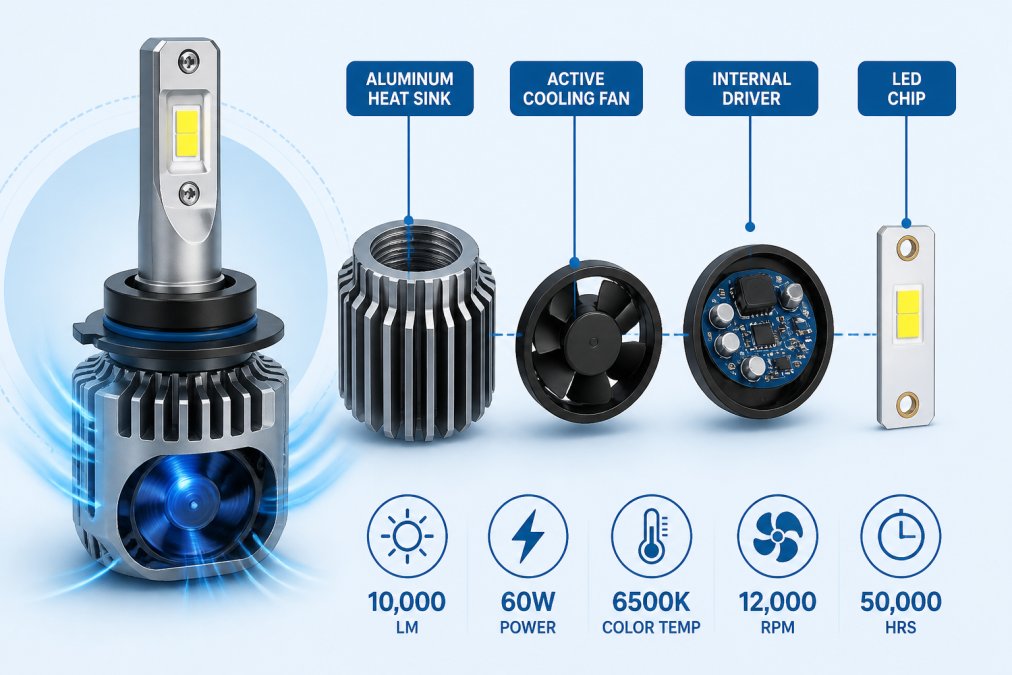
Heat is the enemy of LED longevity. Every degree Celsius above the semiconductor's rated operating temperature reduces lifespan exponentially. A bulb running at 85°C lasts roughly half as long as one running at 65°C.
Premium kits use active cooling, a small fan inside the bulb housing that pulls hot air away from the LED junction. The RMS Lighting LLC RMSH7GL62 - 90W 20K Lumens Canbus LED Bulb includes an active cooling fan and substantial aluminum alloy heat sink designed to dissipate thermal energy aggressively. Budget kits rely on passive cooling, which is inadequate in sealed headlight housings. The LED junction temperature rises, brightness drops, and the driver struggles to regulate voltage.

Aluminum conducts heat roughly 200 times better than plastic. A substantial aluminum sink with fins increases surface area, allowing more heat to dissipate into surrounding air.
Driver Reliability and Lifespan
The driver is a power supply circuit that converts your vehicle's 12V or 24V electrical system into the precise current and voltage the LED needs. A good driver holds voltage steady even when the alternator is struggling.
Budget drivers are often undersized, with little headroom for voltage spikes. When your vehicle's alternator surges, the driver can't handle it, causing the LED to dim or fail. Premium drivers include overvoltage protection, current limiting, and voltage regulation circuits. The RMS Lighting LLC kits use CANBUS-compatible drivers that communicate with your vehicle's onboard computer, eliminating error codes. The driver is oversized relative to the LED's nominal draw, giving it headroom to handle real-world electrical noise.
Driver lifespan is typically 5,000-10,000 hours for budget units and 20,000+ hours for premium ones. Since the driver often fails before the LED itself, this matters significantly.
LED vs. Halogen Headlight Performance: The Real Differences
Halogen bulbs work by heating a tungsten filament until it glows. LEDs work by exciting electrons in a semiconductor. These different mechanisms produce different light characteristics that directly affect visibility and driving safety.
Brightness, Color Rendering, and Beam Pattern
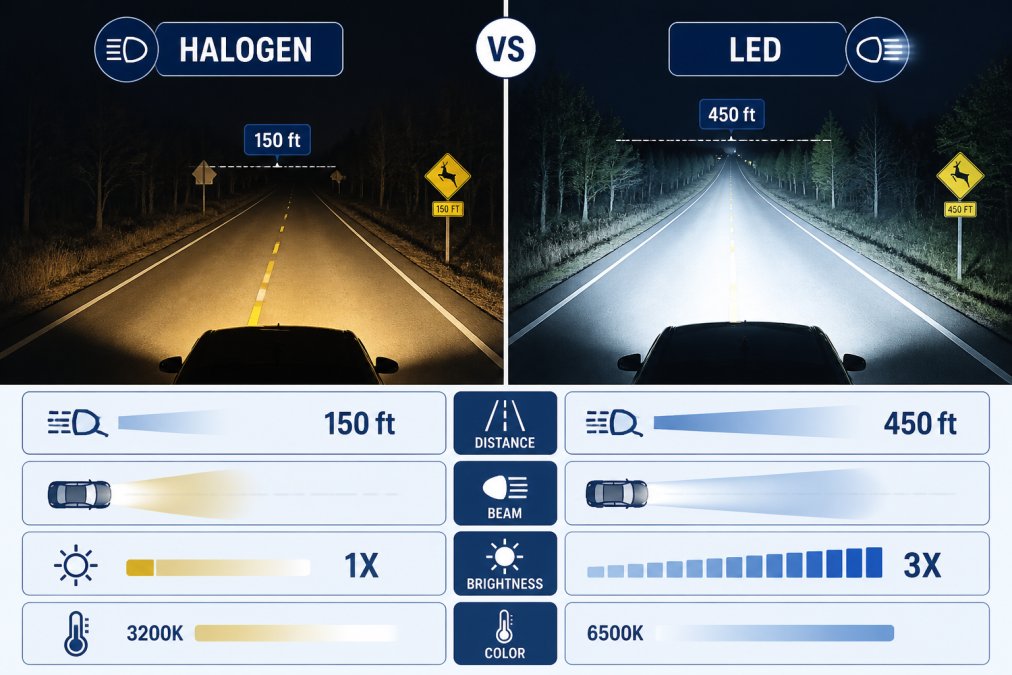
Halogen headlights typically produce 1,000-1,500 lumens per bulb. A quality LED kit produces 10,000-30,000 lumens per bulb set. The road ahead is brighter, details are clearer, and hazards appear sooner.
Halogen runs at roughly 3,000 Kelvin (warm yellowish light). LEDs typically run at 6,500 Kelvin (cool white light). The human eye perceives cool white as brighter even at the same lumen output. This is why LED conversions feel like such a dramatic upgrade.
Beam pattern is critical and often overlooked. A poorly designed LED in a halogen-era housing creates a scattered, unfocused beam. Proper beam pattern requires either LED-specific housings or precise optical design that accounts for how light reflects inside the halogen housing.
RMS Lighting LLC kits are designed to work in factory housings with correct beam patterns. The RMSH13GL62 - 90W 20K Lumens Canbus LED Bulb produces a 360° beam angle, ensuring consistent light distribution regardless of bulb orientation.
Energy Consumption and Long-Term Savings
A halogen bulb draws roughly 55 watts per bulb (110 watts for a pair). An LED draws 30-65 watts depending on the model. The RMS Lighting LLC RMSH4M2S - 60W LED Bulb draws 60 watts for the pair, roughly half the power of halogen for significantly more light output.
The bigger savings come from reduced replacement frequency. A halogen bulb lasts roughly 500-1,000 hours. An LED lasts 10,000-50,000 hours depending on quality. Over a decade, you're replacing halogen bulbs 10-20 times versus 1-2 times for LED. The total cost of ownership heavily favors LED, even expensive LED kits.
LED Headlight Conversion Kit Installation Guide: What You're Paying For
Installation complexity is one reason premium kits cost more. They're engineered to work with factory wiring and electronics, which requires more sophisticated design than a simple bulb swap.
Plug-and-Play vs. Custom Wiring
True plug-and-play means the LED bulb fits the factory socket, and the driver integrates seamlessly with your vehicle's electrical system. No rewiring, no modifications, no error codes.
Budget kits often claim plug-and-play but require external drivers mounted under the hood or behind the bumper. That's added complexity. RMS Lighting LLC's premium kits are designed for easy installation, ensuring you benefit from the latest in lighting technology. Installation takes minutes.
CANBUS Compatibility and Error Codes
Modern vehicles use CANBUS, a communication network that lets different electronic systems share information. When you install an LED that draws significantly less power than the halogen it replaces, the lighting system detects the change and triggers an error code.
CANBUS-compatible drivers solve this by including a load resistor or by communicating directly with the vehicle's computer. Premium drivers do this elegantly. The RMS Lighting LLC kits are CANBUS-compatible, meaning they work with modern vehicle electronics without error codes or hyper-flashing issues.
Safety Certifications and Flicker-Free Technology
A quality LED kit should carry relevant safety certifications. In the US market, look for UL listing or ETL certification. These indicate the product has been tested for electrical safety, thermal safety, and performance under real-world conditions.
Flicker refers to rapid on-off cycling of the LED. At high frequency (above 3,000 Hz), flicker is invisible to the human eye but can still cause eye strain. Some budget LEDs flicker at lower frequencies, creating a noticeable strobe effect that's distracting and potentially unsafe.
Premium LEDs use high-frequency drivers (typically 10,000+ Hz) that eliminate visible flicker. They also use multiple LED chips instead of a single high-power chip, which distributes heat and improves light consistency.
Upfront Cost vs. Total Cost of Ownership
The question "Are expensive LED kits worth the price?" can only be answered by looking at total cost, not just upfront cost.
Breaking Down the Price Difference
A budget LED kit costs $30-50 per bulb. A premium kit from RMS Lighting LLC costs $50-109 per bulb depending on the model. The upfront difference is $20-60 per bulb.
That gap reflects the cost of quality components. A CREE CSP3570 chip costs more than a generic chip. An active cooling fan adds cost. A sophisticated CANBUS-compatible driver adds cost. Rigorous testing and quality control add cost.
| Component | Budget Kit | Premium Kit |
|---|---|---|
| LED Chip | Generic semiconductor | CREE CSP3570 or CSP1860 |
| Heat Sink | Thin aluminum or plastic | Substantial aluminum with fins |
| Cooling | Passive only | Active cooling fan |
| Driver | Basic regulator | CANBUS-compatible with overvoltage protection |
| Testing | Minimal | Beam pattern and thermal testing |
| Warranty | 30-90 days | 1-2 years typical |
Warranty, Returns, and Peace of Mind
Budget kits often come with 30-90 day warranties. Premium kits typically offer 1-2 year warranties, and reputable manufacturers stand behind their products with hassle-free returns.
The RMS Lighting LLC team is available to help with installation questions, compatibility issues, and troubleshooting. That support has real value when diagnosing vehicle-specific issues. The peace of mind matters too. A premium kit that works reliably for 5+ years eliminates frustration from repeated failures and error codes.
Common Mistakes With Budget LED Kits
Understanding why cheap LED conversions fail helps you avoid them.
The most common mistake is assuming all LEDs are created equal. A 60-watt LED from a reputable manufacturer performs completely differently from a 60-watt LED from a no-name brand. The second mistake is ignoring CANBUS compatibility. Installing a non-CANBUS LED in a modern vehicle guarantees error codes. The third mistake is underestimating thermal stress. A bulb that works fine on the bench fails quickly in a sealed headlight housing. The fourth mistake is choosing based purely on lumen claims. A budget kit might claim 20,000 lumens, but if the driver throttles back due to heat, you're not getting what was advertised. The fifth mistake is trying to save money on installation. A professional installation ensures the kit is compatible with your specific vehicle and properly configured to avoid electrical issues.
Are expensive LED kits worth the price? Yes, but only if you're comparing them to budget kits that fail prematurely or create electrical problems. RMS Lighting LLC's premium kits cost more upfront because they use quality semiconductors like CREE chips, sophisticated thermal management with active cooling fans, and CANBUS-compatible drivers that eliminate error codes. Over 5-10 years of ownership, the superior lumen maintenance, reliability, and warranty coverage make the premium option significantly cheaper than replacing budget bulbs repeatedly. For drivers who value consistent visibility, safety, and hassle-free operation, the investment is justified. Learn more about RMS Lighting LLC's tested and verified LED solutions and experience the difference that precision-engineered lighting can make for your vehicle.
Frequently Asked Questions
Is there a real performance difference between cheap and expensive LED kits?
Yes. Expensive LED kits use premium CREE or CSP chips that maintain brightness longer, feature better thermal management with aluminum heat sinks and active cooling fans, and include reliable CANBUS drivers that prevent dashboard error codes. Budget kits often use generic semiconductors with poor heat dissipation, leading to premature dimming, overheating, and electrical failures. Premium kits also offer flicker-free operation and consistent color rendering, which affects both visibility and eye health during extended driving.
What safety risks come with low-quality LED headlight bulbs?
Cheap LED kits create several safety hazards: inconsistent beam patterns that scatter light instead of focusing it, causing reduced visibility for the driver; poor color rendering that impairs depth perception; hyper-flashing and dashboard error codes that distract from driving; and overheating that can damage vehicle wiring or cause bulb failure at critical moments. Additionally, budget kits often lack proper voltage regulation, creating voltage spikes that can harm other electrical components. Premium kits with UL certification and tested beam patterns eliminate these risks.
How does heat dissipation affect LED kit lifespan and performance?
Heat is the primary killer of LED performance. Quality kits use aluminum alloy heat sinks and active cooling fans to maintain operating temperatures between -40°C and +85°C, which preserves lumen maintenance and driver efficiency over years of use. Cheap kits without proper thermal management overheat quickly, causing the LED chips to dim, the driver to fail, and the entire bulb to burn out within months. Superior heat dissipation directly translates to longer lifespan, consistent brightness, and reliable performance in all weather conditions.
Are expensive LED kits worth the investment for older vehicles?
For older vehicles, expensive LED kits are often the better choice because they're engineered for compatibility with aging electrical systems. Premium CANBUS kits regulate voltage across 9-32V ranges, preventing the error codes and hyper-flashing common with budget options on vintage wiring. Older housings also benefit from better beam pattern control, which premium kits provide through precise optics and driver design. The upfront cost is offset by avoiding multiple replacements, electrical damage, and the frustration of dashboard warnings that budget kits frequently cause.
This article was written using GrandRanker