

Avoiding Headlight Glare From Oncoming Traffic

Table of Contents
- Understanding Headlight Glare and Why It Happens
- Techniques for Shifting Your Gaze to Avoid Oncoming Glare
- Adjusting Your Rearview and Side Mirrors for Night Driving
- Maintaining a Clean Windshield to Reduce Glare
- Night Driving Glasses for Glare: What Actually Works
- Best Practices for Night Driving Safety Beyond Glare
- Upgrading Your Vehicle's Lighting to Improve Your Own Visibility
- Conclusion
Last Updated: August 15, 2026
Understanding Headlight Glare and Why It Happens
Headlight glare from oncoming traffic occurs when bright light enters your eyes directly or reflects off surfaces inside your vehicle, temporarily overwhelming your vision. Your pupils dilate at night to gather more light, making them more sensitive to sudden bright sources. When an oncoming vehicle with high-beam headlights approaches, the contrast between the dark road and intense light creates a physiological response lasting several seconds.
Modern LED and HID bulbs produce brighter, more concentrated light patterns than older halogen bulbs. While these improve visibility for the driver using them, they create significant challenges for oncoming drivers. Your windshield also plays a role, dust, film buildup, and scratches scatter light unpredictably, making glare worse even when headlights aren't particularly bright.
The issue isn't simply about brightness; it's about contrast, angle, and how your eyes respond to sudden light intensity changes. Night driving safety depends on maintaining your ability to see the road while protecting yourself from these temporary vision disruptions.
Techniques for Shifting Your Gaze to Avoid Oncoming Glare
The most effective immediate technique is to shift your gaze away from the direct beam of oncoming headlights toward the right edge of the road. Focus on the white line marking the right shoulder or the roadside itself. This keeps your central vision away from the bright source while maintaining awareness of the road ahead through peripheral vision.
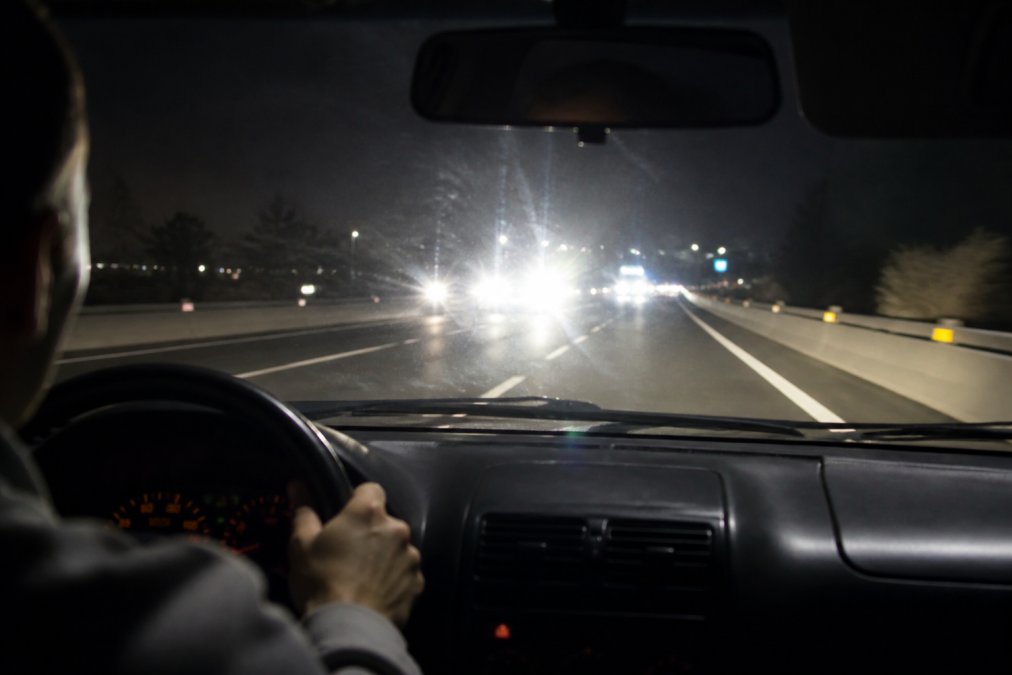
This technique works because peripheral vision is more tolerant of bright light than central vision. Your peripheral retina contains more rod cells, sensitive to light but less affected by glare. By using this area to track road position while your central vision focuses on the shoulder line, you maintain steering control without experiencing full glare impact.
Begin shifting your gaze when you first detect oncoming headlights on the horizon, not when the vehicle is close. This gives your eyes time to adjust and prevents sudden glare shock. As the vehicle passes, gradually return your gaze to center, allowing your pupils to readjust to the darker road ahead.
Many drivers mistakenly look down at the road surface directly in front of their vehicle. While this reduces glare exposure, it severely limits your ability to see obstacles, lane markings, and curves ahead. The right-edge focus maintains both safety and comfort.
Adjusting Your Rearview and Side Mirrors for Night Driving
Your rearview mirror can become a secondary glare source from vehicles behind you. Most modern vehicles include an auto-dimming rearview mirror that reduces bright light reflection automatically. If your vehicle lacks this feature, manually adjust the mirror's angle slightly downward or to the side during night driving to redirect the brightest reflections away from your direct line of sight.
Side mirrors require similar attention. Position them to show the adjacent lane without reflecting oncoming traffic directly into your peripheral vision. The optimal position shows approximately one-quarter of your vehicle's side in the mirror, with the rest showing the adjacent lane. This balance provides both glare reduction and safety awareness.
Mirror adjustment is often overlooked as a night driving consideration, yet mirrors are one of the few glare sources you can control immediately without equipment changes. Taking 30 seconds to adjust them before a night drive can noticeably reduce fatigue from repeated glare exposure.
Maintaining a Clean Windshield to Reduce Glare
A clean windshield is one of the most underrated defenses against headlight glare. Dust, pollen, bug residue, and film buildup scatter incoming light in multiple directions, creating a halo effect that's often more uncomfortable than direct light itself.
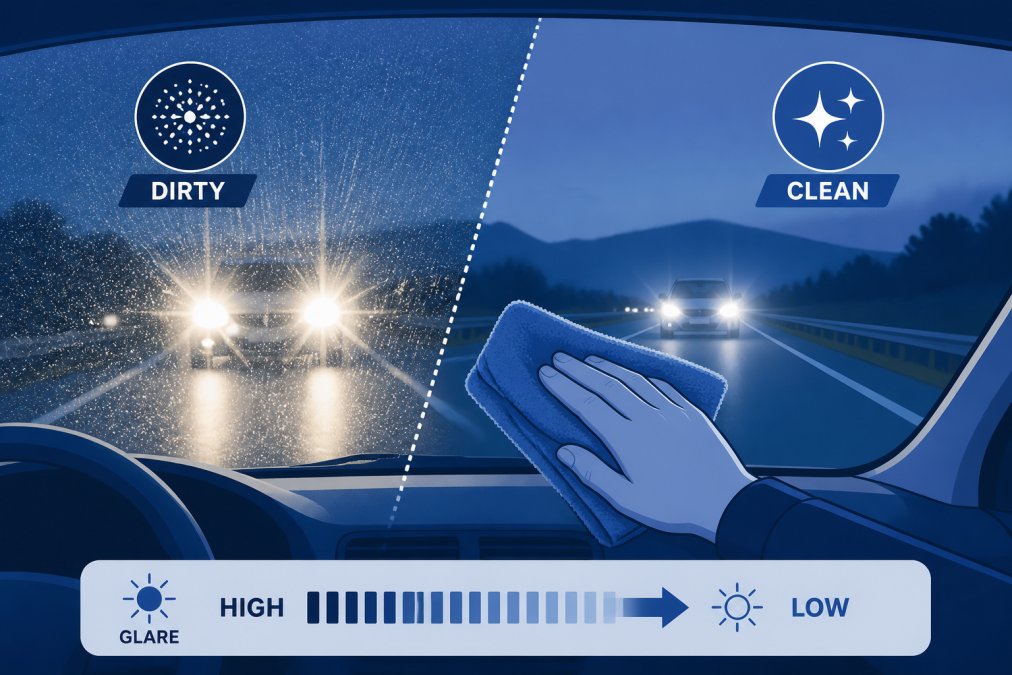
Clean your windshield every 5-7 days during regular driving, more frequently during significant night driving. Use a microfiber cloth with automotive glass cleaner to remove film buildup that water alone won't address. Pay particular attention to the inside of the windshield, where interior dust and dashboard off-gassing create a film that scatters light from oncoming headlights.
The interior surface is often dirtier than the exterior, yet many drivers neglect it. This interior film acts like a diffuser, spreading oncoming light across your field of vision. Cleaning it weekly can reduce glare perception by 20-30 percent. Use vertical strokes to avoid creating streaks that catch light.
Replace windshield wipers every 6-12 months, or more often if you drive frequently at night. Worn blades leave streaks and residue that scatter light. Invest in premium windshield washer fluid that includes anti-film agents rather than budget formulas that leave buildup.
Consider a windshield treatment product designed to reduce glare and improve water beading. These products create a hydrophobic coating that helps water and debris run off rather than settling on the glass. Application takes 15-20 minutes and typically lasts 3-6 months.
Night Driving Glasses for Glare: What Actually Works
Night driving glasses come in several types with different effectiveness levels. Anti-reflective coated lenses reduce light reflection off the lens surface itself, helping with interior light sources but having minimal effect on oncoming headlights. Polarized lenses reduce glare from reflective surfaces like water and wet pavement, but they can interfere with LCD displays and may reduce contrast on dark roads.
Yellow or amber-tinted lenses increase contrast and reduce blue light, which can help with eye strain during long night drives. However, they don't directly address bright oncoming headlights and may reduce your ability to see dimly lit road areas.
The most effective approach combines multiple strategies rather than relying on glasses alone. If you wear night driving glasses, look for those with anti-reflective coating on the back surface. Avoid heavily tinted lenses that reduce overall light transmission, your eyes need maximum available light at night.
Prescription eyewear wearers should ensure their glasses are optimized for night driving. Ask your optometrist about anti-reflective coatings and lens materials that reduce glare. If you've had LASIK or refractive surgery, discuss any increased glare sensitivity with your eye care provider.
Night driving glasses are a supplement to proper technique and vehicle maintenance, not a replacement. Start with fundamentals, clean glass, proper mirror positioning, and gaze-shifting technique, before investing in specialized eyewear.
Best Practices for Night Driving Safety Beyond Glare
Reduce your overall speed during night driving, especially on unfamiliar roads. Your visibility is reduced by 50 percent or more compared to daytime. Speed reduction gives you more time to react to obstacles and oncoming vehicles.
Increase your following distance behind other vehicles. Maintain a 4-second following distance at night, compared to 2-3 seconds during the day. Count the seconds between when the vehicle ahead passes a fixed point and when you reach that same point.
Keep your headlights on low beam when following other vehicles or when oncoming traffic is present. Switch to high beams only on empty roads with no oncoming or forward traffic. Many modern vehicles have automatic high-beam systems that switch based on oncoming traffic detection.
Avoid looking at oncoming high beams even briefly. The afterimage can persist for several seconds, temporarily reducing your vision. Train yourself to automatically shift your gaze to the road edge when you detect oncoming headlights.
Take breaks during long night drives. Eye fatigue from repeated glare exposure and reduced visibility contributes to slower reaction times and reduced alertness. Stop every 2 hours for a 15-minute break.
Upgrading Your Vehicle's Lighting to Improve Your Own Visibility
Better headlights on your own vehicle directly improve your ability to see the road and obstacles ahead, reducing your reliance on gaze-shifting and other glare-avoidance techniques. Modern LED headlights provide significantly better visibility than older halogen bulbs while producing a more focused beam pattern less likely to create glare for oncoming drivers when properly aimed.
If your vehicle uses factory halogen bulbs, upgrading to quality LED conversion kits can transform your night driving experience.
RMS Lighting LLC offers precision-engineered LED headlight conversion kits designed for vehicles ranging from classic cars to modern trucks. Their conversion kits maintain the original factory appearance while delivering the visibility benefits of modern LED technology. The RMS3303PRO 7" Round Headlight Conversion Kit and RMS3307PRO 5x7" Large Square Headlight Conversion Kit are engineered with correct LHD lens patterns and mini projector LED bulbs rated at 10,000 lumens, ensuring maximum visibility without creating excessive glare for oncoming traffic.


The key advantage of professional conversion kits over simple bulb replacements is beam pattern control. A proper LED conversion maintains the correct light distribution pattern, concentrated on the road ahead with controlled cutoff at the top to minimize upward scatter. Budget LED bulbs often produce scattered light patterns that create more glare than the original halogen setup.
When upgrading your headlights, ensure the conversion kit is properly aimed. Misaligned headlights create glare for oncoming drivers regardless of brightness. Have your headlights professionally aimed after installation, or follow the manufacturer's aiming instructions carefully. Proper aiming takes 15-30 minutes and makes a significant difference in both your visibility and your responsibility to other drivers.
Conclusion
Avoiding headlight glare from oncoming traffic requires a multi-layered approach rather than a single solution. Start with fundamentals: maintain a clean windshield, adjust your mirrors properly, and master the gaze-shifting technique of focusing on the right road edge when oncoming headlights approach. These three steps alone will reduce glare-related fatigue significantly.
For drivers ready to upgrade their own visibility, RMS Lighting LLC's LED headlight conversion kits deliver the precision-engineered performance that transforms night driving. Their kits feature correct LHD lens patterns and 10,000-lumen mini projector LED bulbs, ensuring you see the road clearly while maintaining proper beam control for oncoming traffic. Combined with proper technique and windshield maintenance, a quality headlight upgrade makes night driving safer and more comfortable for everyone on the road. Learn more about RMS Lighting LLC's conversion options and find the right kit for your vehicle.
Frequently Asked Questions
How do you avoid being blinded by oncoming headlights at night?
The most effective technique is to shift your gaze to the right edge of your lane or the right white line rather than staring directly at oncoming headlight glare. This allows your eyes to track the road while avoiding the most intense light. Additionally, slightly reduce speed when approaching vehicles with high-intensity LED or HID headlights, adjust your rearview mirror to the night position, and ensure your windshield is clean. If glare persists, consider anti-reflective coatings on your glasses or upgrading to LED conversion kits that provide better road illumination for your own visibility.
Do night driving glasses for glare actually help?
Night driving glasses with anti-reflective coatings can reduce glare by minimizing light scattering off the lens surface, though their effectiveness varies by individual. Glasses with slight yellow or amber tints may improve contrast sensitivity, making road markings and lane positioning clearer in low-light conditions. However, they work best when combined with other techniques like proper gaze management and mirror adjustment. For drivers with astigmatism or significant refractive errors, prescription night driving glasses are more effective than over-the-counter options. Results depend on lens quality and your specific visual needs.
Why are modern LED headlights so bright to other drivers?
Modern LED and HID headlights produce significantly more lumens than traditional halogen bulbs, creating intense light output that can overwhelm oncoming drivers' pupils during dilation at night. LEDs also emit light at higher color temperatures (cooler, bluer light) which scatters more in the atmosphere and off windshields, increasing glare perception. Additionally, many aftermarket LED conversions use improper beam patterns or lack the precision lens design found in factory projector housings, causing light to scatter unpredictably. Properly engineered LED conversion kits with correct lens patterns and projector technology minimize this effect while improving the installing driver's own visibility.
What's the best way to clean a windshield to reduce glare?
Clean your windshield with a microfiber cloth and automotive glass cleaner designed to remove road film, dust, and mineral deposits that scatter light. Wipe in one direction on the outside and the opposite direction on the inside to avoid streaks that amplify glare. Use distilled water when possible to prevent mineral buildup. Clean both the inside and outside surfaces, interior dust and condensation are often overlooked causes of glare. For best results, clean your windshield weekly during night driving season, and consider applying an anti-reflective or hydrophobic coating that reduces light scattering and improves contrast sensitivity at night.
This article was written using GrandRanker