

Premium LED Headlight Conversion Kits: 2026 Buyer's Guide

Table of Contents
- What Makes a Premium LED Headlight Conversion Kit Different
- Top LED Headlight Conversion Kits for Classic Vehicles
- How to Install LED Headlight Conversion Kit: Step-by-Step
- DOT Compliance for LED Headlights: Legal Requirements
- CANbus LED Decoder Installation and Flickering Solutions
- Brightness, Beam Pattern, and Heat Management
- Comparison Table: Kit Features and Pricing
- Which LED Conversion Kit Should You Choose?
Last Updated: August 13, 2026
What Makes a Premium LED Headlight Conversion Kit Different
A premium LED headlight conversion kit replaces factory halogen sealed beams with modern LED optics and high-output bulbs, delivering dramatically improved nighttime visibility while maintaining original factory appearance. Premium kits differ from budget alternatives in three core areas: optical precision, thermal management, and component durability.
Premium kits use OE-spec glass lenses engineered for LED bulbs, producing clean beam patterns with sharp cutoff lines that improve visibility without blinding oncoming drivers. Budget kits often use plastic housings or mismatched optics designed for halogen filaments, scattering light inefficiently.
Heat management separates premium from mediocre. High-output LED bulbs generate significant thermal energy. Premium kits feature active cooling fans paired with aluminum alloy heat sinks that maintain optimal operating temperatures, extending bulb lifespan and preventing flickering issues.
RMS Lighting LLC specializes in premium conversion kits with rotating bulb bases for precise beam alignment, built-in CANBUS electronics to prevent dashboard error codes, and waterproof housings rated IP68.
Top LED Headlight Conversion Kits for Classic Vehicles
7-Inch Round Gen2 Kit: 30,000 Lumens
The RMS3321S130 7" Round Gen2 Kit delivers 30,000 lumens per bulb using premium CSP3570 LED chips, representing a 3-4x improvement over factory halogen sealed beams.

The kit includes two 65-watt LED bulbs at 6500K paired with OE-spec glass housings. The 360-degree adjustable beam angle and rotating bulb base allow precise alignment. Built-in CANBUS electronics eliminate dashboard error codes, while active cooling maintains performance from -40°C to +85°C. Installation is plug-and-play with H4 connectors. The 3-year warranty reflects confidence in component longevity. At $239.00 per kit, this suits owners seeking maximum brightness without quad headlight complexity.
5x7 Large Square Gen2 Kit: 30,000 Lumens
The RMS3322S130 5x7 Large Square Gen2 Kit delivers identical 30,000-lumen output in rectangular housings for Mazda RX-7s, Toyota Corollas, and older Chevrolet trucks.

The key differentiator is beam pattern accuracy. RMS Lighting LLC specifies Left-Hand Drive (LHD) lens patterns for North American drivers, ensuring correct beam cutoff alignment. The kit includes two glass housings with reflective backgrounds and bulb covers, maintaining factory aesthetics. The rotating bulb base and adjustable beam angle enable fine-tuning after installation. CANBUS electronics prevent dashboard warnings. At $239.00, this matches 7-inch round pricing while delivering superior light distribution for rectangular housings.
4x6 Small Square Gen2 Kit: 15,000 Lumens
Quad headlight systems use four smaller 4x6 sealed beams. The RMS3323S130 4x6 Small Square Gen2 Kit includes four housings and four 15,000-lumen bulbs, delivering 60,000 lumens total.

The kit includes plug-and-play harness adapters converting H4 3-prong connectors to factory 2-prong high beam connectors, preventing lamp-out indicator errors. The 4x6 format appears on 1979-1986 Ford Mustang Fox Bodies, full-size GM models, Chevrolet Camaros, Pontiac Firebirds, and 1973-1987 Chevrolet and GMC square body trucks. At $299.00 for the complete quad set, the per-bulb cost is reasonable. RMS Lighting LLC recommends specifying your vehicle's year, make, and model during ordering to ensure correct fitment.
Budget-Friendly 10,000-Lumen Options
The RMS3321M2S 7" Round Gen2 Kit with 10,000 Lumens and RMS3322M2S 5x7 Large Square Gen2 Kit with 10,000 Lumens deliver meaningful visibility improvements at lower price points.
These kits use 50-watt bulbs with 6 CSP CREE 1860 LED chips, producing roughly 10,000 lumens per bulb, a 2-3x improvement over factory halogen sealed beams. The 7-inch round and 5x7 large square versions cost $179.00 each. The 4x6 quad option at $269.00 remains a solid value for four-headlight systems. All include 2-year warranties. OE-spec glass lenses and rotating bulb bases remain standard across all RMS Lighting LLC kits, ensuring beam quality isn't compromised at lower price tiers.
| Kit Type | Lumens Per Bulb | Wattage | Price | Best For |
|---|---|---|---|---|
| 7" Round Gen2 (30K) | 30,000 | 65W | $239 | Maximum brightness, rural/highway driving |
| 5x7 Large Square Gen2 (30K) | 30,000 | 65W | $239 | RX-7s, Corollas, older Chevys |
| 4x6 Small Square Gen2 (15K) | 15,000 | 65W | $299 | Quad headlight systems (4 total) |
| 7" Round Gen2 (10K) | 10,000 | 50W | $179 | Budget-conscious owners, urban driving |
| 5x7 Large Square Gen2 (10K) | 10,000 | 50W | $179 | Cost-effective rectangular housings |
| 4x6 Quad Gen2 (10K) | 10,000 | 50W | $269 | Budget quad systems |
How to Install LED Headlight Conversion Kit: Step-by-Step
What You'll Need Before Starting
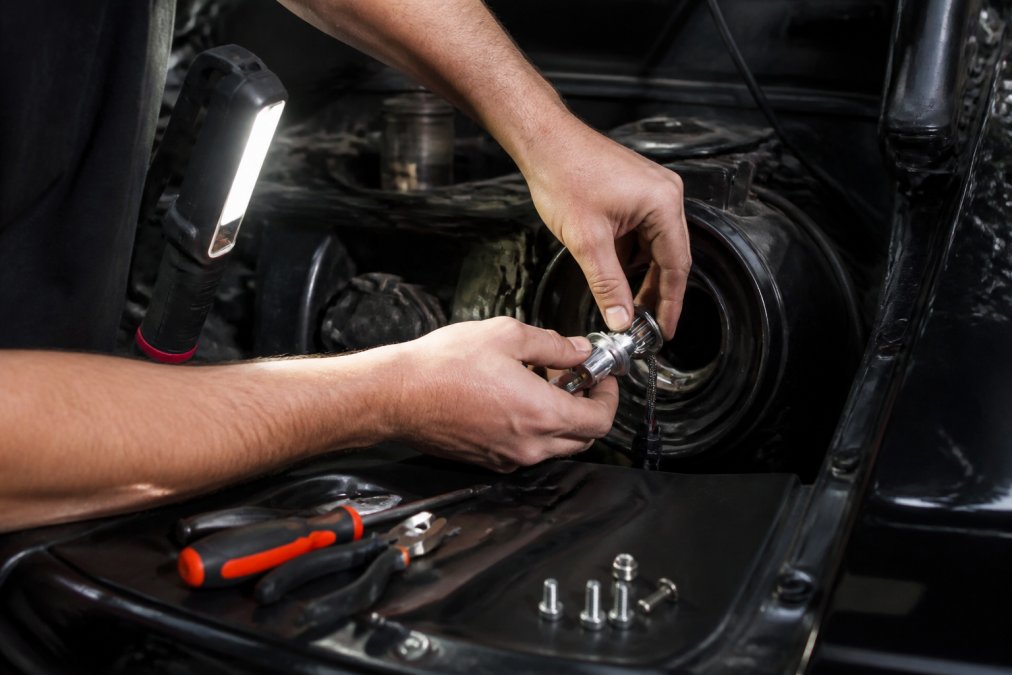
Gather these items before beginning installation: your LED headlight conversion kit, flathead and Phillips screwdrivers, socket set (10mm and 13mm sockets typical), flashlight or work light, panel removal tools, masking tape and marker, small container for fasteners, vehicle service manual for your year, make, and model, and electrical tape.
Most installations take 45 minutes to 2 hours per headlight. Quad systems take proportionally longer.
Installation Process
Step 1: Disconnect the Battery (2 minutes)
Disconnect the negative battery terminal to prevent electrical shorts. Wait 30 seconds for residual charge to dissipate.
Step 2: Remove the Headlight Trim and Bezel (5-10 minutes)
Remove trim rings or bezels held by screws or clips. Label each fastener with masking tape for correct reinstallation.
Step 3: Disconnect the Factory Headlight Connector (2 minutes)
Gently pull the factory sealed beam connector straight back. Some connectors require a release tab or clip to be unlatched. Do not force the connection.
Step 4: Remove the Factory Sealed Beam (2 minutes)
Rotate the retaining ring counterclockwise until the beam pops free. Some vehicles use screws instead. Check your service manual if unsure.
Step 5: Insert the New LED Housing (3 minutes)
Align the new LED housing with the mounting hole and push straight in until fully seated. Rotate the retaining ring clockwise to lock it in place.
Step 6: Connect the LED Bulb Connector (1 minute)
Plug the LED bulb connector into the factory wiring harness. If your kit includes harness adapters, connect the adapter first, then plug the LED bulb into the adapter.
Step 7: Adjust the Beam Pattern (5 minutes)
Start the vehicle and turn on headlights. Aim the beam at a wall or garage door about 25 feet away. The cutoff line should be horizontal and centered. Locate the rotating bulb base inside the housing and rotate it clockwise or counterclockwise in small increments until the beam aligns correctly.
Step 8: Reinstall Trim and Bezels (5 minutes)
Reinstall the trim ring, bezel, and fasteners. Ensure everything is tight and sits flush.
Step 9: Test All Functions (3 minutes)
Turn on low beam, high beam, and parking lights. Verify all functions work correctly and check for dashboard warning lights.
Step 10: Reconnect the Battery (1 minute)
Reconnect the negative battery terminal. Start the vehicle and verify headlights operate normally. Take a short test drive to confirm beam pattern and visibility improvements.
Common Installation Mistakes to Avoid
Mistake 1: Over-tightening the Retaining Ring
Excessive force can crack the housing or strip threads. Tighten until snug, then stop.
Mistake 2: Skipping the Beam Alignment Step
Factory headlight buckets vary in depth and angle. A 5-minute alignment adjustment ensures the cutoff line sits exactly where it should, maximizing visibility and minimizing glare.
Mistake 3: Forcing Connectors
If a connector feels stuck, stop and inspect it. Forcing a misaligned connector damages pins and creates intermittent electrical faults.
Mistake 4: Installing Without Disconnecting the Battery
Always disconnect the negative terminal first to prevent accidental shorts.
Mistake 5: Ignoring the Service Manual
Headlight access differs significantly across vehicles. Your service manual shows the correct procedure for your specific year, make, and model.
DOT Compliance for LED Headlights: Legal Requirements
LED headlight conversion kits occupy a gray area in automotive regulations. The Department of Transportation (DOT) and Federal Motor Vehicle Safety Standards (FMVSS) establish requirements for headlight output, beam pattern, and color temperature. Factory LED headlights are engineered to meet FMVSS 108, which specifies beam pattern, cutoff line sharpness, color temperature (2700K to 6000K), and glare limits. Aftermarket conversion kits are not subject to the same certification process.
In most states, using a conversion kit on public roads is technically prohibited if not DOT-certified. However, enforcement is inconsistent, focusing on functional safety, whether the beam pattern is safe and doesn't blind oncoming drivers, rather than certification status.
Focus on beam pattern quality and cutoff line sharpness rather than certification claims. A well-engineered kit with proper optics and a sharp cutoff is functionally safer than a poorly designed kit. RMS Lighting LLC kits are engineered with OE-spec glass lenses and rotating bulb bases specifically to achieve the beam control that meets FMVSS standards.
Color temperature matters legally. Most FMVSS regulations specify a maximum of 6000K. RMS Lighting LLC kits operate at 6500K, slightly above the DOT limit but consistent with modern OEM LED headlights. Practical enforcement focuses on whether light appears excessively blue rather than precise kelvin measurements.
CANbus LED Decoder Installation and Flickering Solutions
CANbus (Controller Area Network bus) is the communication protocol connecting your vehicle's electronic modules. When installing an aftermarket LED bulb in a vehicle designed for halogen filaments, electrical characteristics change. The vehicle's computer detects this mismatch and triggers error codes or causes flickering.
This happens because halogen and LED bulbs draw different power amounts and produce different electrical signatures. The vehicle's onboard diagnostic system sees the LED as a fault and cycles power to the bulb, creating flickering.
Premium LED bulbs include a built-in CANBUS decoder that mimics halogen bulb electrical characteristics, tricking the vehicle's computer into accepting the LED as normal. This prevents error codes and eliminates flickering.
RMS Lighting LLC's premium LED bulbs, RMSH4S130, RMSH7S130, RMSH11S130, and RMSH13S130, all feature premium CANBUS design with active cooling fans and aluminum alloy housings.
If flickering occurs after installation, verify the bulb connector is fully seated and the wiring harness is intact. If flickering persists, the CANBUS decoder may have encountered a vehicle-specific electrical configuration requiring a separate decoder module. Budget CANBUS bulbs use basic decoders working on most vehicles but failing on others. Premium CANBUS designs use sophisticated electronics handling a wider range of vehicle electrical systems, which is why premium kits rarely produce error codes.
Brightness, Beam Pattern, and Heat Management
Brightness is measured in lumens, quantifying total light emitted. A 30,000-lumen LED bulb produces roughly 3-4 times more light than a factory 7,500-lumen halogen sealed beam, dramatically improving nighttime visibility on unlit rural roads.
However, raw lumens alone don't determine visibility. Beam pattern matters equally. Poorly designed beams scatter light in all directions, reducing effective visibility while creating glare. Well-engineered beams concentrate light on the road surface with sharp cutoff lines preventing light projection above the horizon.
RMS Lighting LLC kits use OE-spec glass lenses engineered for LED optics, producing clean beam patterns with defined cutoff lines matching factory OEM performance. The rotating bulb base allows fine-tuning beam angle after installation to account for headlight bucket depth variations.
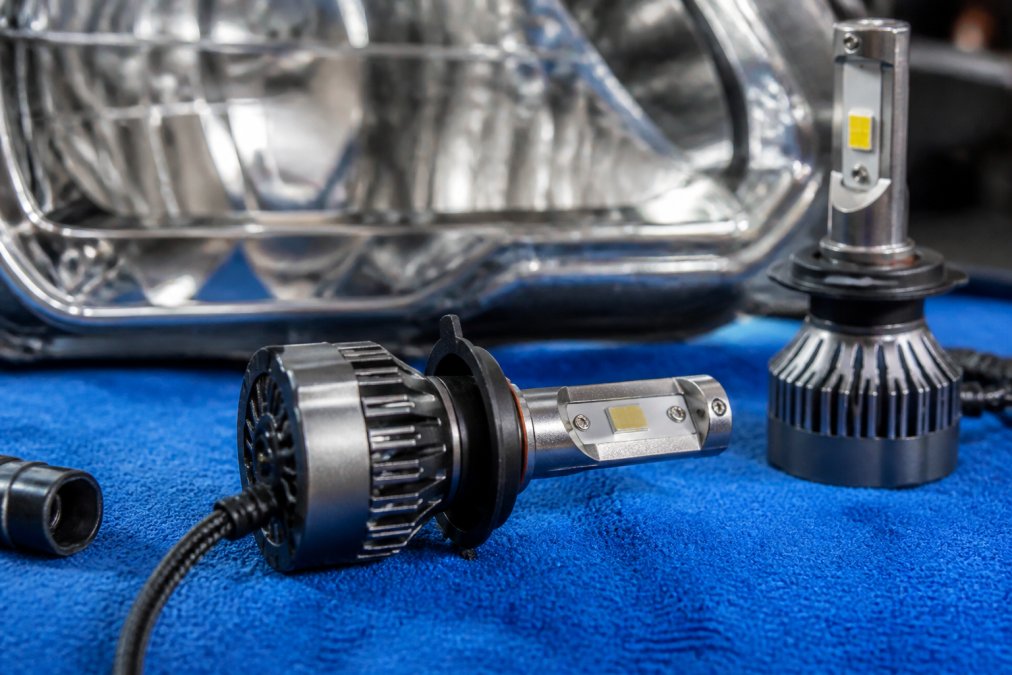
Heat management determines LED bulb lifespan and reliability. LED chips generate significant thermal energy. Inefficient heat dissipation degrades internal electronics, causing premature failure.
Premium LED bulbs use active cooling fans paired with aluminum alloy heat sinks. The fan draws air across heat sink fins, removing thermal energy continuously. Budget LED bulbs rely on passive cooling without fans, which struggles in hot weather. A passive-cooled LED bulb in a 100-degree summer engine bay may reach 85-90 degrees Celsius, degrading components and reducing lifespan from five years to two years.
RMS Lighting LLC bulbs operate across -40°C to +85°C, ensuring reliable performance from cold winters to hot summers. The active cooling fan runs continuously when the headlight is on, maintaining thermal stability regardless of ambient conditions. Wattage indicates power consumption. RMS Lighting LLC's 65-watt LED bulbs consume roughly the same power as factory halogen sealed beams, preventing electrical system strain.
Comparison Table: Kit Features and Pricing
| Model | Lumens | Wattage | Housing Type | Warranty | Price | Best For |
|---|---|---|---|---|---|---|
| RMS3321S130 7" Round 30K | 30,000 | 65W | OE Glass | 3 years | $239 | Maximum brightness, 7" sealed beams |
| RMS3322S130 5x7 Large Square 30K | 30,000 | 65W | OE Glass | 3 years | $239 | RX-7s, Corollas, rectangular housings |
| RMS3323S130 4x6 Small Square 15K | 15,000 | 65W | OE Glass | 3 years | $299 | Quad headlight systems (4 total) |
| RMS3321M2S 7" Round 10K | 10,000 | 50W | OE Glass | 2 years | $179 | Budget-conscious, urban driving |
| RMS3322M2S 5x7 Large Square 10K | 10,000 | 50W | OE Glass | 2 years | $179 | Cost-effective rectangular housings |
| RMS3323M2S 4x6 Small Square 10K | 10,000 | 50W | OE Glass | 2 years | $269 | Budget quad systems |
Which LED Conversion Kit Should You Choose?
The right choice depends on three factors: your vehicle's headlight format, budget, and driving patterns.
If your vehicle has 7-inch or 5x7-inch sealed beams and you drive primarily on unlit rural roads or highways, the 30,000-lumen kits justify the $239 investment. The brightness improvement is transformative, and the 3-year warranty reflects premium component longevity.
If you drive mostly on well-lit urban roads or prioritize cost savings, the 10,000-lumen options at $179 deliver meaningful visibility improvements without the premium price. You'll still see a 2-3x brightness increase over factory halogen sealed beams.
Quad headlight systems require either the $299 30,000-lumen kit or the $269 10,000-lumen kit depending on brightness needs. Verify your vehicle's headlight format before ordering.
The rotating bulb base is worth more than the lumen difference between tiers. A properly aligned 10,000-lumen beam outperforms a misaligned 30,000-lumen beam. Spend 5 minutes on alignment after installation.
RMS Lighting LLC kits include plug-and-play installation, OE-spec glass lenses, built-in CANBUS electronics, and active cooling fans across all tiers. Primary differences are brightness output and warranty length. For most classic car owners, the 7-inch or 5x7-inch 30,000-lumen kits represent the best balance of brightness, beam quality, and long-term reliability.
Upgrading factory halogen sealed beams with a premium LED headlight conversion kit transforms nighttime driving. The challenge isn't finding a kit, it's choosing one engineered with proper optics, thermal management, and CANBUS compatibility. RMS Lighting LLC kits address each requirement with OE-spec glass lenses, active cooling fans, and rotating bulb bases ensuring professional-quality beam alignment. Whether you prioritize maximum brightness or cost-effective visibility improvements, the right kit exists for your vehicle and budget. Start with your headlight format, verify compatibility with your vehicle's year and make, and invest in a kit with proper heat dissipation and CANBUS electronics. Your nighttime visibility and safety depend on it.
Frequently Asked Questions
Are LED headlight conversion kits legal for street use?
LED headlight conversion kits are legal when they meet DOT standards and maintain proper beam patterns with a defined cutoff line. Premium kits with OE-spec glass lenses and correct Left-Hand Drive (LHD) optics comply with federal motor vehicle safety standards. Cheap kits using plastic housings or Right-Hand Drive patterns often fail DOT requirements and create excessive glare, which is illegal on public roads.
Will your LED conversion kit cause CANbus errors or flickering?
Premium LED conversion kits like RMS Lighting's feature built-in CANbus drivers and active cooling fans that eliminate flickering and error codes. Budget kits often lack proper CANbus electronics, triggering dashboard warnings and hyper-flashing. If you experience issues, a CANbus LED decoder can resolve them by managing the communication between the LED bulbs and your vehicle's onboard computer system.
How do I know if an LED conversion kit will fit my vehicle?
LED conversion kits are designed for specific sealed beam sizes: 7-inch round, 5x7 large square, or 4x6 small square. Check your vehicle's original headlight housing dimensions and match them to the kit size. Contact the manufacturer before ordering with your vehicle's year, make, and model to confirm fitment. Premium kits include detailed compatibility lists for popular classic vehicles.
What's the difference between a cheap and premium LED conversion kit?
Premium kits feature OE-spec glass lenses that resist yellowing, correct LHD beam patterns for nighttime visibility, active cooling systems, built-in CANbus drivers, and higher lumen output (30,000 lumens vs. 10,000). They deliver sharper cutoff lines, proper filament alignment, and durability warranties. Cheap kits use plastic housings, inferior optics, and lack thermal management, resulting in poor beam patterns and early failure.
How much brighter are LED headlights compared to halogen?
Premium LED conversion kits deliver 30,000 lumens compared to traditional halogen bulbs at 1,000-1,500 lumens, providing 15-20 times more light output. This dramatic increase in brightness improves nighttime visibility significantly. The 6500K cool white color temperature also enhances contrast and road detail, making it easier to spot obstacles and oncoming traffic at distance.
This article was written using GrandRanker