


How to Choose Reliable LED Headlights: 2026 Guide

Table of Contents
- Understanding Bulb Size and Fitment for LED Headlights
- LED Headlight Color Temperature Guide: What 4300K, 6000K, and 6500K Mean
- Beam Pattern Accuracy and Light Distribution
- Projector vs. Reflector Housing: Which Works With LED Upgrades
- CANbus LED Headlight Error Codes and Compatibility
- How to Install LED Headlight Bulbs: Step-by-Step Process
- DOT Compliance for LED Headlights and Legal Considerations
- Heat Management, Lifespan, and Durability
Last Updated: August 14, 2026
Understanding Bulb Size and Fitment for LED Headlights
Choosing reliable LED headlights starts with understanding your vehicle's bulb socket type. Common designations include H4, H7, H11, H13, 9004, and 9007, and this fitment determines compatibility. Installing an LED bulb into the wrong socket won't work and can damage your vehicle's electrical system.
Your owner's manual lists the exact bulb type required. If unavailable, the socket type is usually printed on the bulb itself or visible inside the headlight housing. H4 bulbs are common in classic vehicles and imports, H7 in European models, and H11 in newer domestic trucks and SUVs. The RMS Lighting LLC team has tested LED conversion kits across all major socket types to ensure proper fitment without modification.

Consider the physical space inside your headlight housing as well. Some LED designs are more compact than others, and older reflector housings have less clearance than modern projector housings. Premium LED bulbs are engineered to mount at the exact focal point that halogen bulbs occupy, preserving the light distribution your vehicle's optics were designed for. Fitment also affects heat management; a bulb that's too large may trap heat against the housing, while one that's too small might not dissipate heat efficiently.
| Bulb Type | Common Vehicles | Socket Diameter | Typical Power |
|---|---|---|---|
| H4 | Classic imports, older trucks | 51mm | 60-130W |
| H7 | European models, luxury sedans | 45mm | 55-130W |
| H11 | Modern trucks, SUVs | 39mm | 55-130W |
| H13 | Full-size American trucks | 51mm | 60-130W |
| 9004 | Older domestic vehicles | 51mm | 60-130W |
LED Headlight Color Temperature Guide: What 4300K, 6000K, and 6500K Mean
Color temperature, measured in Kelvin, describes the color of light your LED headlights produce and directly affects visibility and how other drivers perceive your vehicle.
4300K produces a warm, yellowish light that closely mimics halogen bulbs and offers excellent visibility in rain, fog, and snow because warm tones penetrate moisture better than cooler light. It's also the most legally compliant option in most jurisdictions.
6000K produces a bright, neutral white light that sits in the middle ground. It's noticeably brighter than 4300K while maintaining good wet-weather performance, and many drivers prefer it for enhanced nighttime visibility without excessive glare.
6500K produces a cool, bluish-white light that maximizes perceived brightness and is popular among enthusiasts. However, it can cause more glare for oncoming drivers and performs worse in heavy rain or fog. The RMS Lighting LLC 130W CANBUS LED bulbs come standard in 6500K, offering maximum visibility for clear-weather driving and excellent road presence.
The relationship between color temperature and beam pattern matters enormously. A bright 6500K bulb in a poorly-designed housing will scatter light and blind oncoming traffic. The same bulb in a properly-engineered projector housing will create a sharp cut-off line that illuminates the road without spilling into the opposite lane. Most jurisdictions allow 6000K and below without modification, but 6500K sits in a gray area depending on your state's regulations.
Beam Pattern Accuracy and Light Distribution
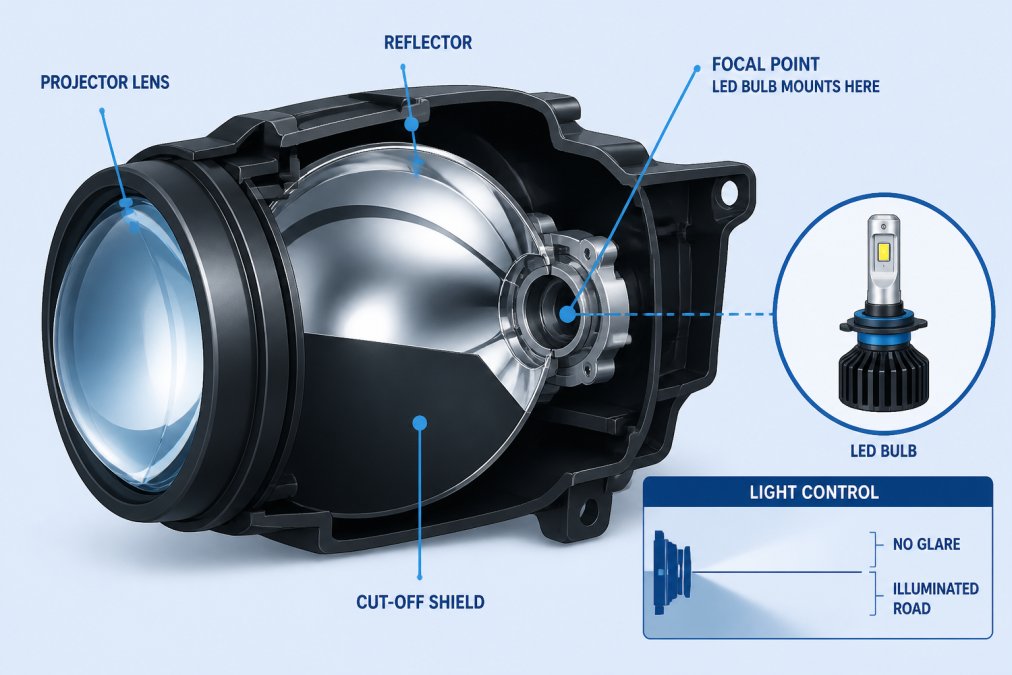
The beam pattern separates reliable LED headlights from cheap alternatives. A proper beam pattern creates a sharp cut-off line that illuminates the road ahead without throwing light into oncoming lanes. Beam pattern accuracy depends on three factors: the LED chip position, the housing design, and the lens optics. The LED chip must sit at the exact focal point where a halogen filament would be, and premium LED bulbs use precision engineering to position the chip correctly.
Projector housings maintain beam accuracy better than reflector housings because they use a lens to focus light and create a defined cut-off line. Reflector housings rely on the shape of the reflective surface, which is less precise. Professional testing uses a wall test at 25 feet to measure light distribution; a proper beam pattern shows bright illumination on the road ahead, a sharp horizontal line at the cut-off point, and minimal light above that line. RMS Lighting LLC validates each bulb to produce the correct beam pattern for its specific housing type before it ships.
Projector vs. Reflector Housing: Which Works With LED Upgrades
Understanding your vehicle's headlight housing type determines which LED upgrades will actually work. Projector and reflector housings use fundamentally different optical systems, and LED performance differs significantly between them.
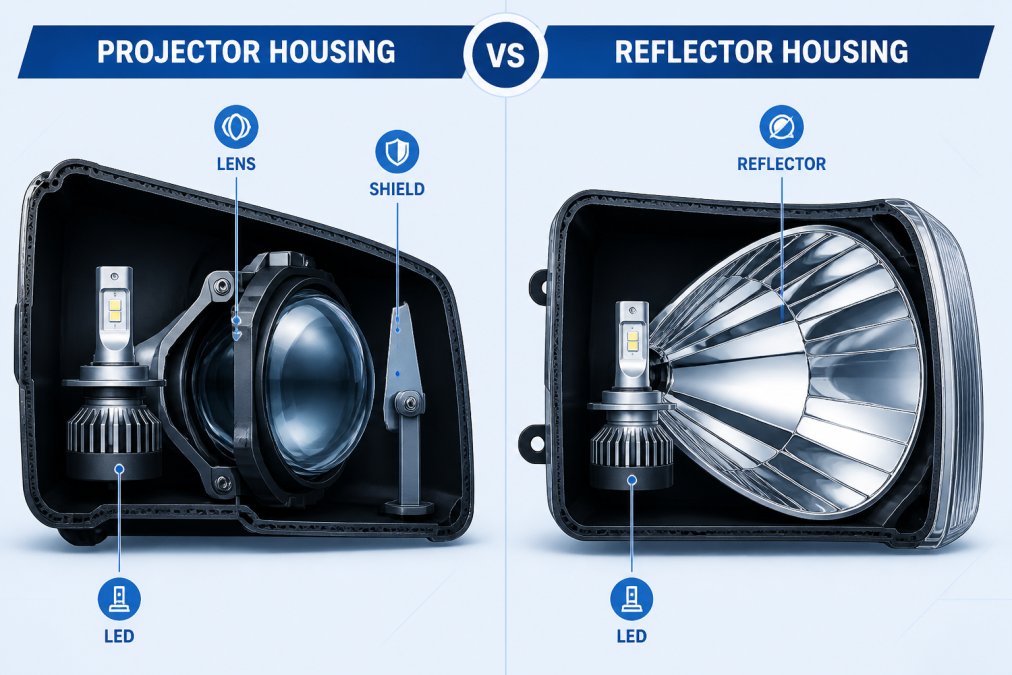
Reflector housings use a curved reflective surface to direct light from the bulb toward the road. The bulb sits at the focal point of the parabolic reflector, and light bounces off the reflective surface to create a beam pattern. Reflector housings are simpler and cheaper to manufacture, which is why older vehicles typically use them. LED bulbs work in reflector housings but with compromises; because LED chips are smaller than halogen filaments, they create uneven light distribution and a softer cut-off line.
Projector housings use a lens and internal shield to focus and direct light. The lens magnifies light from the bulb and projects it onto the road surface, while the internal shield creates a sharp cut-off line by blocking light above a certain angle. Projector housings are more complex and expensive but deliver superior beam patterns. LED bulbs excel in projector housings because the lens compensates for the smaller chip size and focuses the LED's concentrated light into a defined beam pattern with minimal scatter. You can identify your housing type by looking inside the headlight assembly: projector housings have a visible lens that looks like a small camera lens, while reflector housings show a smooth, curved reflective surface.
CANbus LED Headlight Error Codes and Compatibility
One of the most common frustrations with LED headlight upgrades is dashboard error codes and hyper-flashing. These occur when your vehicle's electrical system doesn't recognize the LED bulb as a valid component.
Your vehicle's onboard diagnostic system monitors electrical load across circuits. Halogen bulbs draw a specific amount of current, and your vehicle expects that load. LED bulbs draw significantly less current because they're more efficient. When the system detects lower-than-expected current, it interprets this as a bulb failure and triggers an error code or hyper-flashing turn signals.
CANbus-compatible LED bulbs solve this problem by including load-resistor technology or smart circuitry that mimics halogen current draw. The RMS Lighting LLC 130W CANBUS LED bulbs are engineered with premium CANbus circuitry that works across most vehicle platforms, but compatibility should always be verified for your specific vehicle before purchase. Some vehicles require additional load-resistor modules installed in the circuit to prevent errors.

How to Install LED Headlight Bulbs: Step-by-Step Process
Installing LED headlight bulbs is straightforward for most vehicles, though the exact process varies depending on your car's design.
Step 1: Gather Your Tools and Materials. You'll need the LED bulb kit, a flashlight, possibly a socket wrench or screwdriver, and clean gloves or a lint-free cloth. Never touch the LED chip or lens with bare fingers; oils cause premature failure.
Step 2: Access the Headlight Housing. Open your hood and locate the headlight assembly. Some vehicles require removing a trim panel or wheel well liner. Your owner's manual shows the exact access point.
Step 3: Disconnect the Original Bulb. Twist the bulb socket counterclockwise and pull it straight out. Be gentle; the socket and wiring are fragile.
Step 4: Install the LED Bulb. Align the LED bulb with the socket, insert it straight in, and twist clockwise until it seats firmly. The bulb should feel snug but not forced.
Step 5: Reconnect and Test. Plug the wiring harness back into the bulb socket. Turn on your headlights and verify that both bulbs illuminate.
Step 6: Reinstall Components. Replace any dust covers, trim panels, or wheel well liners you removed.
The entire process typically takes 15-30 minutes per bulb. If you're uncomfortable working in tight spaces, a professional shop can install them for you.
DOT Compliance for LED Headlights and Legal Considerations
LED headlight upgrades exist in a legal gray area in most jurisdictions. Understanding the regulations that apply to your vehicle prevents problems with inspections, insurance, or law enforcement.
The Department of Transportation (DOT) sets standards for vehicle lighting through the Federal Motor Vehicle Safety Standards (FMVSS). FMVSS 108 specifically governs headlight performance, including brightness limits, beam pattern requirements, and color specifications. According to FMVSS 108 headlight standards, headlights must produce a specific range of light intensity and maintain a defined beam pattern to ensure road safety without blinding other drivers.
Most LED headlight bulbs sold for street use are marketed as "DOT-compliant," but this claim is often misleading. DOT compliance technically applies to the entire headlight assembly, not individual bulbs. State regulations vary significantly; some allow any aftermarket headlight as long as it doesn't exceed brightness limits, while others require that headlights match the original manufacturer specification exactly. The safest approach is to verify your state's specific regulations before upgrading by contacting your local DMV or vehicle inspection facility.
Heat Management, Lifespan, and Durability
The longevity of reliable LED headlights depends primarily on heat management. LED chips generate less heat than halogen bulbs but are sensitive to temperature extremes. Quality LED bulbs include aluminum heat sinks that draw thermal energy away from the chip and dissipate it into the surrounding air. The RMS Lighting LLC 130W CANBUS LED bulbs use advanced thermal materials and passive cooling design to maintain optimal chip temperature during extended driving sessions.
The housing environment affects thermal performance significantly. A projector housing with good airflow keeps LED bulbs cooler than a sealed reflector housing. Most quality LED headlight bulbs are rated for 20,000 to 50,000 hours of operation, compared to 500-1,000 hours for halogen bulbs. An LED bulb operating 2 hours daily will last 25-70 years.
Durability extends beyond the LED chip. The bulb's connector, wiring, and housing materials must withstand temperature cycling, vibration, and moisture. Premium bulbs use sealed connectors, quality copper wiring, and corrosion-resistant materials. Water intrusion is a common cause of premature LED failure; if your headlight housing develops a crack, moisture enters and corrodes the bulb's internal circuitry.
Choosing reliable LED headlights comes down to understanding your vehicle's specific requirements and matching them to quality components. Start with your bulb type and housing design, verify CANbus compatibility, and ensure proper installation. The upfront investment in quality LED bulbs pays dividends through improved visibility, reduced maintenance, and years of reliable performance. At RMS Lighting LLC, we've engineered our LED headlight systems with rigorous testing to ensure they deliver on these promises. Whether you're upgrading a classic restoration or modernizing a daily driver, the right LED headlights transform your nighttime driving experience while maintaining the factory appearance your vehicle deserves.
Frequently Asked Questions
How do I know if reliable LED headlights will fit my vehicle's headlight housing?
Check your vehicle's headlight bulb type (H4, H7, H11, H13, or 9004) in your owner's manual or by inspecting the factory bulb. LED headlights come in these same sizes. Verify whether your housing is a projector or reflector type, projector housings work better with LED upgrades because their focused lens design maintains proper beam patterns. Most modern LED bulbs are designed to fit standard housings without modification, though older vehicles may need minor adjustments.
What does CANbus compatibility mean, and why do I need error-free LED headlights?
CANbus is your vehicle's onboard diagnostic system that monitors electrical components. Non-compatible LED bulbs can trigger dashboard error codes and hyperflashing because the system detects a power draw difference from factory halogen bulbs. Error-free, CANbus-compatible LED headlights are designed with resistors and voltage regulators that mimic factory bulb behavior, preventing these warning lights. This is especially critical for vehicles made after 2010, which rely heavily on CANbus monitoring.
Is there a difference between fan-cooled and fanless LED bulbs, and which should I choose?
Fan-cooled LED bulbs use active cooling systems to manage heat dissipation, allowing them to run at higher wattages (like 130W) without overheating. Fanless bulbs rely on passive cooling through their metal housing. Fan-cooled options typically last longer and maintain consistent brightness in enclosed headlight housings where heat builds up. For older vehicles with sealed housings, fan-cooled bulbs are the more reliable choice. Fanless bulbs work well in open-design housings with good airflow.
Are LED headlight conversions legal, and what does DOT compliance mean?
LED headlight legality varies by state. The Department of Transportation (DOT) requires that aftermarket headlights meet SAE (Society of Automotive Engineers) standards for beam pattern, intensity, and color temperature. Most states allow LED replacements only if they're designed as direct drop-in replacements for factory bulbs and don't alter the beam pattern or create glare. Full conversion kits that modify the housing may not be street-legal in some jurisdictions. Always check your state's vehicle code before installation.
What color temperature should I choose: 4300K, 6000K, or 6500K?
Color temperature affects both visibility and legality. 4300K (warm white) provides the best road visibility in rain and fog but may look yellowish. 6000K (cool white) offers a balance between visibility and modern appearance. 6500K (bright cool white) delivers the brightest appearance but can reduce visibility in poor weather. For reliable performance, 6000K to 6500K is recommended for most drivers, as it meets DOT standards while providing excellent lumen output and road visibility without excessive glare.
How do I avoid getting LED headlights that create glare or poor beam patterns?
Look for bulbs specifically designed for your housing type, projector housings with focused lenses maintain beam patterns better than reflector housings. Check product specifications for lumen output and beam pattern testing. Reliable manufacturers test their bulbs in actual headlight housings to ensure the cut-off line (the sharp boundary between lit and dark areas) stays correct. Avoid bulbs with scattered diodes or poor thermal design, as these create unfocused light that causes glare and reduces visibility for oncoming drivers.
What's the actual lifespan and durability difference between cheap LED bulbs and premium options?
Premium LED headlights with proper heat dissipation systems typically last 25,000 to 50,000 hours, while cheaper alternatives often fail within 5,000 to 10,000 hours due to inadequate cooling and low-quality diodes. Thermal management is critical, bulbs that overheat degrade rapidly. Premium options use chip-on-board (COB) technology or multi-diode designs with active cooling fans to maintain consistent performance. The price difference is usually offset by longer lifespan, fewer replacements, and consistent beam quality over time.
What makes a reliable LED headlight brand trustworthy compared to unknown sellers?
Reliable brands provide detailed specifications (wattage, lumen output, color temperature, thermal management details), warranty coverage, and evidence of testing in actual vehicle housings. They publish compatibility lists for specific vehicle years and models, offer customer support, and stand behind their products with return policies. Avoid sellers offering only generic product photos or vague descriptions. Check whether the brand tests for beam pattern accuracy, CANbus compatibility, and flicker issues, these indicate rigorous quality control that protects your investment.
This article was written using GrandRanker