


LED Headlight Alternatives for Trucks: 2026 Guide

Table of Contents
- LED Headlight Alternatives for Trucks: What You Need to Know
- Sealed Beam LED Conversion Kits vs. Modern Headlight Assemblies
- DOT Compliant LED Headlight Bulbs and Installation
- How to Prevent LED Headlight Flickering and Error Codes
- Best LED Headlight Bulbs for Reflector Housings
- Beam Pattern, Cutoff Lines, and Oncoming Traffic Safety
- Installation Process: Plug-and-Play vs. Wired Conversions
- Conclusion
Last Updated: August 12, 2026
LED Headlight Alternatives for Trucks: What You Need to Know
If you're driving a truck with factory halogen headlights, upgrading to LED alternatives delivers immediate benefits: better visibility, sharper beam patterns, and significantly longer bulb life. This guide from RMS Lighting LLC covers the full spectrum of LED conversion options available today, from sealed beam kits for classic trucks to modern full-assembly replacements, helping you make an informed decision based on your vehicle's age, budget, and nighttime visibility needs.
The challenge isn't finding LED options, it's understanding which option solves your specific problem. A sealed beam conversion kit works for a 1980s Ford F-150 but is wrong for a 2015 Tacoma. A full LED headlight assembly delivers superior performance on modern trucks but costs significantly more. Between these extremes sit plug-and-play bulb replacements, canbus-compatible options to prevent error codes, and wired harness setups for vehicles without plug-and-play capability.
Success depends on three factors: compatibility with your truck's existing housing, proper beam pattern alignment to avoid blinding oncoming drivers, and choosing between sealed beam conversions, modern assemblies, or direct bulb replacements. Below, we'll walk through each approach and help you avoid common mistakes that lead to flickering, error codes, and poor light distribution.
Sealed Beam LED Conversion Kits vs. Modern Headlight Assemblies
Sealed beam conversions preserve your truck's original factory housing while upgrading the internal lighting to LED technology. Modern full-assembly replacements swap out the entire headlight unit for a new LED-equipped housing. The choice depends almost entirely on your truck's age and design.
Sealed Beam Conversions for Classic Trucks
Sealed beam headlights dominated truck design from the 1940s through the early 2000s. If your truck has round 7-inch headlights or square 4x6 or 5x7 units, you're working with sealed beam architecture. The advantage is maintaining factory appearance while delivering modern LED performance.
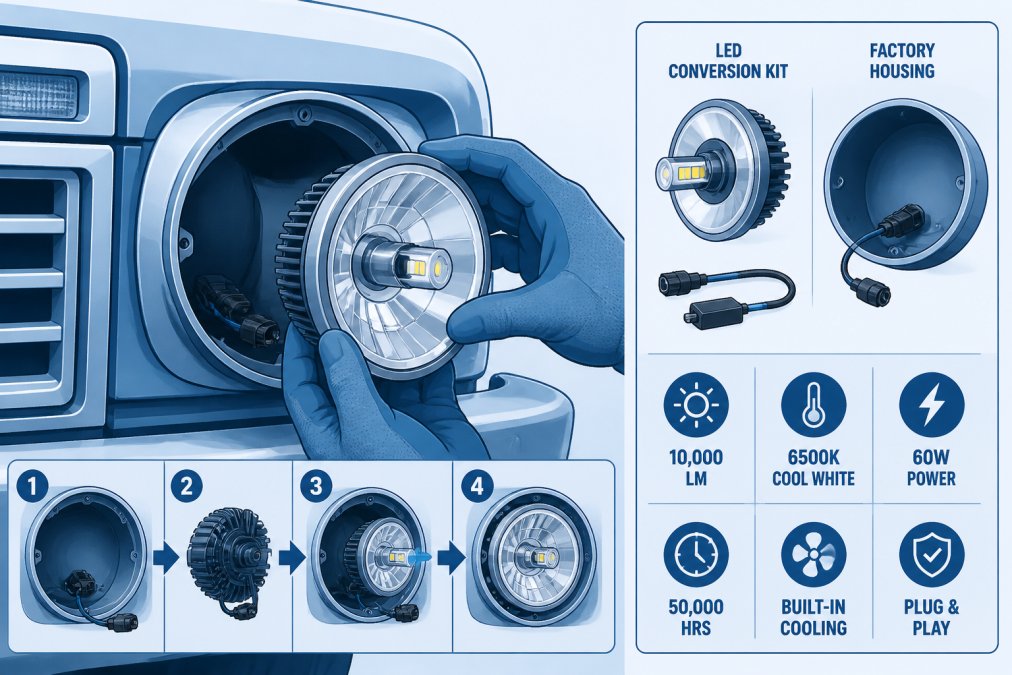
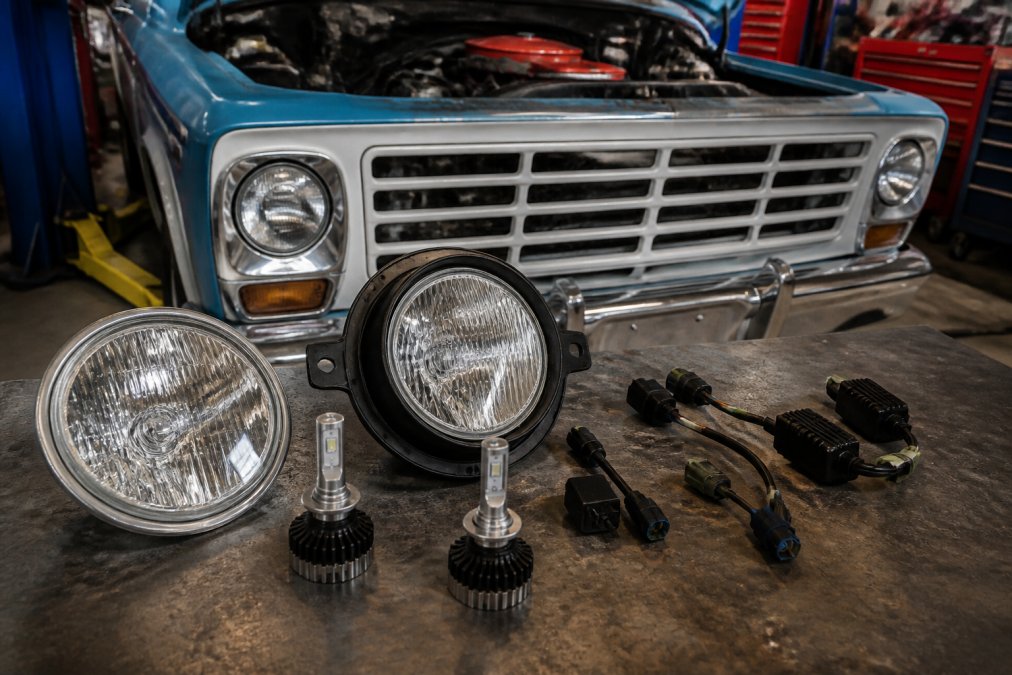
RMS Lighting LLC offers sealed beam LED conversion kits in multiple sizes: 7-inch round, 4x6 small square, and 5x7 large square configurations. These kits include pre-assembled LED bulbs, reflector housings, and necessary harness adapters. Gen2 versions deliver 10,000 lumens per bulb, while higher-output 130-watt versions reach 30,000 lumens.

A critical detail: not all sealed beam conversions produce the same beam pattern. The quality of the internal reflector design determines whether you get a sharp cutoff line that prevents blinding oncoming traffic or scattered light that reduces visibility. RMS Lighting LLC kits feature precision-engineered reflectors that produce defined beam patterns with proper cutoff lines, this separates professional upgrades from budget kits that create glare and safety issues.
Installation typically takes 30-45 minutes per headlight. You remove the retaining ring, disconnect the factory sealed beam unit, install the new LED conversion kit, and reconnect the harness. Most sealed beam conversions are plug-and-play, requiring no special tools or custom wiring.
The trade-off is that sealed beam conversions work only on trucks with sealed beam housings. If your truck has composite or projector-style headlights, this approach won't work.
Full LED Headlight Assemblies for Modern Trucks
Modern trucks from the 2010s onward use composite headlight assemblies designed for LED or HID bulbs. These sealed units require replacing the entire assembly to upgrade lighting technology. Full LED headlight assemblies from manufacturers like Morimoto deliver improved brightness and modern styling that matches your truck's design.
The advantage is precision engineering from the factory. The reflector, lens, and LED bulb are designed together as a system, optimizing beam pattern, cutoff line, and light distribution. You're installing a purpose-built LED headlight, not retrofitting LED technology into a halogen housing.
Installation requires removing the factory assembly, disconnecting the electrical connector, and installing the new LED unit. For many modern trucks, this is a 30-60 minute job, though some models require bumper removal. Most modern LED assemblies are plug-and-play, though some vehicles benefit from canbus error prevention modules.
The primary drawback is cost. Full LED headlight assemblies typically run $1,200-$1,500 per pair, substantially more than sealed beam conversion kits at $179-$299 depending on output level.
DOT Compliant LED Headlight Bulbs and Installation
DOT compliance means the headlight meets Department of Transportation standards for brightness, beam pattern, and safety. All quality LED headlight products should meet DOT requirements for legal street use.
Many truck owners attempt upgrading by installing aftermarket LED bulbs directly into factory halogen housings. This approach has a critical flaw: halogen housings have reflectors and lens designs optimized for halogen filament shape and light distribution. An LED bulb often creates poor beam distribution, excessive glare, or dark spots on the road.
Direct LED bulb replacements work best in projector-style housings. In reflector housings, a sealed beam conversion kit with a purpose-designed reflector is the better choice.
When shopping for LED bulbs, verify DOT compliance in product specifications. Reputable manufacturers publish beam pattern data and test results. RMS Lighting LLC publishes technical specifications for all products, including lumen output, color temperature, and beam pattern characteristics. This transparency distinguishes professional-grade products from budget alternatives.
How to Prevent LED Headlight Flickering and Error Codes
LED headlight flickering and dashboard error codes stem from incompatibility between the LED bulb's electrical characteristics and your truck's factory electrical system. Factory halogen systems expect specific resistance and current draw. LEDs draw less power and have different electrical properties, which can confuse the truck's onboard diagnostics.
Flickering appears as a pulsing or strobe effect, especially noticeable at night or when idling. Error codes appear as dashboard warnings, often "bulb out" or "headlight malfunction" messages, even though the headlights function normally.
Plug-and-play LED kits designed for your specific vehicle often include built-in canbus error prevention, which emulates the electrical signature of the factory halogen bulb. For vehicles that still experience error codes, a canbus decoder module can be added to the harness, a 15-minute installation that translates the LED's electrical characteristics into something the truck recognizes as normal.
Flickering without error codes often indicates insufficient power delivery. This happens when factory wiring is undersized or corroded. The solution is running a dedicated power wire from the battery through a relay and fuse to the LED headlights. This direct power path bypasses factory wiring and delivers consistent voltage, eliminating flickering entirely.
Best LED Headlight Bulbs for Reflector Housings
Reflector housings require LED bulbs specifically designed for reflector optics to produce proper beam patterns. The reflector's parabolic shape focuses light from the bulb's filament point onto the road. An LED bulb designed for a projector housing won't work well in a reflector.
Sealed beam LED conversion kits solve this by replacing both the reflector and bulb as a matched system. The reflector is engineered for the LED bulb's light distribution characteristics, ensuring a sharp cutoff line and even beam spread.
If retrofitting LED bulbs into an existing reflector housing, look for bulbs with a compact LED array that approximates a halogen filament's light point. These "mini projector" LED bulbs include a small lens that focuses the LED array into a tighter beam pattern. RMS Lighting LLC's Gen3 kits feature mini projector technology, delivering better beam control in classic sealed beam housings.

Color temperature also matters for visibility and legal compliance. Factory halogen bulbs produce around 3,000 Kelvin (warm, yellowish light). Most aftermarket LED upgrades range from 5,000 to 6,500 Kelvin (cool, white light). The 6,500K range provides excellent visibility without excessive blue tint. Avoid going higher, beyond this point, light output diminishes and the beam takes on a purple tint that reduces actual visibility.
Beam Pattern, Cutoff Lines, and Oncoming Traffic Safety
The cutoff line is the sharp boundary between illuminated and dark areas on the road ahead. A proper cutoff line keeps light below the horizontal plane where oncoming drivers' eyes are located, preventing glare while maximizing visibility. This separates a quality LED headlight upgrade from a dangerous one.
Poor beam patterns cause two problems: they blind oncoming drivers, creating a safety hazard, and they scatter light inefficiently, reducing your actual visibility benefit. You end up with more total light output but worse functional visibility, a common result of cheap LED retrofits.
Quality LED headlight products are tested for beam pattern performance. Manufacturers use standardized testing equipment to verify that beams meet DOT standards for cutoff line sharpness and illumination pattern. RMS Lighting LLC tests all conversion kits before shipping. This separates rigorously tested products from alternatives that prioritize cost over safety.

When installing LED headlights, beam alignment matters as much as headlight quality. Misaligned headlights create glare regardless of bulb quality. After installation, aim your headlights using a wall test or professional alignment tool. Most trucks have vertical aim adjustment screws on the back of the headlight assembly. Proper aim ensures the beam's cutoff line sits just below the horizontal at 25 feet, the DOT standard.
More light output doesn't automatically mean better visibility. A 10,000-lumen LED headlight with a poor beam pattern creates glare and reduces visibility compared to a 5,000-lumen headlight with a sharp cutoff line. Optical quality matters more than raw lumen output.
Installation Process: Plug-and-Play vs. Wired Conversions
Plug-and-play LED headlights connect directly to your truck's factory electrical connector without additional wiring. Wired conversions require running new power and ground wires from the battery and vehicle frame, bypassing factory wiring entirely.
Plug-and-play is simpler for most DIY installations. You disconnect the factory headlight, connect the LED kit's harness to the truck's factory connector, mount the new headlight, and you're done. Total installation time is typically 30-45 minutes per headlight. This works well for sealed beam conversions and modern LED assemblies designed for your specific truck model.
The limitation is that plug-and-play relies on factory wiring to deliver power. If the wiring is corroded, undersized, or degraded from age, you may experience flickering, dimming, or insufficient brightness. Factory wiring in trucks 15+ years old often shows these issues.
Wired conversions address this by running dedicated power from the battery through a relay and fused disconnect to the LED headlights. This direct power path delivers consistent voltage regardless of factory wiring age. Installation is more complex, running new wire through the engine bay and firewall, installing a relay, and adding a fuse holder, but the result is more reliable performance, especially on older trucks.
Decision framework: If your truck is less than 10 years old with good factory wiring, plug-and-play is the right choice. If your truck is older, you've experienced electrical issues, or you want maximum reliability and brightness, a wired conversion is worth the extra effort.
| Installation Type | Complexity | Time Required | Best For | Power Reliability |
|---|---|---|---|---|
| Plug-and-Play | Simple (30-45 min) | 30-45 minutes | Modern trucks, good factory wiring | Good if wiring is sound |
| Wired Conversion | Intermediate (1-2 hours) | 1-2 hours | Older trucks, degraded wiring, maximum brightness | Excellent, dedicated power path |
For a wired conversion on a sealed beam kit: Run a 10-gauge power wire from the positive battery terminal through a relay (controlled by the factory headlight switch) to the LED headlight's positive connector. Run a ground wire from the LED headlight's negative connector to a clean, bare metal point on the truck's frame or engine block. Install an inline fuse holder on the power wire, typically 30-40 amps depending on the LED bulb's power draw. This setup delivers clean, consistent power and eliminates voltage drop issues.
Conclusion
The LED headlight upgrade landscape for trucks has matured significantly. You now have genuine alternatives that deliver real improvements in visibility, reliability, and longevity compared to factory halogen systems. The choice between sealed beam conversions, full LED assemblies, and direct bulb replacements depends on your truck's age, budget, and whether you prioritize factory appearance or modern styling.
RMS Lighting LLC specializes in sealed beam LED conversion kits that preserve the factory look of classic trucks while delivering modern lighting performance. Our Gen2 and Gen3 kits feature precision-engineered reflectors, canbus-compatible harnesses to prevent error codes, and rigorous beam pattern testing to ensure proper cutoff lines and oncoming traffic safety. Explore our full range of LED headlight conversion kits and find the exact fit for your truck.
Frequently Asked Questions
Are LED headlight conversions legal for trucks?
LED headlight conversions are legal if they meet DOT compliance standards and maintain proper beam pattern with a defined cutoff line. Factory halogen housings with aftermarket LED bulbs may not produce compliant beam patterns, which is why many jurisdictions require either OEM LED-approved housings or conversion kits specifically engineered for your vehicle. Always verify local regulations before installation, as some states have stricter rules about light color temperature (kelvin rating) and beam cutoff specifications.
What causes LED headlight flickering and dashboard error codes?
LED headlight flickering and error codes occur when your vehicle's electrical system detects a resistance mismatch. Factory halogen bulbs draw more current than LEDs, so your truck's canbus system flags the difference. Solutions include canbus decoders, load resistors, or choosing LED bulbs specifically designed with built-in canbus compatibility. RMS Lighting's conversion kits include harness adapters that prevent these issues by matching the electrical load of your original setup.
How do I choose between sealed beam conversions and full LED headlight assemblies?
Sealed beam conversions work best for classic trucks with original factory housings, they maintain authenticity while upgrading to LED brightness and efficiency. Full LED headlight assemblies suit newer trucks where factory housings are already complex and integrated. Sealed beam kits typically cost $179-$299 and install into existing housings, while complete assemblies run $1,200+ but offer integrated projector technology and modern styling. Your vehicle's age and housing type determine which alternative makes sense.
What's the difference between reflector and projector LED headlights?
Reflector housings bounce light off a curved mirror surface, while projector housings focus light through a lens with a precise cutoff line. Projectors provide sharper beam patterns and better road visibility but require more sophisticated LED bulbs. Reflector housings are simpler and work with standard LED bulbs, but achieving a clean cutoff line is harder. For reflector housings, choose LED bulbs engineered specifically for that application to minimize glare and maintain road visibility for oncoming drivers.
The most common objection we hear is concern about error codes and flickering from cheap LED kits. The solution is straightforward: choose products specifically designed for your truck's electrical system, verify DOT compliance and beam pattern testing, and follow proper installation practices. Quality LED headlight alternatives for trucks eliminate these issues entirely while delivering the visibility and reliability you expect from a modern upgrade.
This article was written using GrandRanker