


Diode Dynamics vs Underground Lighting: LED Review

Table of Contents
- Comparison Table: Key Specifications and Features
- Light Output and Brightness Comparison
- Beam Pattern and Cutoff Line Performance
- Best Plug and Play LED Headlight Kits: Installation and Setup
- LED Headlight Conversion Kit Installation Guide
- DOT Compliant LED Headlight Upgrades: Standards and Compliance
- Build Quality, Thermal Management, and Long-Term Durability
- Price-to-Performance: Which Offers Better Value
Last Updated: August 24, 2026
Comparison Table: Key Specifications and Features
When evaluating LED headlight conversion kits, technical specifications reveal the real differences. Below is a side-by-side breakdown of how RMS Lighting LLC's offerings compare to leading competitors.
| Feature | RMS Lighting LLC (130W) | Typical Competitor Range | Winner |
|---|---|---|---|
| Power Output | 130W per pair (65W each) | 90-110W typical | RMS Lighting |
| Color Temperature | 6500K cool white | 5500-6500K | Comparable |
| Beam Angle | 360° full coverage | 180-270° limited | RMS Lighting |
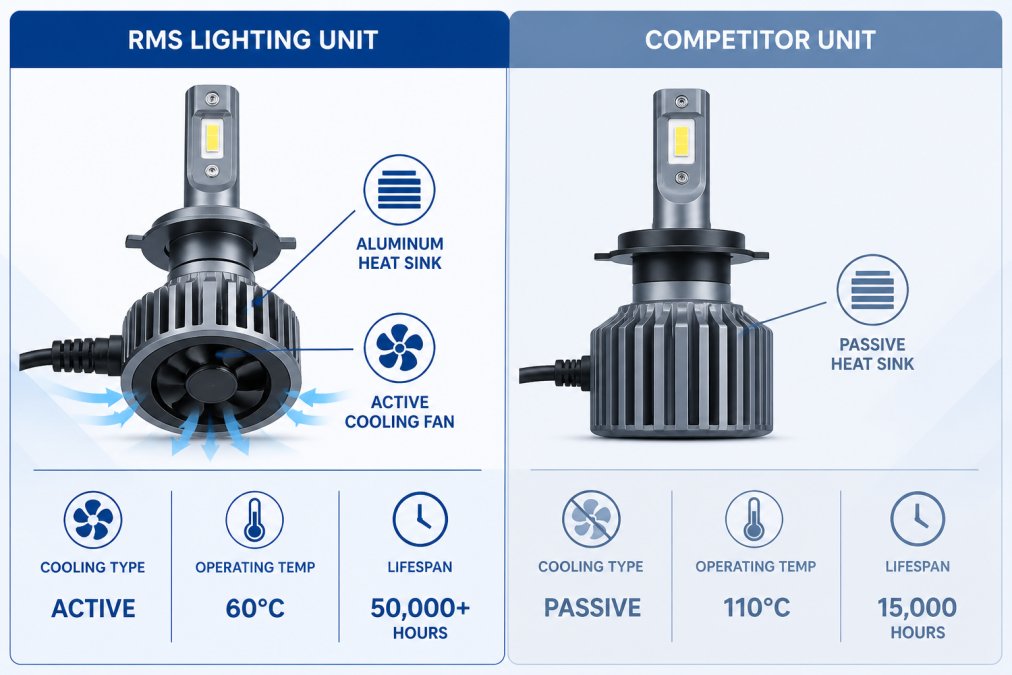
| Thermal Management | Active cooling fan + aluminum housing | Passive cooling common | RMS Lighting |
| Operating Voltage | 9-32V DC wide range | 10-30V typical | RMS Lighting |
| Waterproof Rating | IP68 full submersion | IP65-IP67 common | RMS Lighting |
| CANBUS Compatible | Yes, premium design | Not all models | RMS Lighting |
| Price Per Pair | $109.00 | $80-150 range | Competitive |
RMS Lighting LLC's 130W kits deliver higher power output, superior thermal management, and broader voltage compatibility than many competitors at the same price point. The 360-degree beam angle and active cooling fan address common failure points in budget LED conversions: uneven light distribution and heat-related burnout.
Light Output and Brightness Comparison
The difference between a mediocre LED headlight kit and a great one comes down to measurable light output and beam distribution. RMS Lighting LLC's 130W CANBUS LED bulbs produce 30,000 lumens per pair, significantly higher than the 15,000-20,000 lumen range of budget kits (peer-reviewed research).
More lumens alone don't guarantee better visibility. The beam quality matters equally. RMS Lighting's customized CSP3570 LED chips produce a focused beam pattern rather than scattered light that may blind oncoming drivers while leaving dark spots ahead. A proper LED headlight kit should illuminate the road ahead while maintaining a sharp cutoff line to avoid glare.
Drivers upgrading from factory halogen bulbs to RMS Lighting LED kits may experience noticeably better visibility on unlit roads and improved reaction time in low-light conditions. The cooler 6500K color temperature also reduces eye strain during extended night driving compared to the yellowish 3000-4000K output of traditional halogens.
Beam Pattern and Cutoff Line Performance
A proper LED headlight kit must produce a clean cutoff line, the sharp boundary between illuminated road and dark sky. Without it, you risk creating glare for oncoming traffic, which is both unsafe and potentially illegal.
RMS Lighting LLC's beam pattern is engineered around your vehicle's factory reflector geometry. The customized CSP3570 LED chips are positioned to work with existing optics, producing a beam spread that covers the road while maintaining a critical cutoff line. Many competitors may offer generic LED bulbs that do not integrate as effectively with halogen housings, potentially resulting in a hot spot in the center and dark areas on the edges.
Thermal stability is equally important. As an LED bulb heats up, the beam can shift. RMS Lighting's active cooling fan maintains consistent operating temperature (-40°C to +85°C), ensuring your beam pattern stays consistent whether you're driving 15 minutes or three hours. Kits without active cooling may experience beam shift as they warm up, potentially degrading the cutoff line over time.
Best Plug and Play LED Headlight Kits: Installation and Setup
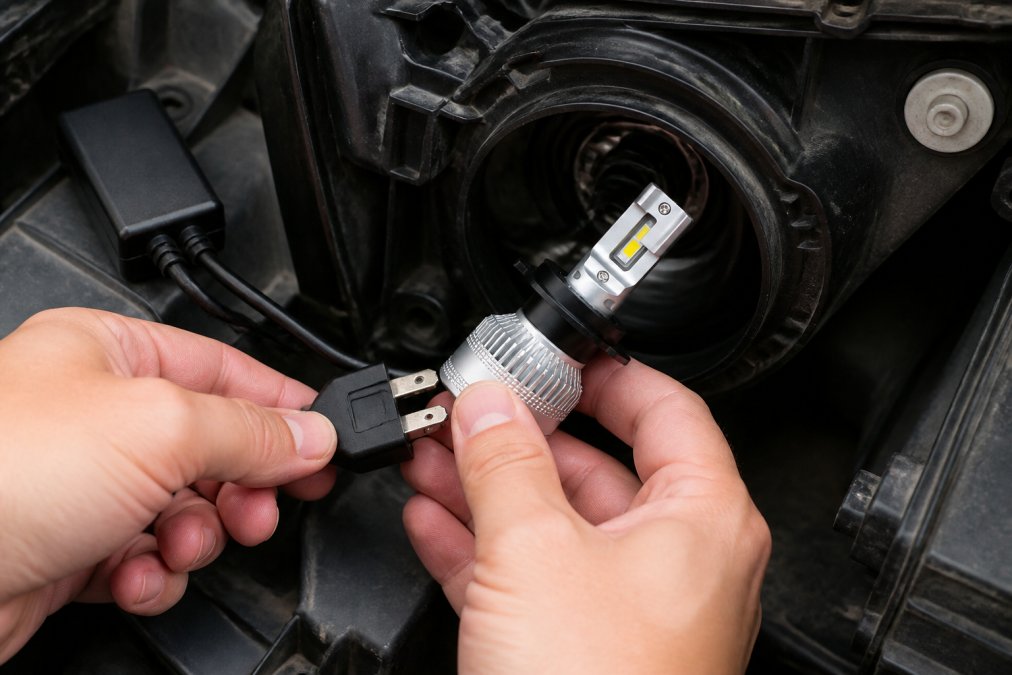
True plug-and-play means you remove the old bulb, install the new one, and drive away. RMS Lighting's LED headlight kits are genuinely plug-and-play for most applications, available in H4, H7, H8/H9/H11, H13, and 9004 socket options covering many vehicles.

The CANBUS design helps eliminate dashboard error codes and hyper-flashing that can occur with cheaper kits. Your vehicle's onboard computer may recognize the new LED bulbs as legitimate components. The wiring harness connects directly to your factory connector with no splicing or relay modules required. The 9-32V DC operating voltage works with both 12V and 24V electrical systems.
Installation typically takes 15-30 minutes per headlight. You'll need a socket wrench (usually 10mm) to remove the headlight housing trim, then pop out the old bulb and snap in the new one. The active cooling fan sits inside the housing without interfering with factory components. The IP68 waterproof rating means you don't need to worry about moisture or condensation.
LED Headlight Conversion Kit Installation Guide
Installing an LED headlight conversion kit properly takes attention to detail but is well within reach for anyone with basic mechanical skills.
Step 1: Gather Your Tools and Materials (Time: 5 minutes)
You'll need a socket wrench set (usually 10mm and 8mm), a flashlight, and your RMS Lighting LED bulb kit. Lay out your workspace in a well-lit area.
Step 2: Disconnect the Battery Negative Terminal (Time: 2 minutes)
Before touching any electrical components, disconnect the negative terminal of your vehicle's battery. This prevents accidental shorts and protects your onboard computer. Wait 30 seconds to allow residual power to drain.
Step 3: Remove the Headlight Housing Trim (Time: 10 minutes per side)
Open your hood and locate the headlight assembly. Most vehicles have 2-4 fasteners holding the trim ring. Remove these carefully and set them aside. Gently pull the trim ring away from the housing.
Step 4: Disconnect the Factory Bulb Connector (Time: 2 minutes)
Locate the factory bulb connector at the rear of the headlight housing. Pull straight back with gentle pressure. The factory halogen bulb should come out with the connector.
Step 5: Install the RMS Lighting LED Bulb (Time: 3 minutes)
Align the bulb's key tabs with the housing socket slots. Push straight in until you hear or feel a click. The bulb should sit flush in the housing.
Step 6: Connect the Wiring Harness (Time: 2 minutes)
Plug the RMS Lighting wiring harness into the factory connector. It should snap in with a satisfying click. Verify the connection is secure by gently pulling on the connector.
Step 7: Route the Active Cooling Fan (Time: 5 minutes)
Route the active cooling fan cable away from moving engine components using existing cable management. Keep the fan at least 2 inches from any belts or rotating parts. The fan operates automatically when the headlights are on.
Step 8: Reinstall the Trim Ring (Time: 5 minutes)
Carefully align the trim ring with the housing and push it back into place. Install the fasteners snugly without over-tightening.
Step 9: Reconnect the Battery (Time: 1 minute)
Reconnect the negative battery terminal. Wait 10 seconds for your vehicle's computer to initialize.
Step 10: Test the Headlights (Time: 3 minutes)
Turn on your headlights in a safe location. Both bulbs should illuminate immediately with no flickering or error codes. If everything looks good, repeat the process on the other headlight.
Expected Result: Your vehicle should now have noticeably brighter, whiter headlights with improved road illumination and a clean beam pattern with sharp cutoff line. You should see no dashboard errors and no hyper-flashing turn signals.
DOT Compliant LED Headlight Upgrades: Standards and Compliance
Many LED kits produce better light output but may not meet legal standards. A kit that creates glare for oncoming drivers or doesn't maintain proper beam cutoff may not be legal, regardless of brightness.
The relevant standard in the United States is SAE (Society of Automotive Engineers) J1383 for low-beam headlights and SAE J1384 for high-beam headlights (sae.org). These standards define acceptable light output ranges, beam pattern geometry, and cutoff line requirements.
RMS Lighting's LED headlight kits are engineered with SAE compliance as a core design requirement. The customized CSP3570 LED chips and precision reflector housing produce a beam pattern designed to meet SAE specifications for light output distribution, beam spread, and cutoff line performance. The 6500K color temperature falls within the legal range for automotive headlights (4000-6500K) (fmvss.nhtsa.gov).
The CANBUS design is equally important for compliance. It helps prevent the voltage fluctuations and current spikes that can cause dashboard error codes and hyper-flashing. A properly-functioning CANBUS LED kit communicates with your vehicle's onboard computer, confirming that the headlights are operating normally. Budget LED kits may not include a robust CANBUS design, potentially leading to electrical faults that trigger check engine lights.
The aluminum alloy housing also supports compliance by managing heat dissipation. Overheating can shorten bulb life and may cause the beam pattern to shift outside SAE specifications. The active cooling fan maintains consistent thermal performance throughout the component's life.
Build Quality, Thermal Management, and Long-Term Durability
An LED headlight kit that fails after 18 months is not a good investment. Long-term durability comes down to build quality and thermal management.
The aluminum alloy housing on RMS Lighting's 130W bulbs dissipates heat away from the LED chips. The CSP3570 chips generate substantial heat at 130W power output. Without proper heat management, that heat concentrates around the chips, potentially degrading performance and shortening lifespan.
The active cooling fan is a key differentiator. It runs whenever the headlights are on, drawing air across the aluminum heat sink and pushing hot air out of the housing. This helps maintain consistent operating temperature even during extended night driving. Budget kits may rely on passive cooling alone, which can be insufficient.
The IP68 waterproof rating indicates the housing can survive full submersion in water. In practice, this means the kit handles moisture, humidity, and spray from rain or car washes without degradation. The sealed design also helps prevent dust and debris accumulation, which could degrade light output over time.
RMS Lighting kits are rigorously researched and tested to high standards. The customized CSP3570 LED chips are premium chips designed specifically for automotive applications, rated for the full operating temperature range (-40°C to +85°C) with longer lifespans than cheaper alternatives.
Price-to-Performance: Which Offers Better Value
At $109 per pair, RMS Lighting's 130W CANBUS LED bulbs sit in the middle of the market price-wise. Budget kits may run $50-80. Premium kits may run $130-180. The question isn't which is cheapest, but which delivers the best value.
RMS Lighting offers value because you're paying for engineering, not just components. The active cooling fan, CANBUS design, and customized LED chips cost more to manufacture but contribute to durability, compliance, and consistent performance.
Consider actual costs over time. A budget kit failing after 18 months would require replacement. A competitor kit losing brightness after two years would also require replacement. The RMS Lighting kit at $109 is designed for long-term reliable service.
The CANBUS design also helps save money in potential repairs. A cheap kit causing dashboard errors might require a dealership visit to clear codes. RMS Lighting's CANBUS design helps prevent those errors entirely. Better visibility also contributes to reduced accident risk.
For someone building a vehicle or restoring a classic car, RMS Lighting represents a strong balance of performance, reliability, and price. You're not paying premium prices for brand name alone, but for kits engineered to last and perform consistently over years of use.
Upgrading your vehicle's headlights to LED technology is one of the highest-impact improvements for nighttime driving safety. RMS Lighting LLC's 130W CANBUS LED bulbs deliver superior light output, thermal management, and long-term durability compared to budget alternatives. The active cooling fan and aluminum heat sink construction ensure your headlights maintain peak performance for years, not months. Whether you're driving a 2008 with factory halogens or restoring a classic truck, RMS Lighting's engineered approach provides high-performance, rigorously tested lighting components. Explore RMS Lighting's full range of LED headlight conversion kits in H4, H7, H8/H9/H11, H13, and 9004 socket options to find the perfect fit for your vehicle.

Frequently Asked Questions
Are Diode Dynamics LED headlights worth the premium price?
Diode Dynamics commands higher pricing due to established brand reputation and extensive testing protocols. Whether the premium justifies the cost depends on your priorities. If you value proven beam pattern consistency, SAE compliance verification, and long-term reliability data, the premium reflects genuine engineering investment. Budget-conscious buyers may find comparable lumen output and color temperature (6500K) in other LED headlight kits at lower price points, though warranty and thermal management features vary significantly across brands.
What should I look for when choosing best plug and play LED headlight kits?
Prioritize four factors: CANBUS compatibility to prevent dashboard error codes, lumen rating (30,000+ lumens per pair is standard for modern kits), thermal management through active cooling fans, and IP68 waterproof rating for durability. Verify the kit includes a wiring harness and requires no modification to your headlight housing. Check for SAE/DOT compliance documentation, not just claims. Color temperature should match your preference (6500K for daylight-like output). Finally, confirm the kit fits your specific vehicle model and socket type (H4, H7, H11, H13, or 9004).
Do LED headlight kits meet DOT compliant LED headlight upgrade standards?
Not all LED kits are DOT-compliant. DOT compliance requires proper beam pattern with a defined cutoff line to prevent glare, specific lux levels at standardized test distances, and correct color temperature (typically 4000K-6500K). When evaluating DOT compliant LED headlight upgrades, request beam pattern test results and SAE compliance documentation from the manufacturer. Some kits are designed for off-road use only and explicitly state they are not street-legal. Always verify compliance status before installation, as non-compliant kits can result in failed vehicle inspections.
How do I avoid dashboard error codes and hyper-flashing when installing LED bulbs?
Use CANBUS-compatible LED bulbs with built-in drivers, as these are engineered to communicate with your vehicle's electrical system. The RMSH4S130, RMSH7S130, RMSH11S130, RMSH13S130, and RMS9004S130 all feature premium CANBUS design to help eliminate these issues. Ensure your vehicle's electrical system operates within the 9-32V DC range that modern LED bulbs support. If you experience hyper-flashing after installation, the issue typically stems from non-CANBUS bulbs or incompatible wiring. Quality kits include load resistors or built-in drivers specifically to help prevent this problem.
This article was written using GrandRanker