


LED vs Halogen Headlights: Pros and Cons Compared

Table of Contents
- LED vs Halogen Headlights: Quick Comparison Table
- How Halogen and LED Headlights Actually Work
- Headlight Bulb Brightness Comparison: Lumens, Kelvin, and Beam Pattern
- Lifespan, Wattage, and Energy Efficiency Compared
- DOT Compliance for LED Headlights: What the Law Actually Requires
- LED Headlight Conversion Kit Installation: Fitment, Canbus, and Flicker Fixes
- Cold Weather, Heat Dissipation, and Environmental Trade-Offs
- Pros and Cons of LED vs Halogen Headlights: Which Upgrade Fits Your Vehicle?
- Frequently Asked Questions
Last Updated: September 30, 2026
LED vs Halogen Headlights: Quick Comparison Table
The pros and cons of LED vs halogen headlights come down to a simple trade-off: LED bulbs deliver far more light output and last dramatically longer, while halogen bulbs cost less upfront and drop into any factory housing without modification. This guide from RMS Lighting LLC breaks down where each technology wins, where it falls short, and what you need to know before upgrading an older vehicle.

Here's the direct comparison:
| Factor | Halogen | LED |
|---|---|---|
| Typical color temperature | 3000-3500K warm yellow | 6000-6500K cool white |
| Typical lifespan | 500-1,000 hours | 10,000-50,000 hours |
| Power draw | Higher wattage for less light | Lower wattage, higher output |
| Upfront cost | Lowest | Higher |
| Drop-in fitment | Native in factory housings | May need adapters or retainers |
| Best for | Budget replacements, stock restorations | Drivers wanting maximum visibility |
The exact keyword here is simple: LED vs halogen is a question of what you value more, upfront savings or long-term performance. Most drivers who commute at night regret choosing the cheaper option.
How Halogen and LED Headlights Actually Work
Halogen and LED headlights produce light in completely different ways, which explains every performance gap between them.
Halogen: The Filament and Gas Approach
Halogen headlights are incandescent bulbs that pass current through a tungsten filament inside a glass envelope filled with halogen gas. The gas cycle redeposits tungsten back onto the filament, which extends its life compared with a plain incandescent bulb.
The catch: most of the energy becomes heat, not light. A halogen bulb runs hot, glows yellow, and dims gradually as the filament thins. That is why a ten-year-old factory bulb looks noticeably weaker than it did new.
LED: Chips, Drivers, and Heat Management
LED headlights use semiconductor chips that emit light when current passes through them. Because LEDs are sensitive to heat, they rely on a driver circuit to regulate voltage and a heatsink or active cooling fan to manage temperature. Maintaining the clarity of the protective lens is essential for these systems to function effectively, as cloudiness can scatter the beam and necessitate polishing your headlights to restore optimal light output.
This is why quality LED bulbs cost more. The chip is only part of the equation; the driver and thermal management determine whether the bulb lasts or fails early.

Headlight Bulb Brightness Comparison: Lumens, Kelvin, and Beam Pattern
A headlight bulb brightness comparison comes down to three measurements: lumens, kelvin, and beam pattern.
- Lumens measure total light output. Halogen bulbs typically produce 1,000-1,500 lumens. Many LED replacements produce several times that.
- Kelvin measures color temperature. Halogen sits around 3000-3500K (yellow). LEDs commonly run 6000-6500K (cool white).
- Beam pattern determines where that light lands. This is the measurement most buyers ignore, and it matters most.
Brightness without a controlled beam pattern creates glare for oncoming drivers and scattered light that does not help you see the road. The NHTSA guidance on vehicle lighting standards sets the baseline for what compliant headlamps must achieve.
For our own H4, H1, H3, H7, and H13 bulbs, the 360° chip layout is designed to position the light source where the factory filament sat, which helps preserve the housing's intended beam pattern.
Lifespan, Wattage, and Energy Efficiency Compared
LED bulbs win the lifespan and energy efficiency comparison by a wide margin, and the numbers are not close.
Halogen bulbs typically last 500-1,000 hours before burning out. Quality LED bulbs run 10,000-50,000 hours, often outliving the vehicle. If you drive two hours a night, that is the difference between replacing bulbs every year and possibly never replacing them again.
Wattage tells a similar story. Halogen bulbs draw more power to produce less light. LEDs convert a higher share of that power into visible light rather than heat, so they draw less current for a brighter result. On older vehicles with tired alternators and wiring, that reduced load is a genuine benefit.
The trade-off is heat concentration. LEDs generate heat at the chip rather than in the filament, so heat dissipation and thermal management become the engineering problem. Bulbs without adequate cooling degrade quickly.
RMSH4M2S - 60W 10K Lumens LED Bulb's →
DOT Compliance for LED Headlights: What the Law Actually Requires
DOT compliance for LED headlights is the single most misunderstood part of this upgrade, and getting it wrong has real consequences, from failed state inspections to liability in a collision.
Federal standards require that vehicle lighting meet FMVSS 108, the federal motor vehicle lighting standard. The rule applies to the complete lamp assembly, not the bulb alone. This distinction is where most DIY upgraders go wrong.
Here is the mechanism: a headlamp is certified as a system. The housing, reflector or projector, lens, and bulb are designed together to produce a specific beam pattern with a sharp cutoff and controlled glare. When you replace the halogen bulb with an LED, you change the light source's size, shape, and position, even if the base fits. The housing was never tested with that source, so the assembly is no longer the certified configuration.
The practical rule: match the bulb to the housing. Projector housings and purpose-built LED lamps handle the beam pattern well because the optics were designed for a small, directional source. Older sealed-beam and reflector housings are far less forgiving, the reflector geometry assumes a filament at a specific focal point, and an LED chip array rarely sits exactly there.
If you drive a vehicle with sealed-beam headlamps, the compliant path is a full housing replacement, not a bulb swap.
LED Headlight Conversion Kit Installation: Fitment, Canbus, and Flicker Fixes
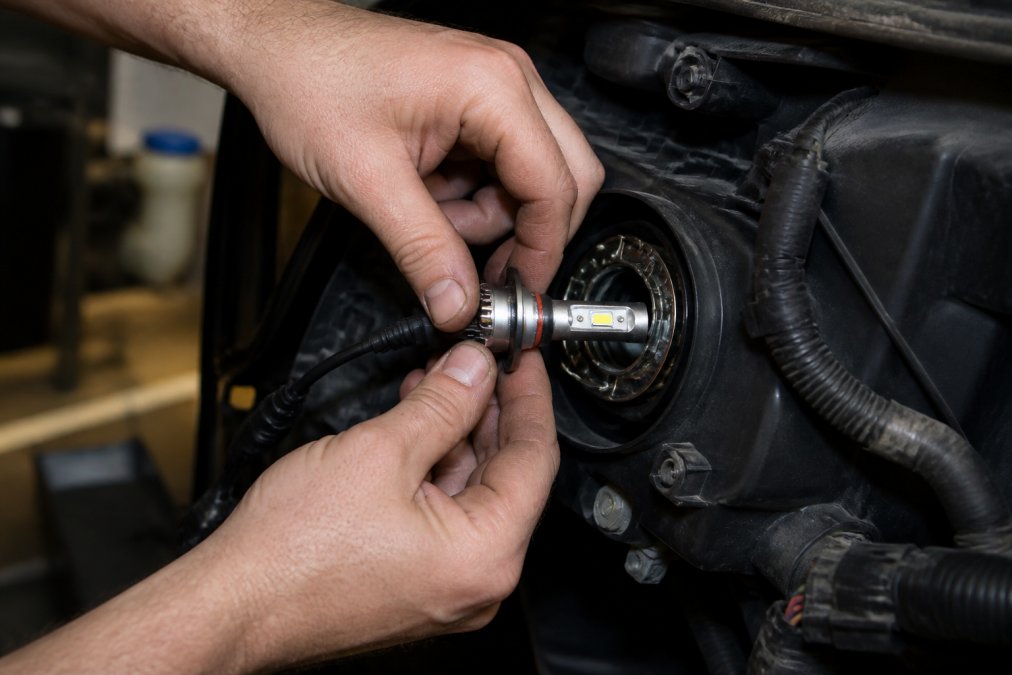
If you want a genuinely plug-and-play option, look for kits with built-in drivers and vehicle-specific connectors. RMS Lighting's H4 60W LED bulbs and H13 60W LED bulbs include built-in drivers and active cooling fans, so they avoid the external resistor clutter that trips up first-time installers.
Cold Weather, Heat Dissipation, and Environmental Trade-Offs
Cold weather performance and environmental impact are two areas where LED and halogen genuinely differ, and the results may surprise you.
Pros and Cons of LED vs Halogen Headlights: Which Upgrade Fits Your Vehicle?
The pros and cons of LED vs halogen headlights point to a clear answer for most drivers, but the right choice depends on your vehicle and priorities.
Choose LED if:
- You drive frequently at night and want maximum visibility
- You want to stop replacing bulbs every year or two
- Your vehicle has projector housings or a purpose-built LED application
- You value the crisp cool white look of 6500K light
Choose halogen if:
- You are restoring a classic vehicle to exact factory specification
- Your budget is the deciding factor
- Your housing is a sealed-beam or older reflector design that will not control an LED beam
Frequently Asked Questions
Should I replace my factory headlights with LED or halogen bulbs?
It depends on your priorities. Halogen bulbs cost less upfront and drop straight into stock housings, but they burn out faster and produce dimmer, yellower light. LED bulbs like the H4 and H13 pairs from RMS Lighting deliver 10,000 lumens at 6500K, use 60 watts, and carry a 2-year warranty. If you drive at night often or own an older vehicle with weak factory lighting, LED is the stronger long-term choice.
What are the downsides of LED headlights?
Three main ones. First, upfront cost: a quality pair runs around $35 to $50 versus a few dollars for halogen bulbs. Second, fitment: some older housings need retainers or adapters, and Canbus-equipped vehicles may throw dashboard warnings without a resistor. Third, beam pattern: a poorly positioned LED bulb can scatter light and glare at oncoming drivers. Choose a kit with a 360-degree beam angle and verify DOT compliance before buying.
Do LED headlight conversion kits require special installation?
Most modern kits are plug-and-play, meaning the bulb connector matches the factory harness. You remove the old bulb, seat the new one, and reconnect. The complications come from tight engine bays, retaining clips on certain H7 applications, and Canbus systems that need a resistor to prevent flickering or dash warnings. If you have never done wiring work, a kit with a built-in driver simplifies the process considerably.
How does the lifespan of an LED bulb compare to a halogen bulb?
LED bulbs typically last far longer than halogen. Halogen filaments degrade and burn out after a few hundred to roughly a thousand hours of use. LED chips have no filament to break and are rated for tens of thousands of hours, though heat management affects real-world life. RMS Lighting bulbs use an active cooling fan and operate from -40°C to +85°C, which helps protect the chip and driver over years of night driving.
Are halogen bulbs being phased out in the automotive industry?
Halogen is declining but not gone. Automakers increasingly fit LED as standard on new vehicles because of lower wattage draw, longer service life, and better visibility. Halogen remains common on older vehicles and budget trims, and replacement bulbs are still widely stocked. For owners of classic cars and older trucks, the practical question is not whether halogen disappears but whether an LED conversion preserves the factory look while improving illumination.
Upgrading your headlights should not mean gambling on fitment, dash warnings, or a beam pattern that blinds oncoming traffic. RMS Lighting LLC builds LED conversion kits with built-in drivers, active cooling fans, and correct left-hand-drive lens patterns, so the upgrade actually works the way it should. Browse the full range of H-series bulbs, confirm your fitment with our team, and drive with the visibility your vehicle deserves. Learn More