

7 Causes of Flashing 4 Wheel Drive Lights and Fixes

Last Updated: November 19, 2026
Quick Summary
Flashing 4 wheel drive lights mean the system detected a fault during engagement, usually from a failing transfer case shift motor, a bad sensor, corroded wiring, a blown fuse, low transfer case fluid, or a weak battery. Read your owner's manual for the blink pattern, then check the fuse, relay, and wiring before replacing parts.
- A steady 4WD light reports status, while a flashing light reports a failed engagement attempt.
- Blink patterns are vehicle-specific, so the owner's manual is the only reliable decoder.
- Pull over if the light flashes with grinding, clunking, binding, or driveline shudder.
- A 4WD light that stays on in 2WD often means a stuck shift motor or failed sensor.
- Off-road lights are generally not street-legal on public roads, and rules vary by state.
Table of Contents
- Two Kinds of 4 Wheel Drive Lights: Warning Indicators vs. Off-Road Lighting
- Flashing 4WD Light Causes: What the Blink Pattern Tells You
- 4WD Light Stays On: Engagement, Sensor, and Transfer Case Problems
- 4WD Light Not Coming On: Why Engagement Fails
- Choosing 4x4 Off-Road Lights: Beam Patterns, Output, and Compatibility
- Repair and Upgrade Costs: Fixing a Fault vs. Upgrading Your Lighting
- Match Your Lighting Kit to Your Vehicle Before You Order
- Frequently Asked Questions
Two Kinds of 4 Wheel Drive Lights: Warning Indicators vs. Off-Road Lighting
Search for 4 wheel drive lights and you'll hit two very different topics. One is the dashboard warning light tied to your four-wheel drive system. The other is the auxiliary lighting bolted to a truck's bumper. This guide covers both, because mixing them up sends people down the wrong repair path.
Here's the split that matters:
- A 4WD indicator light is a dashboard warning light that tells you whether four-wheel drive is engaged.
- 4x4 off-road lights are driving lights, fog lights, or light bars you add for visibility.
One is a diagnostic signal. The other is a lighting upgrade. Treat them as separate problems.
How the 4WD Dashboard Indicator Works
The 4WD indicator light is a simple status report from your vehicle's computer. It confirms that the transfer case has engaged and the front axle is getting power.
On a part-time 4WD system, the light should come on when you move the 4WD selector. It should go off when you switch back to 2WD. A steady light usually means normal operation.
That blink pattern is your first clue. We'll read it next.
Flashing 4WD Light Causes: What the Blink Pattern Tells You
A flashing 4WD light means the system detected a fault during engagement. The transfer case motor, a sensor, or a wiring connection failed the self-check. Unlike a steady light, which reports status, a flashing light reports a failed attempt, the computer commanded engagement and did not get confirmation.
Common causes of a flashing 4WD light include:
- A failing transfer case shift motor
- A bad wheel speed sensor or 4WD engagement sensor
- Corroded wiring or a loose electrical connection
- A blown fuse or stuck relay
- Low transfer case fluid
- A weak battery or poor ground that interrupts the engagement signal
Read the Blink Pattern Before You Touch Anything
Most manufacturers encode information in how the light flashes, and the pattern is vehicle-specific. A common pattern is a repeated sequence, for example, six flashes, a pause, then six more, that corresponds to a stored trouble code in the transfer case control module. Other vehicles use a simple continuous flash with no encoded sequence. Because the meaning varies by make, model, and 4WD system, the owner's manual is the only reliable decoder.
Match the Diagnosis to Your 4WD System Type
The troubleshooting path depends on how your system engages:
- Part-time, shift-on-the-fly systems use a transfer case motor and often an engagement sensor at the front axle. Flashing usually points to the motor or its position sensor.
- Electronic push-button systems add a control module and a selector switch. A failed switch or module can flash the light even when the mechanical parts are fine.
- Full-time and automatic systems rely on wheel speed and steering inputs. A bad wheel speed sensor can trigger a flash because the computer cannot confirm safe engagement.
A Step-by-Step Diagnosis Checklist
Start with the cheap checks before you touch the transfer case.
- Read the owner's manual for your specific blink pattern and engagement procedure
- Confirm the selector is fully in the commanded mode, partial selection causes false faults
- Check the 4WD fuse and relay
- Inspect wiring at the transfer case for corrosion, chafing, and loose connectors
- Scan for fault codes with an OBD2 scanner that reads transfer case and chassis codes, not just engine codes
- Check transfer case fluid level and condition
- Test the shift motor with a helper cycling the selector while you listen and watch the linkage
If you're pulling codes yourself, our walkthrough on how to use an OBD2 scanner for lighting faults shows the same scan process you'll use for 4WD codes. Watch out: clearing a code without fixing the cause just resets the light. It will come back, and you will have erased the evidence a technician needs.
When a Flashing Light Means Stop Driving
A flashing 4WD light is not always a drive-it-home condition, but some symptoms are. Pull over and seek service if you notice any of the following:
- Grinding, clunking, or whining from the transfer case or front axle
- Driveline shudder or binding in tight turns on dry pavement
- The light flashes while the vehicle behaves as if it is in 4WD when you selected 2WD
- Loss of traction or unusual steering pull
A light that flashes only during engagement and then goes steady is usually a minor fault. A light that flashes continuously with noise or binding is a mechanical warning. Treat the second case as a safety issue and have the vehicle towed rather than driven.
4WD Light Stays On: Engagement, Sensor, and Transfer Case Problems
When your 4WD light stays on, the system thinks it is still engaged. That is a real problem on dry pavement.
A steady light in 2WD mode usually points to one of three things:
- A stuck shift motor that cannot return the transfer case to 2WD
- A failed sensor sending a false "engaged" signal
- A mechanical bind inside the transfer case
Driving a part-time 4WD system on dry pavement causes binding and tire wear. If the light stays on and you feel driveline shudder, stop and get it checked. Recall and safety records for your model are worth checking with the National Highway Traffic Safety Administration.
4WD Light Not Coming On: Why Engagement Fails
A 4WD light not coming on means the system never engaged. You're driving in 2WD whether you know it or not.
The usual suspects are the same electrical chain in reverse. A dead fuse, a disconnected harness, or a failed selector switch will all keep the light dark.
Test it in a safe spot: shift into 4WD, then try a slow turn on loose ground. If the front wheels don't pull, engagement failed.
Choosing 4x4 Off-Road Lights: Beam Patterns, Output, and Compatibility
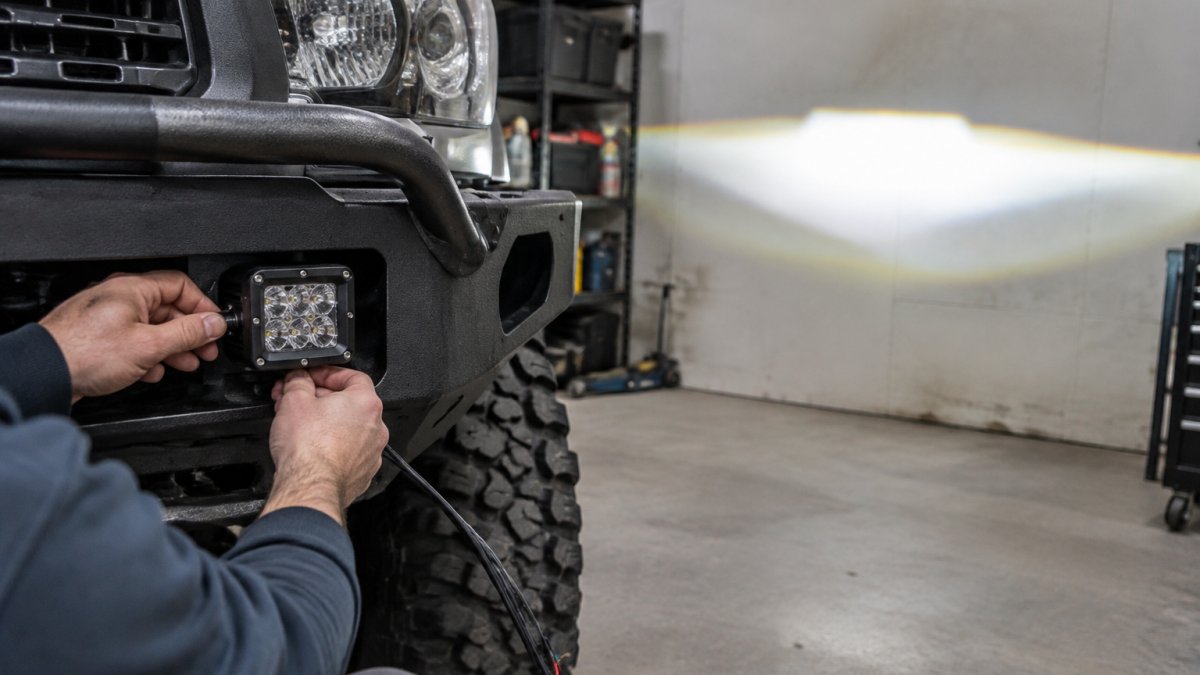
The right 4x4 off-road lights come down to beam pattern, output, and fit. Match those three to your terrain and you'll see better without blinding anyone.
Beam patterns do the real work:
- Spot beam: long, narrow throw for distance
- Flood beam: wide spread for close work and camp lighting
- Combo beam: both in one housing
Select by Terrain and Measurable Performance
Instead of shopping by wattage claims, compare lights on the specs that predict real-world results:
- Usable distance: how far the beam throws useful light, not just peak candela at the lens. A tight spot pod reaches farther than a flood, but a narrow beam is useless on winding trails.
- Beam width: flood and combo patterns cover close obstacles and camp areas; spot patterns leave the sides dark.
- Color temperature: around 5000K-6500K is common for LED; cooler light cuts glare in rain and snow less well than warmer light, which matters in fog and dust.
- Power draw: compare amperage at 12 volts, not just lumen ratings. A pair of large light bars can exceed what a factory circuit safely carries.
- Weather performance: fog and dust call for a low, wide cut-off; distance driving calls for a spot or combo aimed high and far.
A practical pairing is a combo bar for mixed terrain plus a pair of flood pods for camp and close work. Add a spot pod only if you regularly drive open trails where distance matters more than width.
Wiring, Aiming, and Legal Compliance
Off-road lights are generally not street-legal when used on public roads, and rules vary by state. Before you wire anything:
- Use a relay and a dedicated fused circuit rather than tapping a factory headlight wire. Confirm the wire gauge an LED light bar needs so you don't melt a harness.
- Aim lights below the horizon for any light that could reach oncoming traffic, and keep auxiliary lights on a separate switch so they can be turned off on the road.
- Check your state's rules on light height, number of forward-facing lamps, and whether covers are required when not in use. The legal requirements for aftermarket automotive lighting explain what's street-legal versus off-road only.
For a full look at why LED light bars outperform older halogen setups, read our guide on the benefits of LED light bars for off-road trucks.
| Light Type | Best For | Beam Pattern | Watch Out For |
|---|---|---|---|
| Spot pod | Long-distance trail | Narrow spot | Too much glare on road |
| Flood pod | Camp and work light | Wide flood | Short reach |
| Combo bar | Mixed terrain | Spot plus flood | Power draw |
| Fog light | Rain, dust, snow | Low, wide cut | Aim height |
Repair and Upgrade Costs: Fixing a Fault vs. Upgrading Your Lighting
Fixing a 4WD warning light and upgrading your lighting are two different budgets. Know which one you're spending on.
A flashing 4WD light is a repair. Costs depend on the part: a fuse or relay is cheap, a sensor is moderate, and a transfer case motor is the big-ticket item.
A lighting upgrade is a choice.
Before any aftermarket lighting purchase, check your state's rules. The legal requirements for aftermarket automotive lighting explain what's street-legal versus off-road only.
Match Your Lighting Kit to Your Vehicle Before You Order
Fitment is where most lighting upgrades go wrong. Confirm the bulb type before you buy, not after.
Check your owner's manual or the original bulb number.
If you want a factory look with modern output, our bulbs are designed to replace factory bulbs.
Sorting a flashing 4WD light from a lighting upgrade starts with knowing which system you're dealing with.
Frequently Asked Questions
Why is my 4WD light flashing?
A flashing 4WD light usually means the system cannot complete engagement or disengagement. Common causes include a faulty wheel speed sensor, a transfer case actuator that has not fully shifted, low or contaminated transfer case fluid, or a wiring or connector fault. A steady light means 4WD is engaged, while a flashing light is a fault signal. Get a diagnostic scan to pull the fault code before replacing parts, since sensor and actuator codes look similar on the dash but need different repairs.
Can I drive with the 4WD light on?
If the light is steady and 4WD is genuinely engaged, you can drive, but avoid dry pavement in part-time 4WD because the drivetrain binds in turns. If the light is flashing or stays on when you did not select 4WD, treat it as a warning: the system may be stuck in a mode you did not choose. Keep speeds low, avoid sharp turns, and have the fault code read soon. A flashing light combined with grinding or clunking means stop driving and call for service.
Why is my 4WD light not coming on when I press the selector?
Check the simple electrical items first: the 4WD fuse, the relay, and the selector switch connector. If those are fine, the transfer case actuator motor or the 4WD control module may have failed, or a wheel speed sensor is sending bad data that blocks engagement. Scan for fault codes before swapping parts. On older vehicles with manual hubs, confirm the hubs are locked, since the light will not illuminate until the front axle actually engages.
Are LED off-road lights legal on the road?
Auxiliary off-road lights such as light bars and spot pods are generally not legal for on-road use, and state rules may restrict their height, mounting, or number of forward-facing lamps. Fog lights and driving lights have their own rules, and headlamp replacements must meet federal standards for beam pattern and aim. Check your state's lighting statutes before mounting a light bar, and keep auxiliary lights on a separate switch so you can turn them off on public roads.
