


Benefits of LED Headlights for Night Driving

Table of Contents
- Why LED Headlights Change Night Driving
- Key Benefits of LED Headlights for Night Driving
- LED vs. Halogen Headlights: What Changes on the Road
- LED vs. HID Headlights: Practical Trade-Offs
- LED Headlight Glare and Proper Aiming
- LED Headlight Conversion Kit Compatibility and Installation
- How to Choose and Install an LED Upgrade
- Conclusion
- Frequently Asked Questions
Last Updated: October 4, 2026
Why LED Headlights Change Night Driving
The benefits of LED headlights for night driving come down to one thing: you see more of the road, sooner. LED headlamps produce brighter, whiter light than the halogen bulbs most older vehicles left the factory with. This guide from RMS Lighting LLC explains what changes on the road, where LED technology falls short, and how to upgrade without blinding oncoming drivers.
LED headlights use light-emitting diodes instead of a heated filament or an arc tube. The diode converts current directly into illumination, so LED headlamps reach full brightness instantly and draw far less power than the halogen bulbs they replace.
Halogen technology has barely changed in decades: a tungsten filament glows inside a halogen gas capsule, throwing a warm, yellowish light that fades with age. LED headlight upgrades replace that filament with a semiconductor, delivering a longer, wider view of the road.
Key Benefits of LED Headlights for Night Driving
Four benefits matter most: more usable light output, whiter light for contrast, lower electrical draw, and far longer service life. Each changes how the vehicle performs after dark, but only if the bulb matches the housing and the beam is aimed correctly.
Brighter Light Output and Longer Viewing Distance
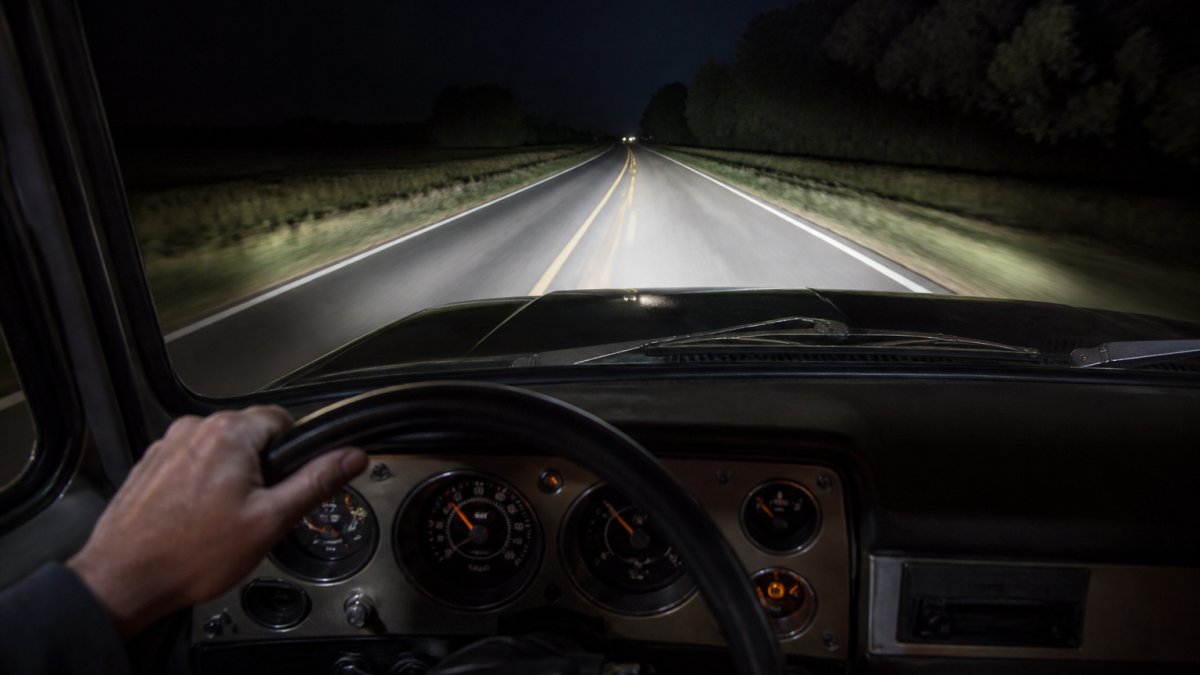
Lumen output is the headline number, but it is not the whole story. A factory halogen bulb produces a modest amount of light that drops as the filament ages, while a modern LED headlight bulb is rated in the thousands of lumens, our H4 and H7 LED bulbs, for example, are rated at 10,000 lumens per pair at 6500K.

More lumens do not automatically mean more usable light. What matters is how much output lands on the road ahead rather than scattering into the trees, signs, or oncoming lanes. Beam distance, how far ahead the light reaches at usable intensity, is what correlates with earlier warning of deer, debris, and unlit curves.
Drivers who upgrade correctly often notice the difference first at the edges of the beam, not the center. The wider spread catches the shoulder, the ditch, and the edge of the pavement.
Whiter Light and Improved Nighttime Visibility
Color temperature is measured in Kelvin, and it changes what your eyes can pick out. Halogen bulbs sit around 3000K to 3500K, a warm yellow tone, while LED headlamps commonly run at 6000K to 6500K, crisp white light.
That whiter light improves contrast against road markings, signs, and pavement edges, drivers often describe the road looking "cleaner" after an upgrade. It reflects more distinctly off retroreflective paint and signage, so lane lines and roadside markers stand out earlier.
There is a limit worth naming. Color temperature is not brightness, and pushing past about 6500K into blue-tinted territory can reduce usable visibility in rain, fog, or snow, because blue light scatters more in airborne moisture.
Lower Power Consumption and Less Electrical Load
LED bulbs draw a fraction of the current a halogen bulb needs for the same or greater light output. That matters most on older vehicles with aging alternators, marginal wiring, and small batteries.
Lower wattage means less heat in the housing, less strain on the charging system, and more headroom for auxiliary lighting. It also reduces voltage drop at the headlight connector, a common cause of dim halogen output on older harnesses.
Longer Lifespan and Lower Maintenance Costs
Halogen bulbs burn out, it is not a matter of if, but when, and the failure usually arrives at the least convenient moment. LED bulbs are rated for dramatically longer service life, meaning fewer replacements and lower maintenance costs over the life of the vehicle.
Replacement frequency drops sharply, along with the hassle of pulling housings apart every couple of years. For a daily-driven older vehicle, that reliability is worth as much as the brightness.
LED vs. Halogen Headlights: What Changes on the Road
The switch from halogen to LED changes three things immediately: how far you see, how clearly you see it, and how often you think about your bulbs.
Halogen bulbs produce a warm, yellowish beam that dims with age. LED headlights produce a whiter beam that holds its output far longer. On a dark rural road, that difference shows up as earlier warning of deer, debris, and unlit curves.
There is a catch worth naming. A cheap LED bulb dropped into a housing designed for a halogen filament can scatter light badly, producing a bright but useless wash that lights up signs and oncoming drivers while leaving the road dim. The bulb must match the housing's optics.
| Factor | Halogen | LED |
|---|---|---|
| Color temperature | ~3000-3500K warm yellow | ~6000-6500K cool white |
| Warm-up time | Instant | Instant |
| Power draw | Higher for given output | Lower for given output |
| Service life | Short, dims with age | Long, holds output |
| Heat | Radiates forward into housing | Managed by built-in cooling |
LED vs. HID Headlights: Practical Trade-Offs
HID headlights, also called xenon, use an electrical arc inside a gas-filled capsule rather than a filament or a diode.
Startup and warm-up. HID capsules need a ballast to strike the arc, and that arc takes several seconds to reach full brightness, some systems take 10 to 30 seconds to stabilize, flickering or shifting color in that window.
Color shift over time. As an HID capsule ages, its color temperature drifts, often toward purple or blue, and output drops, so a bulb that started crisp white can end up dim and off-color.
RMSH4M2S - 60W 10K Lumens LED Bulb's (Pair) 6500K →
Wiring and failure points. A ballast is an extra electronic component that must be mounted, wired, and protected from heat and moisture, one more thing that can fail and leave the headlight dark. LED bulbs integrate their driver into the bulb base, so there is no external ballast and no high-voltage component to route.

Heat management. HID capsules radiate heat forward into the housing, which is why some HID retrofits cook reflectors and lenses over time.
| Factor | Halogen | HID (Xenon) | LED |
|---|---|---|---|
| Light source | Heated filament | Electrical arc in gas | Semiconductor diode |
| Warm-up | Instant | Several seconds to full output | Instant |
| External hardware | None | Ballast required | Driver integrated into bulb |
| Color stability | Dims and yellows with age | Shifts color as capsule ages | Holds color temperature |
| Heat direction | Radiates forward | Radiates forward | Managed at bulb base |
| Retrofit complexity | Baseline | High (ballast, wiring, fitment) | Low (plug-and-play options) |
For a plug-and-play upgrade on an older vehicle, LED is the simpler, more predictable path: no external ballast, no warm-up delay, and no high-voltage components.
LED Headlight Glare and Proper Aiming
Glare is the number one complaint about LED headlight upgrades, and it is almost always an aiming problem, not a bulb problem. A correctly aimed LED headlamp puts light on the road.
Two things control glare: the beam cutoff and the bulb's position inside the housing. The cutoff is the sharp horizontal line at the top of the beam that stops light rising into oncoming traffic. If the bulb's light source sits even a few millimeters off from where the original filament sat, the cutoff blurs.
Proper aiming fixes most of this. Park on a level surface facing a wall, mark the horizontal center of each beam, and adjust until the top of the cutoff sits slightly below the marked line. Re-aim any time you change bulbs or ride height.
LED Headlight Conversion Kit Compatibility and Installation
Compatibility is where most upgrades succeed or fail. Before buying, confirm three things: your bulb type, your housing style, and whether your vehicle needs a canbus adapter or resistor to avoid error codes.
Bulb type is the starting point. Check your owner's manual or the original bulb number. Common types include H4, H7, and H8/H9/H11, and each fits a different housing.
Housing style matters just as much. Sealed beam headlights, common on older cars and trucks, do not accept a drop-in bulb because the lens and reflector are one sealed unit, those vehicles need a full conversion kit that replaces the entire housing.
A conversion kit solves the sealed beam problem by pairing a new glass housing with a matched LED bulb. Our 7" Gen2 Round Headlight Conversion Kit replaces factory 7" sealed beam headlights with an OE-style glass housing and a 10,000-lumen H4 LED bulb, keeping the original factory look while adding modern output.

For vehicles with standard replaceable bulbs, a bulb-only upgrade is often enough. Match the bulb type, verify the housing accepts an LED, and check whether your vehicle needs a canbus-compatible bulb to prevent dashboard error codes.
How to Choose and Install an LED Upgrade
Choosing the right LED headlight upgrade comes down to fitment, output, and beam quality, in that order.
- Identify your bulb type. Check the owner's manual or the original bulb number. Write it down.
- Confirm your housing style. Sealed beam units need a full conversion kit; replaceable-bulb housings accept a bulb upgrade.
- Decide on output. Higher-lumen bulbs deliver more light, but only if the housing can focus it. Match output to your housing's design.
- Check for canbus or error-code issues. Some vehicles need a compatible bulb or adapter to avoid hyper-flashing or dashboard warnings.
- Verify beam pattern after install. Aim the lights against a wall and confirm a sharp cutoff before driving.
- Re-aim and road-test. Adjust until the beam sits correctly and no light spills into oncoming lanes.
For most older vehicles, start with a bulb upgrade matched to your existing housing. If you run sealed beam headlights, a full conversion kit is the only path that preserves the factory look while adding LED performance.
Conclusion
Upgrading to LED headlights improves safety, visibility, and reliability at the same time, provided the bulb matches the housing and the beam is aimed correctly. Get those two things right and the difference on a dark road is immediate.
At RMS Lighting LLC, we build LED headlamp conversion kits and bulbs that replace factory components with ease, from plug-and-play H4, H7, and H8/H9/H11 bulbs to complete 7" round conversion kits with OE-style glass housings. Every product is rigorously researched and tested, backed by a 2-year warranty, and designed to keep your vehicle looking factory-correct while delivering modern light output.
Get started with RMS Lighting LLC and see the road ahead more clearly on your next night drive.
Frequently Asked Questions
What is the downside of LED headlights?
LED headlights can cause glare for oncoming drivers if they are not properly aimed or if the bulb is placed in a housing not designed for LED. They also require good thermal management; cheap kits without cooling fans may overheat and fail early. Additionally, some LED retrofits are not street-legal depending on local regulations, so check compatibility and aiming before buying.
Are LED headlights brighter than halogen headlights?
Yes, LED headlights typically produce more lumens and a whiter light than halogen bulbs. For example, a 60W LED bulb can output 10,000 lumens, while a standard halogen bulb might produce around 1,000 to 1,500 lumens. This extra light output translates to better nighttime visibility and longer viewing distance, but it must be aimed correctly to avoid blinding others.
Can LED headlights cause glare for other drivers?
They can if the beam pattern is not controlled. Proper aiming and a compatible housing with a sharp cutoff are essential. Some LED conversion kits, like the RMS Lighting 7" Gen2 Round Headlight Conversion Kit, feature adjustable bases for optimal beam alignment and light distribution. Always follow state inspection rules and aim your lights according to the manufacturer's instructions.
Are LED headlight conversion bulbs compatible with every vehicle?
No, compatibility depends on the bulb type (e.g., H4, H7, H11) and the vehicle's electrical system. Some older vehicles may need additional adapters or resistors to prevent error codes or hyper-flashing. Always verify your original bulb number and consult the product listing or customer support before ordering. RMS Lighting offers kits for many classic and modern vehicles.