

Is It Safe to Use LED Fog Lights? A 2026 Review

Table of Contents
- LED vs Halogen Fog Lights: Key Differences
- DOT Compliance for LED Fog Lights
- LED Fog Light Beam Pattern Issues
- How to Install LED Fog Lights Safely
- Canbus, Flicker, and Electrical Compatibility
- Pros and Cons of LED Fog Lights
- Conclusion
- Frequently Asked Questions
Last Updated: September 12, 2026
LED vs Halogen Fog Lights: Key Differences
Is it safe to use LED fog lights? Yes, if the bulbs go into a housing designed to control their output. The longer answer involves beam geometry, heat, and federal lighting standards.

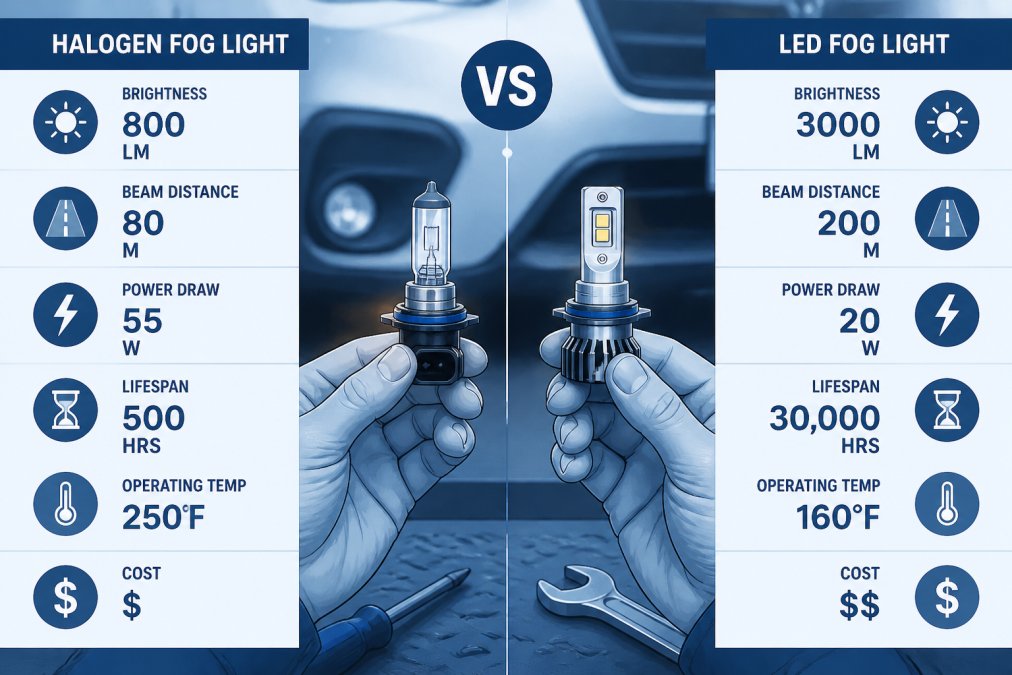
Fog lights are auxiliary lamps mounted low on a vehicle's front end, projecting a wide, low beam under rain, fog, or snow so the driver can see the road edge without the glare that reflects back from a high-mounted headlamp. Halogen fog lamps have been the factory standard for decades because they are cheap, dim, and forgiving. LED fog lights change that equation in ways that matter to safety and legality.
The core difference: a halogen bulb is a filament radiating heat in every direction, and the reflector housing is designed around that spread. An LED bulb is a small array of diodes on a heat sink, and where those diodes sit inside the housing determines whether light goes where you need it or into oncoming traffic.
Lumen Output and Color Temperature
Lumen output is the total visible light a bulb produces; color temperature is its hue in kelvin. Factory halogen fog bulbs typically produce warm, yellowish light in the 3,000K to 3,500K range (energy.gov). LED fog light bulbs commonly run 6,000K to 6,500K, reading as crisp white with a slight blue cast.
The practical difference is contrast: warm light cuts through fog and snow with less backscatter, while cool white light renders road markings and signs more sharply. Neither is universally better.
For a sense of what the market offers, the U.S. Department of Energy's lighting standards guidance explains how lumens and color temperature are defined and measured, which helps when comparing claims on a product listing.
Heat Dissipation and Housing Compatibility
Heat is where most cheap LED conversions fail. A halogen bulb tolerates heat because it generates it; an LED bulb generates heat at its base and must shed it through a heat sink or fan. If the housing traps that heat, the diode degrades and output drops.
RMS Lighting LLC builds its bulbs around 6063 aviation-grade aluminum construction, chosen for efficient heat dissipation. Aluminum mass and surface area decide whether an LED bulb lasts or fades.
Housing compatibility is the second variable: a reflector designed for a filament has a different focal point than one designed for a diode array, and when the two do not match, output scatters.
DOT Compliance for LED Fog Lights
DOT compliance for LED fog lights means the lamp assembly meets Federal Motor Vehicle Safety Standard 108, enforced by the National Highway Traffic Safety Administration. It applies to the lamp, not the bulb.
That distinction trips up a lot of buyers. Swapping a bulb does not create a compliant lamp; the housing must already be certified, and the replacement bulb must preserve the beam pattern the housing was certified to produce. A NHTSA overview of Federal Motor Vehicle Safety Standard 108 lays out the performance requirements, including photometry and glare limits.
What FMVSS 108 Actually Requires of a Fog Lamp
FMVSS 108 incorporates by reference SAE J583, "Front Fog Lamps," which defines the photometric grid a fog lamp must satisfy. Key requirements:
- A sharp upper cutoff. Above a defined horizontal line, the lamp may emit only a small fraction of its peak intensity, keeping light out of oncoming drivers' eyes.
- A wide, low spread. The beam must be broad enough to illuminate the road edge and lane markings at close range, the entire purpose of a fog lamp.
- Minimum and maximum intensity zones. SAE J583 specifies test points across the beam pattern, each with a permitted candela range. A lamp can fail by being too dim in one zone or too bright in another.
- A marking requirement. Compliant lamps carry a DOT symbol, the manufacturer's name or trademark, and a code identifying the lamp type, typically molded into the lens or housing.
How to Verify a Lamp Is Actually Compliant
The fastest check is physical: look for the DOT marking on the lamp itself, not the box or listing. A listing claiming "DOT approved" or "SAE certified" without a corresponding marking on the hardware is making a claim the manufacturer may not be able to support.
A second check is the manufacturer's documentation: a legitimate maker can point to the test report or the specific SAE standard the lamp was designed to meet. If a seller cannot name the standard, that is a signal.
A third check applies to aftermarket LED housings sold as complete assemblies. These are the only LED fog lamps that can be independently compliant, because housing and light source are certified together. A standalone LED bulb dropped into a factory halogen housing is not a certified lamp, no matter how it is marketed.
The Practical Legal Consequences
State inspection programs vary, but many check fog lamp aim and function, and a lamp failing FMVSS 108 photometric requirements can be cited. More importantly, a non-compliant lamp that contributes to a collision can become a liability question in civil litigation.
OEM vs. Aftermarket Compliance
A factory fog lamp is certified as a complete assembly. An aftermarket LED fog lamp assembly can also be certified, but only if the manufacturer tested it to SAE J583 and marked it accordingly. An aftermarket LED bulb is a replacement light source, not a lamp, and cannot carry a DOT compliance claim on its own.
Compliance lives with the housing. If you keep your factory housings, the safest path is a bulb whose emitter geometry matches the original filament position, preserving the certified beam pattern. If you replace the whole assembly, buy one carrying the DOT marking and naming SAE J583 in its documentation.
LED Fog Light Beam Pattern Issues
LED fog light beam pattern issues are the most common complaint after a conversion, and they trace to one of three causes: a diode array sitting too far forward, a 360-degree bulb the reflector cannot focus, or a fluted lens never designed for a point source.
A fog lamp's job is a wide, flat, low beam with a sharp cutoff. When the pattern is wrong, you get less usable light on the road and more glare for everyone else.
Why Reflector Housings Struggle With LED Bulbs
A halogen fog lamp housing is an optical system built around a single, small, roughly spherical light source: the filament. The reflector's surface is shaped so light radiating from that one point bounces forward into a controlled beam with a cutoff.
An LED bulb is not one point source. It is typically two or more chips on opposite sides of a metal stalk, each emitting in a broad arc. Inside a reflector designed for a filament, the reflector receives light from several positions at once, producing several overlapping beams instead of one, and no clean cutoff.
This is the mechanism behind the glare complaint. It is not that LED bulbs are too bright; it is that the housing cannot focus them. A dimmer LED bulb in the same housing produces the same scattered pattern, just less of it.
The Three Failure Modes, Explained
Emitter position mismatch. The filament sits at a specific depth relative to the socket flange, and the reflector is designed around that depth. If the LED chip sits even a few millimeters forward or back, the focal point shifts and the beam narrows into a hotspot or spreads into a wash. This is the most common cause.
360-degree emission. Some LED bulbs use a cylindrical chip arrangement radiating in all directions. In a projector housing this can work; in a reflector housing, light aimed backward and sideways is not captured, so it escapes as stray light or is absorbed, leaving the forward-facing portion too weak for a proper beam.
Fluted or diffused lenses. Many factory fog lamps use a lens with molded flutes or a diffusing texture designed for the halogen filament's output pattern. An LED bulb's different emission geometry interacts with the flutes unpredictably, producing a pattern the lamp was never certified to produce.
How to Diagnose a Bad Beam Pattern
The test is simple and needs no equipment. Park on level ground facing a wall or garage door at roughly 25 feet, turn on the fog lamps only with headlamps off, and step back to look at the pattern.
A correct fog lamp pattern has three features:
- A distinct horizontal cutoff line, with the top edge of the beam well below the height of the lamp itself.
- A wide, even spread across the bottom of the pattern, with no bright hotspot in the center.
- No light above the cutoff line. A fuzzy glow or scattered patches above the line mean the housing is not focusing the bulb.
If the pattern fails any of these, the problem is the bulb-to-housing match, not the lumen rating. A brighter bulb makes the failure worse.
Why More Lumens Is the Wrong Fix
A fog lamp's usefulness depends on where the light goes, not how much there is. A 10,000-lumen bulb in a scattering housing produces a bright, useless smear that blinds oncoming traffic; a 3,000-lumen bulb with a correctly positioned emitter produces a usable beam with a clean cutoff.
The fix is matching the bulb's emitter position to the housing's focal point. A correctly positioned chip array with a stated emitter depth matters more than a higher wattage rating. If a listing does not state emitter position, the beam pattern is a gamble.
The Projector Alternative
Some vehicles use projector-style fog lamps. A projector uses a lens and cutoff shield to shape the beam and is more tolerant of different light source geometries because the shield, not the reflector, defines the cutoff. LED bulbs tend to perform better in projector fog lamps, though the emitter still needs to sit near the lens's focal point.
If your vehicle has reflector fog lamps and you want a guaranteed-correct beam pattern, the most reliable path is a complete LED fog lamp assembly certified as a unit, not a bulb swap into the factory housing.
How to Install LED Fog Lights Safely
Safe installation comes down to four checks before you touch a wire: confirm the housing is DOT-certified, the bulb type matches the socket, the emitter sits at the same depth as the original filament, and you can aim the lamp afterward. Skip any one and the rest does not matter.
Step-by-Step Installation
- Disconnect the negative battery terminal before touching any lighting circuit.
- Access the fog lamp from behind the bumper or through the wheel well, depending on the vehicle.
- Remove the factory bulb by twisting the socket counterclockwise, then unplug the connector.
- Compare the new LED bulb's emitter position to the old filament; if it sits noticeably deeper or shallower, the beam will not focus correctly.
- Seat the new bulb, reconnect the plug, and secure the retaining ring or clip.
- Reconnect the battery and test both lamps before reassembling trim.
- Aim the lamps against a wall at roughly 25 feet, with the cutoff sitting below the horizontal centerline of the lamp.
Expected result: a wide, flat beam with a visible cutoff and no upward spill above the line.
Common Mistakes to Avoid
The most frequent error is buying on lumen count alone, a 10,000-lumen bulb in a housing that cannot focus it produces a bright, useless smear. The second is ignoring polarity; many LED bulbs are polarity-sensitive, and a reversed connector produces a lamp that does not light. The third is skipping the aim step, which keeps you legal and other drivers safe.
Canbus, Flicker, and Electrical Compatibility
Canbus and flicker issues happen because modern vehicles monitor bulb resistance to detect a burned-out lamp. An LED bulb draws far less current than a halogen, so the computer reads it as a fault and either triggers a dashboard warning or cuts power in pulses, showing up as flicker.
Three fixes exist: a canbus-ready bulb with a built-in resistor solves it at the source; an inline load resistor solves it after the fact, though it generates heat and must be mounted to metal; coding the lighting module to accept LED lamps solves it cleanly, if supported.
Bulb compatibility runs parallel: a bulb that physically fits the socket can still be electrically wrong for the vehicle, which is why RMS Lighting LLC maintains a range of LED bulbs covering many vehicles rather than a single universal part. If a cheap kit threw error codes, the problem was almost certainly resistance, not LED technology.
Pros and Cons of LED Fog Lights
| Factor | LED Fog Lights | Halogen Fog Lights |
|---|---|---|
| Lumen output | Higher, often 8,000-10,000 per pair | Lower, typically 1,000-1,500 per pair |
| Color temperature | 6,000K-6,500K cool white | 3,000K-3,500K warm yellow |
| Lifespan | Long, no filament to burn out | Shorter, filament degrades |
| Heat | Concentrated at the base, needs dissipation | Radiated broadly, self-tolerating |
| Beam focus | Depends entirely on housing match | Forgiving, designed for the housing |
| Canbus risk | Possible on monitored vehicles | None |
| Cost per pair | Higher upfront | Lower upfront |
What works. LED fog lights deliver more usable light at lower current draw, and cool white output makes road edges and markings easier to read. The lifespan advantage is real; there is no filament to fail.
What does not. They are unforgiving of a mismatched housing, can trigger canbus faults, and cheap units with poor thermal management lose output within months. Halogen remains the safer default if you will not verify housing compatibility.
Conclusion
The real challenge with LED fog lights is not the technology; it is matching a bulb to a housing certified to focus it. Get that wrong and you get glare, error codes, and a lamp that lights up the fog instead of the road.
RMS Lighting LLC builds conversion kits and bulbs around that exact problem, with correct left-hand-drive lens patterns and original-style kits that install without modification. Every product is researched and tested before it ships.
Get started with RMS Lighting LLC and upgrade your fog lights with components chosen for your vehicle, not a universal guess.
Frequently Asked Questions
Can I use LED lights for fog lights?
Yes, you can use LED lights for fog lights, but safety depends on the bulb meeting DOT compliance and fitting your housing correctly. LED fog lights produce a brighter, whiter light than halogen, which can improve visibility in fog, rain, or snow. However, if the beam pattern scatters or the color temperature is too high, you may blind other drivers. Always choose bulbs designed for your specific fog light housing and verify they meet SAE standards for street legal use.
Are LED fog lights compatible with my vehicle's electrical system?
Most modern vehicles can run LED fog lights without issues, but older cars or those with canbus systems may need a resistor or anti-flicker module. Canbus systems monitor bulb resistance and can trigger dashboard error codes or hyper-flashing if the LED draws less power than the original halogen. Check your vehicle's year and electrical setup before buying. Plug-and-play kits with built-in canbus compatibility reduce installation headaches and ensure stable performance.
What are the common problems with LED fog lights?
Common problems include beam pattern scatter, glare for oncoming drivers, canbus errors, flicker, and overheating in poorly ventilated housings. Scatter happens when an LED bulb is placed in a reflector housing designed for halogen, causing light to spread instead of focus. Flicker and error codes occur when the vehicle's computer doesn't recognize the lower power draw. Thermal management is critical; cheap LEDs without heat sinks can dim or fail prematurely. Choosing quality bulbs with proper heat dissipation avoids these issues.
Are there any legal restrictions on using LED fog lights?
Yes, legal restrictions vary by state, but federal DOT compliance is the baseline. Fog lights must meet SAE J583 standards for beam pattern, intensity, and color. Many states prohibit using fog lights in clear weather or require them to turn off with high beams. Aftermarket LEDs that don't meet DOT compliance can fail inspection or result in a fix-it ticket. Check your state's lighting laws and always choose street legal LED fog lights to avoid penalties.
Do LED fog lights provide better visibility than halogen?
LED fog lights typically provide better visibility than halogen due to higher lumen output and a cooler color temperature, which can improve contrast in fog and rain. However, too high a color temperature (above 6000K) can reflect back and reduce visibility in actual fog. The key is a focused beam pattern that cuts under the fog layer. Halogen bulbs are less efficient and dimmer, but they produce a warmer light that some drivers prefer in heavy fog. Properly aimed LEDs with a sharp cutoff offer the best balance.