



LED Headlight Cooling Systems Explained

Table of Contents
- What Is an LED Headlight Cooling System?
- Why Heat Dissipation Matters for LED Longevity
- Fanless vs Fan LED Headlights: Active and Passive Cooling
- Best High Performance LED Headlight Bulbs and Thermal Design
- Common Causes of LED Headlight Failure and Thermal Overload
- Thermal Paste, Interface Materials, and OEM vs. Aftermarket Design
- Troubleshooting LED Headlight Thermal Issues
- Conclusion
Last Updated: August 26, 2026
What Is an LED Headlight Cooling System?
An LED headlight cooling system is a thermal management mechanism designed to dissipate heat generated by LED chips and driver electronics, ensuring optimal performance and longevity. Unlike halogen bulbs that waste energy as heat, LED headlights convert most electrical input into light, but the concentrated energy still produces significant thermal stress. The cooling system transfers this heat away from critical parts through conduction, convection, or active airflow.
LED headlight cooling systems come in two primary forms: passive systems that rely on heat sinks and aluminum housings, and active systems that use small fans or forced-air designs. Both solve the same fundamental problem: unchecked heat degrades LED chips, shortens lifespan, and causes lumen depreciation. A well-designed cooling system keeps the junction temperature (where the LED chip connects to its substrate) within safe operating ranges, typically between -40°C and +85°C (ies.org).
RMS Lighting LLC designs LED headlight solutions with thermal management at the core. Their D1 replacement LED bulbs feature fan-cooled designs rated for extreme temperature ranges, delivering 10,000 lumens while maintaining consistent light output. Understanding how these systems work helps you choose the right upgrade and avoid thermal failures that plague cheaper alternatives.

Why Heat Dissipation Matters for LED Longevity
Heat is the silent killer of LED performance. The LED chip is a semiconductor that emits light when current flows through it. As current increases to produce bright light, heat generation increases exponentially. Without proper thermal management, junction temperatures climb rapidly and the LED chip degrades almost immediately.
The relationship between temperature and lifespan is not linear. A 10-degree increase in junction temperature can cut the LED's useful life in half (peer-reviewed research). A bulb rated for 50,000 hours at 50°C might deliver only 25,000 hours at 60°C. For automotive applications where reliable illumination is essential, this degradation becomes a real problem within a year or two of heavy use.
Heat also affects light quality directly. As the LED chip heats up, its color temperature shifts (becoming more yellow or orange) and its light output drops through lumen depreciation. A headlight that started at 10,000 lumens might fade to 7,000 or 8,000 lumens as internal temperatures climb. The beam pattern can also scatter or shift, reducing nighttime visibility.
Driver electronics, the circuit board that regulates current to the LED chip, are equally vulnerable to heat damage. These circuits contain capacitors, resistors, and voltage regulators that fail at elevated temperatures. A failed driver means the bulb stops working entirely. Proper thermal design keeps both the LED chip and driver electronics cool, ensuring years of reliable performance.
Fanless vs Fan LED Headlights: Active and Passive Cooling
The cooling method you choose depends on your vehicle's design constraints, climate, and performance priorities. Passive cooling relies on heat sinks and conduction; active cooling uses fans or forced-air designs.
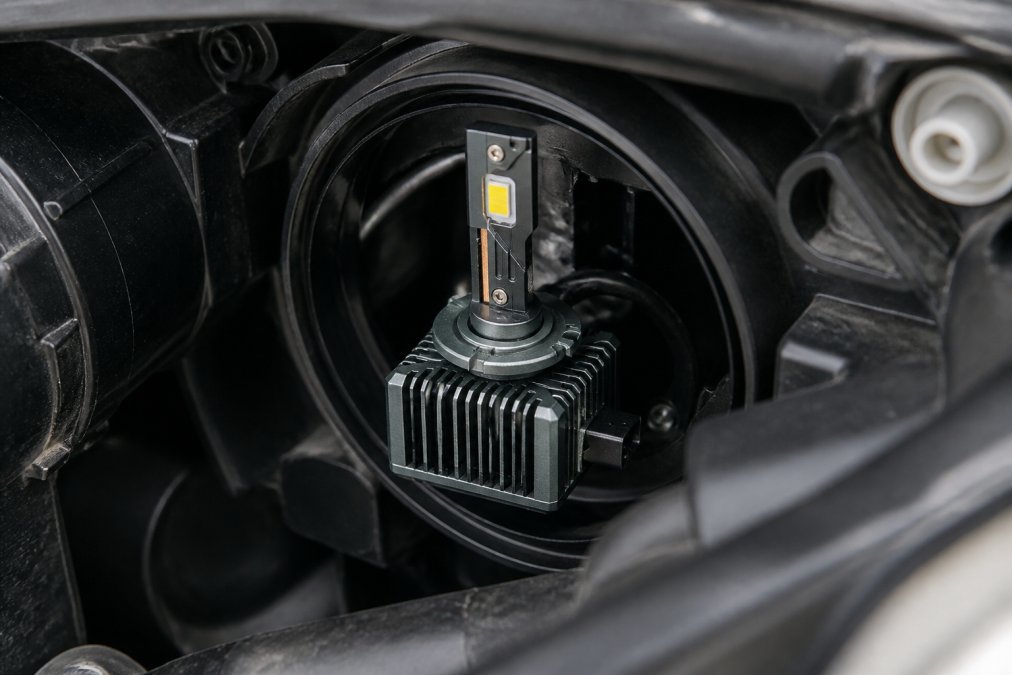
How LED Headlight Fans Work
Active cooling systems use small electric fans (typically 5-12 volt DC) mounted inside or near the headlight housing to force air across the heat sink and LED components. The fan draws power from the vehicle's electrical system through a dedicated relay triggered when headlights turn on. As the fan spins, it carries heat away from the LED chip and driver electronics, maintaining lower junction temperatures even during extended driving or hot weather.
The advantage is straightforward: active cooling is highly effective. A well-designed fan-cooled system can maintain junction temperatures 15-25°C lower than a comparable fanless design, translating directly to longer lifespan and more stable light output (peer-reviewed research). RMS Lighting LLC's fan-cooled D1, D2, D3, and D4 replacement LEDs all feature this active cooling approach, with fans engineered to operate reliably across -40°C to +85°C.
The drawbacks are reliability and complexity. Fans are moving parts that eventually wear out. Bearings can seize, motors can burn out, and dust can clog blades. If the fan fails, the bulb loses its primary cooling mechanism and junction temperatures spike, causing rapid degradation. Installation is also more involved, you need to route power to the fan and ensure adequate airflow, which isn't always possible in tight headlight housings.
Passive Cooling and Heat Sinks
Fanless LED headlights rely entirely on passive heat dissipation through aluminum heat sinks and conduction pathways. The heat sink is typically a large aluminum block with fins that increase surface area. Heat flows from the LED chip through a thermal pathway into the heat sink, where it radiates into the surrounding air. No moving parts, no power draw, no maintenance.
Passive systems are simpler, more reliable, and easier to install in tight spaces. They work in any climate and can operate for decades without degradation. The trade-off is thermal performance. Without forced airflow, passive systems rely on natural convection and radiation alone, which is significantly slower than active cooling. Junction temperatures tend to run 15-25°C higher than fan-cooled equivalents, reducing lifespan and increasing the risk of lumen depreciation.
Passive cooling works best in moderate climates and for vehicles that don't run headlights for extended periods. If you live in a hot region or frequently drive at night for hours, passive cooling may not be sufficient.
| Cooling Type | Thermal Performance | Reliability | Installation Complexity | Best For |
|---|---|---|---|---|
| Active (Fan-Cooled) | Excellent (15-25°C lower) | Good if maintained | Moderate to high | High-performance, hot climates, extended use |
| Passive (Fanless) | Good | Excellent | Low | Moderate climates, occasional use, tight spaces |
Best High Performance LED Headlight Bulbs and Thermal Design
High-performance LED headlight bulbs combine advanced thermal design with optimized LED chips and driver electronics to deliver maximum light output while maintaining safe operating temperatures. The best designs use multiple strategies: efficient LED chips that waste less heat, optimized driver circuits that minimize power loss, and strong heat sinks that maximize thermal conductivity.
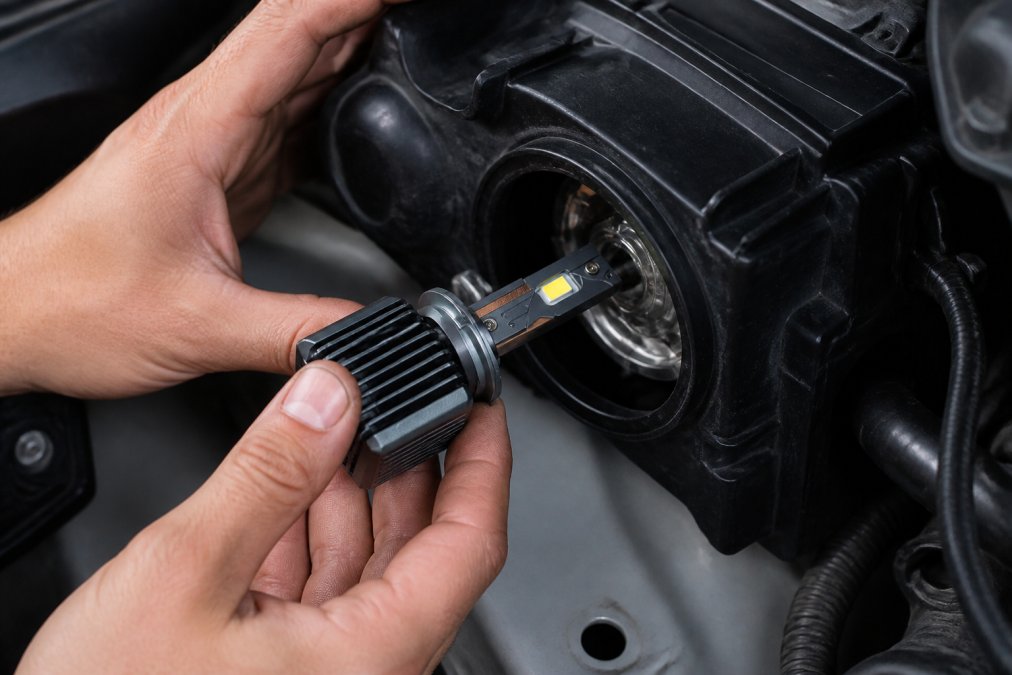
RMS Lighting LLC's LED replacement bulbs represent this integrated approach. The D1 Replacement LED 100W uses a 4575 LED chip with a 100-watt power rating and fan-cooled design to deliver 10,000 lumens in 6500K color temperature. The D2 Replacement LED 86W, D3 Replacement LED 108W, and D4 Replacement LED 116W scale power and thermal capacity to match different vehicle housings, all maintaining the same safe operating temperature range.


The key differentiator in high-performance designs is the thermal interface material, typically thermal paste or thermal pads that bridge the gap between the LED chip and the heat sink. Poor thermal interface contact creates air gaps that block heat transfer, causing junction temperatures to spike even with adequate heat sinks. Quality thermal paste has high thermal conductivity and fills microscopic surface irregularities, ensuring maximum contact and heat flow.
OEM LED headlights often use more sophisticated thermal pathways than aftermarket bulbs, engineered for specific housing and airflow characteristics. Aftermarket LED headlights must work across multiple vehicle designs, forcing compromises. The best aftermarket designs compensate with oversized heat sinks, more efficient LED chips, or active cooling.
Common Causes of LED Headlight Failure and Thermal Overload
Most LED headlight failures trace back to thermal mismanagement.
Thermal runaway occurs when junction temperature climbs beyond the safe operating range. The LED chip becomes less efficient as it heats, generating more heat per unit of light output. This creates a feedback loop where temperatures spiral upward until the driver electronics shut down or the LED chip burns out.
Lumen depreciation happens gradually as the LED operates at elevated temperatures. Light output fades noticeably over a few hundred hours, leaving you with dim, yellowed headlights. This is the most common complaint about cheap LED kits.
Driver circuit failure is another common mode. Voltage regulators and current-limiting circuits are sensitive to heat. Capacitors fail first, causing voltage spikes that destroy the LED chip. Once the driver fails, the entire bulb is dead.
Thermal cycling stress occurs in climates with large temperature swings. The LED chip, heat sink, and housing materials expand and contract at different rates. Over hundreds of thermal cycles, mechanical stress creates micro-fractures in solder joints.
Condensation and moisture ingress can trigger thermal failure indirectly. Moisture condensing on the LED chip or driver electronics creates electrical leakage paths that cause short circuits and thermal spikes. Proper housing ventilation and sealed thermal pathways prevent this.
Thermal Paste, Interface Materials, and OEM vs. Aftermarket Design
The thermal interface between the LED chip and the heat sink is critical. Even a tiny air gap creates significant thermal resistance that blocks heat transfer. This is why the quality of thermal paste matters.
Good thermal paste has thermal conductivity in the range of 3-5 watts per meter-kelvin. It's thixotropic, staying where you put it without running, and maintains its properties across the full operating temperature range. When applied correctly in a thin layer, it fills surface irregularities and creates a continuous thermal pathway.
Poor-quality thermal paste (or no paste at all) can increase junction temperature by 10-20°C compared to proper installation. Some cheap LED kits use dry thermal pads that lose effectiveness over time. Others skip thermal paste entirely, relying on mechanical contact alone, a recipe for rapid failure.
OEM LED headlights often use proprietary thermal interface materials optimized for their specific housing design. Aftermarket designs must make compromises, using standard thermal paste or thermal pads available to multiple manufacturers. The best aftermarket designs specify high-quality thermal interface materials and provide clear installation instructions.
OEM designs also benefit from housing optimization. The headlight enclosure itself acts as a heat sink and thermal pathway. Engineers design airflow patterns, material selections, and component placement to maximize heat dissipation. Aftermarket bulbs must work in whatever housing exists. The best aftermarket designs compensate with oversized heat sinks and active cooling.
Troubleshooting LED Headlight Thermal Issues
If your LED headlights are dimming, flickering, or failing prematurely, thermal issues are the most likely culprit.
Check for visible heat damage. Remove the headlight and inspect the LED bulb and housing for discoloration, warping, or burn marks. Dark spots or burnt areas indicate the bulb has been running too hot.
Verify proper installation. Ensure the bulb is fully seated in the housing and making good contact with any thermal interface or mounting surface. Loose fitment creates air gaps that prevent heat transfer.
Test the fan (if applicable). Listen for the fan running when headlights are on. If the fan isn't spinning, the bulb isn't getting active cooling and will overheat. Check that power is reaching the fan relay.
Monitor light output over time. Healthy LED headlights maintain consistent brightness for thousands of hours. Significant dimming within the first few months suggests thermal degradation.
Check ambient temperature effects. If headlights dim noticeably in hot weather or after extended driving, thermal design is marginal.
Verify electrical connections. Poor connections create resistance that generates heat in wiring and driver circuits. Clean all connections and ensure wiring is properly sized for the bulb's power draw.
Consider environmental factors. If your vehicle is parked in direct sunlight, the headlight housing heats up before you turn on the lights. In extreme heat climates, even well-designed bulbs may struggle. Active cooling or repositioning to minimize sun exposure helps.
Conclusion
LED headlight cooling systems are essential to reliable, long-lasting automotive lighting. Heat management determines whether your upgrade delivers years of bright, stable illumination or fails within months. Passive cooling works for moderate climates and occasional use; active cooling is necessary for hot regions, extended driving, or maximum performance.
RMS Lighting LLC's fan-cooled LED replacement bulbs, including the D1, D2, D3, and D4 models, deliver active thermal management rated for extreme temperature ranges, 10,000 lumens output. Choose a design that matches your climate and driving patterns, verify proper installation, and monitor performance over time. Your nighttime visibility and safety depend on it.
Frequently Asked Questions
Do LED headlights need a cooling fan?
Not all LED headlights require active cooling fans. High-output LED bulbs that exceed 100 watts benefit from fan-cooled designs to manage thermal loads and maintain consistent light output. Fanless LED headlights rely on passive cooling through heat sinks and aluminum alloy housings, which work well for lower wattage applications. The choice depends on your bulb's power rating and the thermal pathway available in your vehicle's headlight assembly. RMS Lighting's fan-cooled options operate at temperatures from -40°F to +85°F, ensuring reliable performance across climate conditions.
How does heat affect the lifespan of an LED bulb?
Excessive heat causes lumen depreciation, reducing brightness over time and shortening bulb life. When an LED chip reaches its junction temperature limit, thermal shutdown protection activates to prevent permanent damage. Sustained high operating temperatures accelerate the degradation of internal components and the driver electronics that regulate power delivery. Proper thermal management through heat dissipation keeps the LED chip within its safe operating range, preserving light output and extending longevity. Environmental durability testing shows that LED bulbs operating at controlled temperatures last significantly longer than those exposed to thermal stress.
What is the difference between active and passive cooling in headlights?
Active cooling uses an electric fan to force airflow across the heat sink and radiator, actively removing heat from the LED chip. This method is highly effective for high-wattage bulbs and maintains lower junction temperatures under demanding conditions. Passive cooling relies on natural convection and conduction through aluminum alloy heat sinks without mechanical fans. Fanless designs are simpler and more reliable but work best in lower-power applications or vehicles with good housing ventilation. Both approaches use thermal paste and interface materials to improve heat transfer between the LED chip and the cooling structure.
Why do some LED headlight conversions cause dashboard error codes?
Dashboard errors typically result from improper driver electronics or incompatible power delivery to the vehicle's electrical system. Low-quality aftermarket kits may not include proper thermal protection circuits or load resistors, causing the vehicle's onboard diagnostics to detect a malfunction. Thermal overload can also trigger error codes if the bulb's temperature sensor detects unsafe conditions. RMS Lighting's conversion kits are engineered to match OEM specifications and include integrated thermal management, preventing error codes and ensuring plug-and-play installation without modification to your vehicle's wiring or computer settings.
This article was written using GrandRanker