

Do LED Headlights Void Your Vehicle Warranty?

Last Updated: November 6, 2026
Quick Summary
Installing LED headlights does not automatically void your entire vehicle warranty, because the Magnuson-Moss Warranty Act prevents a manufacturer from canceling your whole warranty over an aftermarket part. Your LED headlights warranty is a separate product agreement, and a dealer can only deny coverage for a specific repair if it shows the LED upgrade caused that failure.
- A dealer must show a causal connection between your LED upgrade and the failed part before denying a claim.
- RMS Lighting's H-series LED bulbs carry a 2-year warranty covering defects in the product itself.
- Prefer kits with integrated CAN bus compatibility over add-on load resistors spliced into factory wiring.
- Cutting factory connectors to hardwire a kit is the fastest way to hand a dealer a reason to deny an electrical claim.
- Ask the dealer to put any denial in writing with the specific failed component and diagnostic basis named.
Table of Contents
- Do LED Headlights Void the Whole Warranty or Just Related Repairs?
- What the Aftermarket LED Headlights Warranty Really Covers
- Halogen to LED Headlight Conversion: Fitment and Electrical Checks
- Factory LED Assemblies vs Aftermarket Bulbs: Different Warranty Rules
- Manufacturer Warranty vs Dealer Decisions: Who Actually Denies a Claim
- When a Warranty Claim Denied Due to LED Headlights Happens
- Choosing an LED Kit That Keeps Your Coverage Intact
- Frequently Asked Questions
Do LED Headlights Void the Whole Warranty or Just Related Repairs?
Here's the short answer, and it's the one most forum threads get wrong: installing LED headlights does not automatically void your entire vehicle warranty. Under the Magnuson-Moss Warranty Act, a manufacturer cannot cancel your whole warranty just because you added an aftermarket part.
But that protection has a boundary. If your LED headlight bulbs or wiring cause a failure, the dealer can deny coverage for that specific repair. So the real question isn't "void or not void." It's "what can they link to my modification?"
The honest answer: a dealer must show a causal connection between your LED upgrade and the failed part before denying a claim.
How Causation Decides a Warranty Claim
Causation is the deciding factor in nearly every warranty dispute over aftermarket parts. A dealer can only deny coverage when the modification caused or contributed to the failure (the FTC).
That distinction matters. A failed alternator after a high-draw LED install is one conversation. A failed window motor on the same truck is a completely different one.
The burden sits with the dealer to demonstrate that link. Many owners don't know this, so they accept a denial without asking for the reasoning in writing.
What the Aftermarket LED Headlights Warranty Really Covers
Your aftermarket LED headlights warranty covers the bulbs and kit itself, not your vehicle. These are two separate agreements, and mixing them up causes most of the confusion.
When you buy a conversion kit, the product warranty protects you against defects in that product. Just as a bulb warranty does not cover damage to the factory harness, understanding how modifications such as a flex fuel kit affect coverage can help protect your warranty.
Read the product warranty terms before you buy. Look for:
- What counts as a defect versus misuse
- Whether installation by a non-professional affects coverage
- The returns window and who pays return shipping, if stated in the seller's terms
A replacement bulb with a solid product warranty protects your wallet. It does nothing for your vehicle warranty, and vice versa.
Halogen to LED Headlight Conversion: Fitment and Electrical Checks
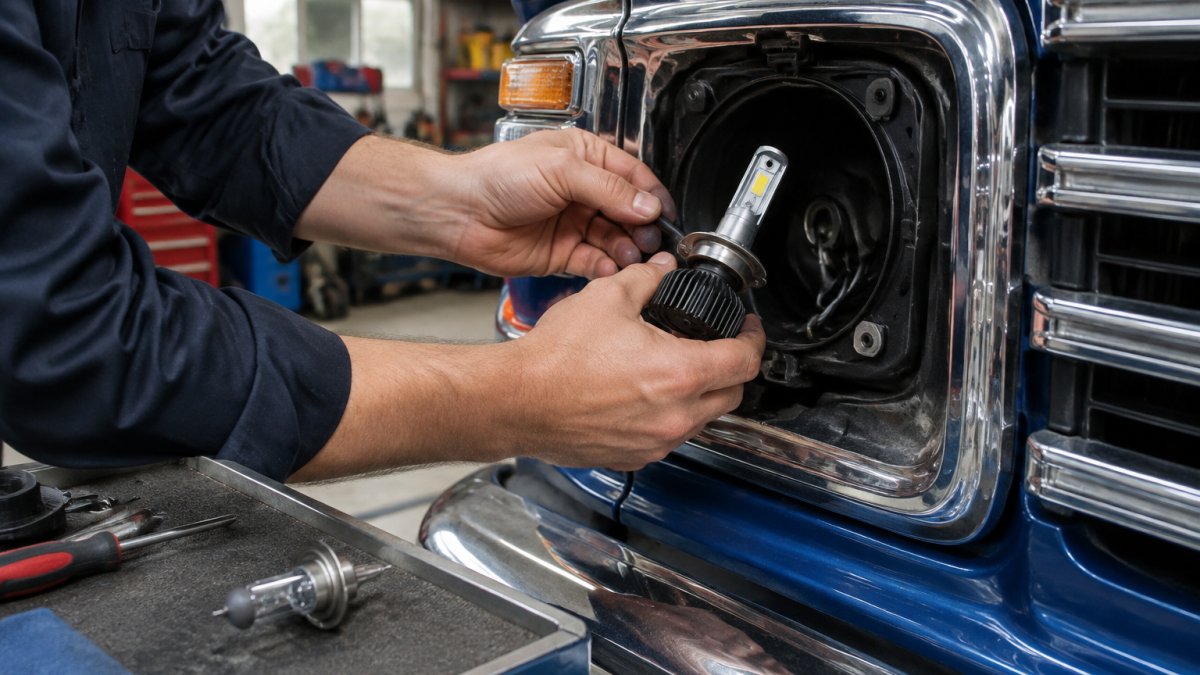
A halogen to LED headlight conversion is safe for your warranty when the kit fits correctly and draws power within the factory system's limits.
Bulb type, base, and housing compatibility
Start with the bulb type in your owner's manual or the original bulb number stamped on the base. Confirm the housing accepts the bulb depth and base without forcing it. A common mistake is forcing a bulb into a housing that needs an adapter; some applications require extra bulb holders or retainers. Beyond the base, check the housing's optical design.
CAN bus, load resistors, and bulb-out warnings
Many modern vehicles monitor bulb current and will flash a bulb-out warning or hyperflash when an LED draws less current than the halogen it replaced. Some kits include a built-in driver or CAN bus adapter that presents the correct load to the vehicle. Others require a separate load resistor. This matters for warranty because a resistor that runs hot and is spliced into factory wiring is exactly the kind of install a dealer can point to.
Polarity and connector fit
LED bulbs are polarity-sensitive in a way halogens are not. If a bulb doesn't light, the first check is whether the connector is reversed, many kits include a reversible plug or a polarity adapter for this reason. Do not solve a polarity problem by cutting and re-pinning the factory connector. That converts a plug-and-play install into a wiring modification and hands a dealer a causation argument.
Heat management and driver placement
LED bulbs generate heat at the base, and the driver or heatsink needs airflow. A bulb whose heatsink is crammed against a housing cap or boot can overheat, and a driver zip-tied to a harness can chafe or trap heat. Check that the kit's heatsink fits behind the housing cap and that any external driver has a mounting point that doesn't contact moving parts or sharp edges.
Wiring, fuses, and the built-in driver
Your factory wiring and fuses were sized for halogen bulbs, not LEDs. Most quality LED kits draw less current than the halogen bulbs they replace, which actually reduces load on the circuit. A built-in driver manages that current and keeps the bulb stable. If you're doing your own wiring and fuse checks, our guide on how to wire LED light bars to factory switches safely walks through the safe approach.
Factory LED Assemblies vs Aftermarket Bulbs: Different Warranty Rules
Factory-installed LEDs and aftermarket LED bulbs live under completely different warranty rules. A factory LED assembly is part of the original equipment, so it's covered by your vehicle warranty from day one.
Here's the practical split:
| Factor | Factory LED Assembly | Aftermarket LED Bulb |
|---|---|---|
| Covered by vehicle warranty | Yes | No, covered by product warranty |
| Failure claim process | Dealer handles it | You contact the seller |
| Modification risk | None | Dealer may question related failures |
| Typical coverage length | Matches vehicle warranty | Set by the bulb maker |
If you're weighing a full projector upgrade against a simple bulb swap, our guide on how to decide on projector headlight upgrades covers which path fits your goals and your risk tolerance.
Manufacturer Warranty vs Dealer Decisions: Who Actually Denies a Claim
The manufacturer sets warranty terms, but the dealer is the one who decides whether to submit or deny your claim.
You have use here. Ask the dealer to put the denial in writing with the specific reason. Under Magnuson-Moss, they can't blanket-void coverage over an aftermarket part.
If a dealer won't budge, escalate to the manufacturer's customer relations line. A written denial with no stated causation is a weak position for them.
When a Warranty Claim Denied Due to LED Headlights Happens
A warranty claim denied due to LED headlights is not the end of the conversation. You can push back, and often should. The key is building a clear record that separates your modification from the failed part, and then forcing the dealer to state a causal link in writing. Most owners skip the record-building step and argue verbally, which is why denials stick.
Get the denial and the diagnostic basis in writing
The first move is to ask the service advisor for the denial in writing, with the specific failed component named and the diagnostic basis stated. A denial that says "aftermarket lighting" without naming a failed part or a mechanism is not a causation finding, it's a flag. Ask for the repair estimate and the diagnostic notes as well; those documents often reveal whether the dealer actually tested the circuit or simply saw the LED kit and stopped.
Document the install before and after
Photograph your install, wiring, and connectors as they sit now, and keep your product warranty and receipt for the LED kit. If you still have the original halogen bulbs and any factory parts you removed, keep them, they let you return the vehicle to stock for diagnosis and show that the install was reversible. A reversible, plug-and-play install is much harder to tie to a failure than a spliced one.
Separate the warranty types before you escalate
Before escalating, be clear about which agreement is actually in play. The factory vehicle warranty, an extended service contract, the aftermarket product warranty on the LED kit, and any state consumer-protection rights are four different things, and a denial under one does not automatically apply to the others. If the failed part is the LED bulb itself, that's a product-warranty conversation with the seller, not a vehicle-warranty conversation with the dealer.
Escalate in order
If the dealer won't explain the causation, escalate to the manufacturer's customer relations line and ask them to review the denial. A written denial with no stated causation is a weak position for the dealer, and manufacturers generally prefer a documented review over a dispute.
Use this checklist when a claim is denied:
- Get the denial in writing with the specific failed component named
- Ask the dealer to state how the LED install caused or contributed to the failure
- Request the repair estimate and the diagnostic notes
- Photograph your install, wiring, and connectors as they sit now
- Keep your product warranty, receipt, and any installer invoice
- Retain the original halogen bulbs and removed factory parts
- Confirm which warranty type the denial applies to
- Escalate to the manufacturer, then to your state attorney general's office
The pattern to watch for is a denial with no stated cause. That's usually a dealer covering itself, not a real warranty exclusion.
Choosing an LED Kit That Keeps Your Coverage Intact
The best way to protect your warranty is to pick a kit that installs cleanly and reverses easily.
Our headlamp conversion kits are designed around that idea. Our H4 and H13 pairs run $50, and the H7 pair runs $35, each with a 2-year warranty.
Before you buy, confirm two things: your bulb type and your state's rules on aftermarket lighting. Our breakdown of the legal requirements for aftermarket automotive lighting and our guide to whether aftermarket LED headlights are street legal both cover what to check.
Warranty risk comes down to causation and clean installation, not the LED itself. If you want a kit designed to drop into factory housings without touching your wiring, RMS Lighting LLC can help.
Frequently Asked Questions
Will LED headlights void my entire vehicle warranty?
No. Federal law, under the Magnuson-Moss Warranty Act, prevents a manufacturer from voiding your whole warranty simply because you installed aftermarket parts. A dealer can only deny coverage for a specific repair if the modification caused the failure. If your LED headlights warranty claim involves an unrelated component, such as a transmission or suspension issue, the lighting upgrade should not affect it. The key question is always causation, not the mere presence of an aftermarket part.
Can a dealer deny a warranty claim because I installed LED headlights?
A dealer can deny a claim only if it can show the LED installation caused or contributed to the failure. For example, if a bulb's built-in driver overloaded a circuit and damaged a fuse box, the dealer may exclude that repair. But a blanket denial with no causal explanation is not valid. Ask for the denial in writing, including the specific component and the reasoning, so you have a record if you need to escalate.
Are LED headlights covered by an extended warranty or service contract?
Usually not. Extended warranties and service contracts typically cover factory equipment, and an aftermarket LED bulb or conversion kit is not factory equipment. Check your contract's exclusions section for language about modifications or non-original parts. The LED kit itself is more likely to be covered by the product's own warranty, which is why buying from a seller that offers a clear product warranty, such as a two-year term, matters more than relying on your vehicle's extended coverage.
What should I do if a warranty claim is denied after an LED headlight installation?
Request the denial in writing with the specific failed component and the dealer's reasoning. Then check your owner's manual and warranty booklet for the exact exclusion language. If the denial cites your LED upgrade without proving causation, escalate to the manufacturer's regional customer service team. Keep your purchase receipt, installation notes and any product warranty documentation. Under the Magnuson-Moss Warranty Act, the burden falls on the warrantor to show the aftermarket part caused the failure.
Prices of RMS Lighting LED headlamp conversion kits
