

Risks of LED Headlight Conversion: What to Know

Table of Contents
- How LED Headlight Conversion Changes Your Vehicle's Lighting
- Beam Pattern Distortion and Glare: The Biggest Safety Risk
- DOT Compliance for LED Headlights: What the Law Actually Requires
- Heat Sink and Thermal Management Problems in Halogen Housings
- Electrical System Damage, CANbus Errors, and Wiring Risks
- Insurance Claim Denial and Legal Liability After Conversion
- Choosing Best High Performance LED Headlight Bulbs That Minimize Risk
- Conclusion
- Frequently Asked Questions
Last Updated: September 16, 2026
How LED Headlight Conversion Changes Your Vehicle's Lighting
LED headlight conversion replaces factory halogen or incandescent bulbs with LED units in the existing housing, and it changes far more than brightness. A halogen bulb's filament radiates in every direction, and the housing was shaped around that emission pattern. An LED bulb emits from small diode chips on a flat substrate and generates waste heat at the base rather than the tip. Those two differences, emission geometry and heat location, drive nearly every risk covered in this guide from RMS Lighting LLC.
The lumen gap is real. A typical factory halogen low beam produces roughly 1,000 to 1,500 lumens, while many aftermarket LED replacements advertise 10,000 lumens or more. That is a five- to ten-fold increase aimed at a housing that was never designed for it. The NHTSA Federal Motor Vehicle Safety Standard 108 governs how vehicle lighting must perform, and it sets photometric requirements rather than naming specific bulb technologies. Understanding what that standard actually tests, and what it does not, is the difference between a clean upgrade and a citation at your next inspection.
Below, we break down the six risks that matter most: beam pattern distortion, glare, DOT compliance, thermal management, electrical and CANbus faults, and insurance exposure. Then we cover how to pick bulbs that minimize each one.
Beam Pattern Distortion and Glare: The Biggest Safety Risk
Beam pattern distortion is the single most consequential risk of LED headlight conversion, because it turns a focused low beam into a scatter of uncontrolled light. The cause is focal point alignment, and it is not a tuning problem you can aim your way out of.
In a halogen housing, the filament is a small, roughly cylindrical source positioned at one precise point inside the reflector or projector. Every surface of that housing is shaped to collect light from that exact point and redirect it into a defined pattern with a sharp horizontal cutoff and a controlled hot spot below it. That cutoff keeps your low beam out of oncoming drivers' eyes while still throwing usable light down the road.
An LED replacement bulb does not reproduce that source. Its light comes from two or more small diode chips mounted on a flat blade, so the emitting surface is a rectangle, not a cylinder. Two things go wrong. First, the emitting surface sits a fraction of an inch from the housing's optical center, and a reflector amplifies that positional error, smearing the sharp cutoff into a gradient. Second, the LED emits from two opposing faces rather than 360 degrees, so light leaves in a different angular distribution than the housing was designed to collect. The reflector cannot redirect light it never receives in the expected direction, and it over-redirects the light it does receive.
The visible result is diffuse light above the cutoff line, exactly where oncoming traffic sits. Drivers experience glare even when the bulb is aimed correctly at the wall, because the problem is the beam's shape, not its angle. Scattered light also means less light on the road, since energy that should be concentrated in the low beam pattern is thrown into the trees and other drivers' eyes. A conversion that looks dramatically brighter in a driveway can put less usable light on the pavement than the halogen bulb it replaced.
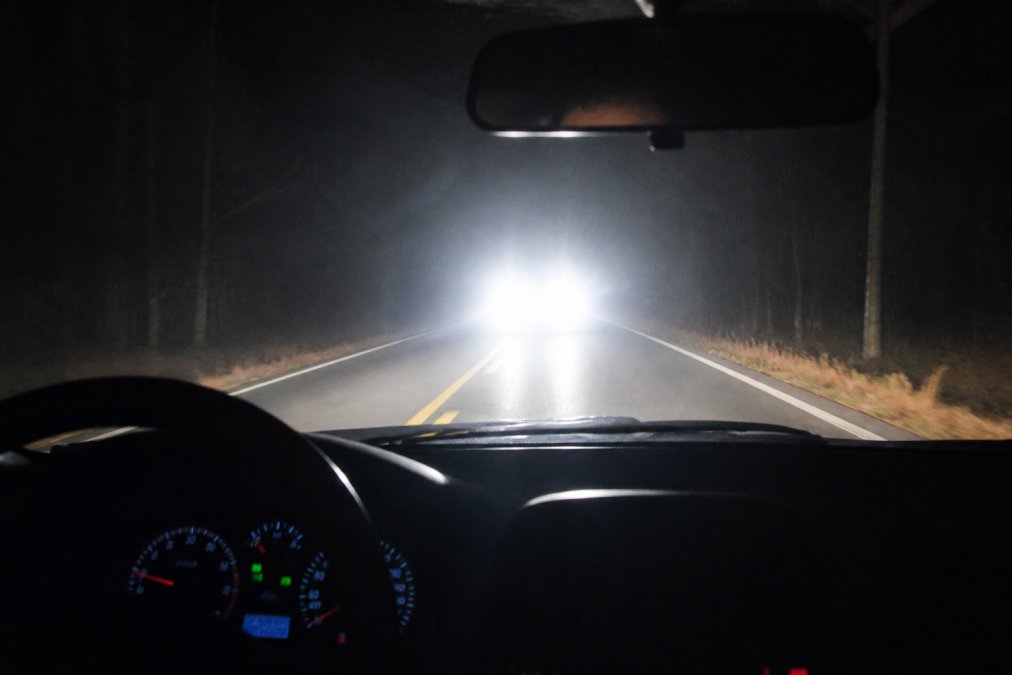
Glare has a measurable human cost beyond annoyance. Dazzled oncoming drivers lose contrast sensitivity and take longer to recover their night vision, and the effect is worse for older drivers. That is why glare is treated as a safety defect rather than a cosmetic complaint, and why a conversion that produces it can be cited even when the driver did nothing else wrong.
DOT Compliance for LED Headlights: What the Law Actually Requires
DOT compliance for LED headlights is not a simple yes-or-no label on a box. Federal law requires headlamps, as complete assemblies, to meet the photometric and marking requirements of Federal Motor Vehicle Safety Standard 108, administered by the National Highway Traffic Safety Administration. The standard applies to the lamp assembly, not a replacement bulb sold on its own. A bulb marketed as "DOT approved" makes a claim that is difficult to substantiate, because approval applies to the sealed assembly originally certified with the vehicle.
In practice, a halogen housing certified with its original bulb remains compliant only with that bulb installed. Swapping in an LED changes the light source the assembly was tested with, which can move it out of compliance even if nothing else changed. State inspection programs and officers who test for glare and cutoff enforce the outcome, not the marketing language. A citation for improper lighting is typically a fix-it ticket with a modest fine, but the compliance question does not end at the roadside.
This is where most articles on LED conversion stop, and it is the gap that matters most. The compliance status of your lighting can follow you into an insurance claim. Insurers assess fault and coverage based on whether the vehicle was roadworthy and legally compliant at the time of the incident. A non-compliant lighting modification gives an adjuster a documented reason to dispute a claim, particularly in a night-time collision where glare or visibility is a factor. If an investigation finds your converted headlights contributed to a collision, you may be exposed to civil liability your policy does not cover. The financial exposure from a denied claim or liability judgment can run into figures most drivers never budget for, and it dwarfs the cost of a ticket.
RMSH4M2S - 60W 10K Lumens LED Bulb's →
The practical takeaway: for a fully compliant upgrade, the reliable path is a complete replacement assembly engineered and certified as a unit, not a bulb swap into a halogen-designed housing. Bulb upgrades can still be reasonable for off-road use, show vehicles, or where you knowingly accept the compliance trade-off. Before you convert, check your state's inspection requirements and your policy's language on modifications, because the compliance decision is also a financial one.
Heat Sink and Thermal Management Problems in Halogen Housings
Thermal management is where LED conversions fail quietly rather than spectacularly. LEDs are more efficient than halogens at turning electricity into light, but far less tolerant of heat at the junction.
Electrical System Damage, CANbus Errors, and Wiring Risks
CANbus errors are the most common complaint from drivers who install cheap LED kits, and they stem from how modern vehicles monitor lighting circuits.
| Risk | What Causes It | What It Looks Like | Mitigation |
|---|---|---|---|
| CANbus error | Lower current draw than halogen | Dashboard warning, hyper-flash | Bulbs with built-in driver, correct wattage match |
| Flickering | Poor voltage regulation | Pulsing or strobing output | Regulated driver, quality harness |
| Connector heat | Excess current draw | Melted or discolored plugs | Match wattage to circuit rating |
| Premature failure | Thermal derating | Dimming after warm-up | Active cooling, adequate airflow |
Insurance Claim Denial and Legal Liability After Conversion
Insurance claim denial is the risk most drivers never consider until it is too late, and it is one of the strongest reasons to think carefully before converting.
Choosing Best High Performance LED Headlight Bulbs That Minimize Risk
Choosing best high performance LED headlight bulbs that minimize risk comes down to matching the bulb to your housing and your vehicle's electrical system, not chasing the highest lumen number on the box.
Conclusion
The risks of LED headlight conversion are manageable, but only when you understand what you are changing.
Frequently Asked Questions
Will police pull you over for aftermarket LED headlights?
Yes, police can pull you over if your LED headlight conversion produces excessive glare or fails to meet DOT compliance standards. Many states treat non-compliant lighting as a primary offense, meaning an officer can stop you without another violation. Fines vary by state and can range from $50 to over $200. Beyond tickets, a non-compliant setup may fail vehicle inspection. Choosing bulbs with correct beam cutoff and proper optical alignment reduces the chance of attracting attention.
Can LED headlight conversion cause electrical system damage?
Poorly designed LED kits can overload wiring harnesses, trigger CANbus errors, or cause flickering and hyper-flashing. Some cheap bulbs lack built-in voltage regulation, which leads to unstable current draw and premature failure of the bulb or the vehicle's electrical components. High-quality kits with built-in drivers and active cooling fans manage electrical load more effectively. Always verify that the bulb's operating voltage matches your vehicle's system and check for CANbus compatibility before installing.
What is the difference between DOT-compliant and non-compliant LED bulbs?
DOT-compliant LED bulbs meet federal safety standards for beam pattern, brightness, and glare control. They are designed to work with specific housing types and produce a proper beam cutoff that keeps light on the road and out of oncoming drivers' eyes. Non-compliant bulbs often lack these optical controls, resulting in scattered light, excessive glare, and failed inspections. Look for bulbs that are tested for your specific housing design.
Do LED headlights damage plastic headlight lenses?
LED bulbs themselves do not typically damage plastic lenses, but poor thermal management can. Some high-output LEDs generate significant heat at the base, and without proper heat dissipation, that heat can degrade the reflector housing or nearby wiring over time. Bulbs with active cooling fans and heat sinks manage temperatures better. If you notice clouding, melting, or discoloration near the bulb opening, remove the LEDs and inspect the housing for damage.