

Stop Radio Interference From Truck LED Headlights

Table of Contents
- Why LED Headlights Cause Radio Interference
- How to Diagnose the Source of the Static
- Install a Ferrite Core for LED Lights
- Use an LED Headlight Anti-Flicker Harness
- Check Ground Connections and Cable Routing
- Troubleshooting LED Headlight Static That Persists
- Quality Bulbs and EMC Compliance
- Conclusion
- Frequently Asked Questions
Last Updated: September 8, 2026
Why LED Headlights Cause Radio Interference
Radio frequency interference (RFI) and electromagnetic interference (EMI) are the two culprits behind the static you hear when your LED headlights are on. When you upgrade from factory halogens to aftermarket LED bulbs, you are introducing a new electronic component into an environment that was never designed to shield against its emissions.
The root cause is the driver module, sometimes called the ballast, built into the bulb base. LEDs run on direct current at low voltage, but your truck supplies alternating current at 12 volts (energy.gov). The driver converts that power, and the conversion process generates electrical noise across a broad frequency band. That noise radiates from the bulb and travels back through the wiring harness, where your antenna picks it up as static or signal degradation.
The quality of the driver module determines how much noise escapes. Cheap bulbs skip the filtering components entirely, which is why the problem is so common with budget kits.
How to Diagnose the Source of the Static
Before buying any parts, confirm that your LED headlights are actually the source of the interference. A simple test takes less than five minutes and prevents wasted money on suppression hardware you do not need.
Start with the engine running and the headlights off. Tune your radio to a weak AM station, the kind that already has some background noise. Note the baseline level of static. Now switch the headlights on. If the noise gets noticeably worse, your bulbs are emitting RFI. If the static stays the same, the problem lives elsewhere in the truck, such as the alternator or ignition system.
A second test isolates whether the noise travels through the air or the wiring. Turn the headlights on and listen to the static, then walk to the front of the truck and stand between the headlights and the antenna. If the noise changes as your body blocks the signal path, the interference is radiating through the air. If nothing changes, the noise is traveling down the wiring harness and needs a hardwired fix.
Install a Ferrite Core for LED Lights
A ferrite core is the cheapest and most effective first step for suppressing radio interference from truck LED headlights (fcc.gov). These small cylindrical clips suppress high-frequency noise by absorbing it as heat instead of letting it radiate or travel back through the wiring.
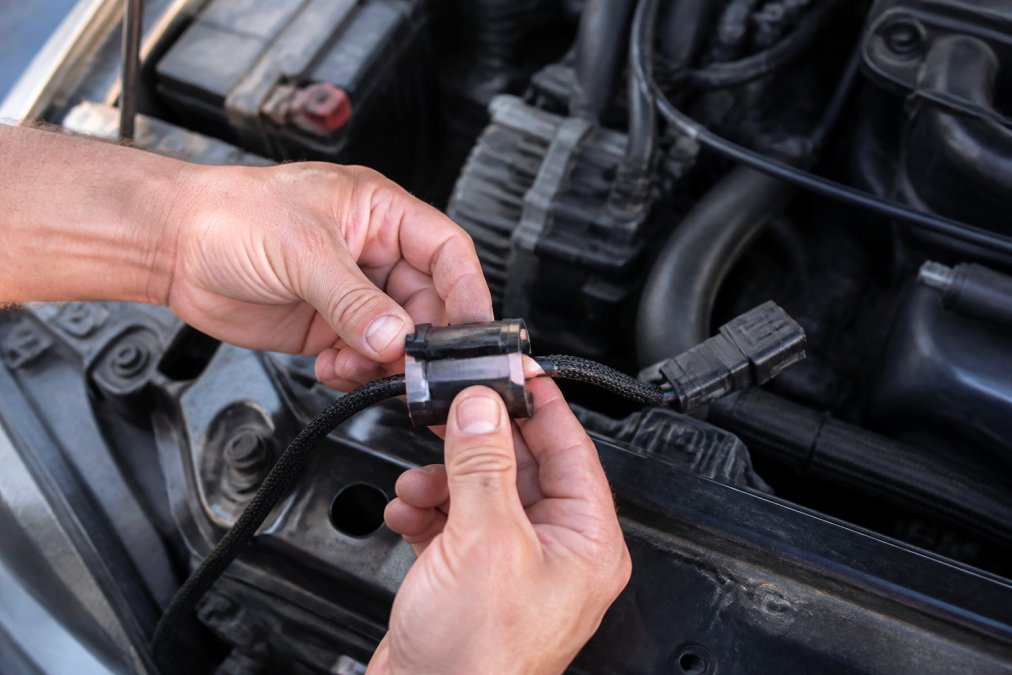
Installation takes about two minutes per side. Unclip the ferrite core, wrap the headlight power wire around it once or twice, then snap it shut as close to the bulb connector as possible. The closer the core sits to the noise source, the better it performs.
For trucks with severe interference, stack two cores on each side or use a larger core rated for higher frequencies. A single wrap is usually enough for most vehicles. The key is placing the ferrite bead on the section of wire between the bulb and the main harness, not on the antenna cable itself.
Use an LED Headlight Anti-Flicker Harness
A ferrite core suppresses radiated noise, but it does nothing for interference that travels through the truck's electrical system. For that, you need an LED headlight anti-flicker harness, sometimes called a CANBus harness or decoder.
These harnesses install inline between your factory connector and the LED bulb. They contain capacitors that smooth out the voltage and filter the electrical noise before it can propagate through the wiring harness to your antenna. Many aftermarket LED kits include these harnesses specifically to prevent the dashboard error codes and flicker that confuse older trucks expecting halogen bulbs.
Plug-and-play installation means no cutting or splicing. Unplug the factory connector, plug in the harness, then connect the bulb to the other end. Secure the harness with a zip tie so it does not rattle against the fender. For trucks with persistent static, pairing a quality anti-flicker harness with a ferrite core on the same wire resolves the vast majority of RFI complaints.
Check Ground Connections and Cable Routing
Poor grounding is the most overlooked cause of radio interference from truck LED headlights. The noise needs a clean path back to the battery negative terminal. If the ground connection is loose, corroded, or bolted to a painted surface, the interference has no place to go and radiates through the body and wiring instead.
Inspect the ground connection for your headlight circuit. Remove the bolt, scrape the contact area down to bare metal, and reattach the ground wire securely. This is called establishing a clean mass connection, and it often solves problems that no amount of filtering hardware can fix.
Cable routing matters just as much. Headlight power wires running parallel to the antenna cable act like a transmitter, coupling noise directly into your reception. Separate the two by at least six inches wherever possible. If they must cross, cross them at a 90-degree angle to minimize coupling. Shielded cable for the antenna feed line adds another layer of protection against picking up radiated noise.
Troubleshooting LED Headlight Static That Persists
When static survives ferrite cores, an anti-flicker harness, and clean grounds, the problem usually comes down to the bulbs themselves. Low-quality LED drivers lack basic suppression components, and no amount of external filtering can fully compensate for a poorly designed circuit.

Test this by swapping one side back to a halogen bulb. If the static disappears on that side only, the LED bulb is the culprit. If the static remains on both sides, the noise is coming from a shared circuit, such as the headlight switch or the body control module.
Pinpoint the Exact Frequency with an SDR
A more precise diagnostic method that professional installers use involves a Software Defined Radio (SDR) dongle, available for under $30. This tool lets you visualize the RF spectrum around your truck, turning a vague static complaint into a specific frequency measurement.
- Connect the SDR to a laptop and open a spectrum analyzer application like SDR# or GQRX.
- Attach a short telescopic antenna to the SDR and place it near the headlight connector.
- With the headlights off, capture a baseline spectrum from 500 kHz to 30 MHz. This covers AM broadcast and longwave bands.
- Turn the headlights on and observe the new peaks. A noisy LED driver will show a characteristic comb of spikes, often with a fundamental frequency around 100-200 kHz and harmonics extending into the AM band.
This approach tells you two things. First, it confirms the LED driver is the source. Second, the specific frequency of the noise tells you which suppression method will work. Broadband noise across the entire spectrum responds best to a ferrite core. A narrow, high-amplitude spike may require a tuned LC filter or a better-shielded bulb.
Distinguish Driver Noise from Alternator Whine
A common mistake is chasing the noise in the wrong frequency range. AM radio interference operates below 1.7 MHz, while FM static and cell phone buzz occupy different bands. A ferrite core that fixes AM noise may do nothing for a high-frequency whine.
For persistent cases, check whether the noise changes with engine RPM. Alternator whine tracks engine speed and typically sounds like a rising and falling whistle. LED driver noise, by contrast, is usually constant regardless of RPM because the driver operates at a fixed switching frequency. If the noise is RPM-dependent, inspect the alternator's diodes and the main battery ground strap before replacing any headlight components.
Quality Bulbs and EMC Compliance
The permanent solution to radio interference is buying bulbs that never create the problem in the first place. Electromagnetic compatibility (EMC) compliance means a product is tested to ensure its emissions stay below limits that interfere with other electronics. Quality LED manufacturers design their driver modules with proper filtering and shielding from the start.
The FCC's guidance on unintentional radiators explains that electronic devices generating radio frequency energy must comply with emission limits. Bulbs sold for road use in the United States should meet these standards, but enforcement is inconsistent, especially for imported budget kits.
Why Cheap Bulbs Emit More Noise
The difference between a $20 bulb kit and a $60 kit is not just brightness. It is the engineering inside the driver module. A well-designed driver uses a multi-stage filtering approach:
- Input capacitors (typically 100 nF ceramic and 10 µF electrolytic) smooth the 12V DC input and prevent high-frequency noise from traveling back into the truck's wiring.
- A shielded inductor in the switching regulator contains the magnetic field generated during voltage conversion. Unshielded inductors radiate noise directly into the engine bay.
- A metal or metallized plastic housing over the driver acts as a Faraday cage, containing radiated emissions. Many budget bulbs omit this housing entirely, leaving the bare circuit board exposed.
A common pattern is that cheap drivers use a simple buck converter running at a frequency between 100 kHz and 1 MHz without any output filtering. This creates strong harmonics that land squarely in the AM broadcast band (530-1700 kHz). Premium drivers often use a higher switching frequency above 2 MHz, pushing harmonics out of the AM band where they are less audible.
What to Look For Before You Buy
When shopping for replacement bulbs, look for specifications that mention EMC compliance, CANBus compatibility, or built-in suppression. These features indicate the manufacturer has addressed RFI during design rather than leaving you to fix it after installation.
Specific criteria to check on the product page or packaging:
- FCC ID or certification mark: A genuine FCC ID means the device has been tested as an unintentional radiator. Be aware that some importers print a fake "FCC" logo without certification. You can verify a real FCC ID on the FCC's database.
- Driver housing material: Look for a sealed metal or thick plastic housing. Avoid bulbs where you can see the circuit board through a clear or thin plastic window.
- Input voltage range: Bulbs rated for 9-32V DC (covering both 12V and 24V systems) typically have more robust internal filtering than bulbs rated only for 10-16V.
- Warranty and return policy: A manufacturer that stands behind EMC performance will offer at least a one-year warranty and a no-questions return policy.
The Cost of Getting It Wrong
Beyond the frustration of chasing static, there is a legal and safety dimension. The FCC can issue fines for operating devices that cause harmful interference, though enforcement against individual vehicle owners is rare. More practically, some aftermarket bulbs with poor shielding can generate enough RFI to interfere with the truck's own tire pressure monitoring system (TPMS) or keyless entry receiver, both of which operate in the 315 MHz and 433 MHz bands.
Our bulbs use high-power CanBus LED chips with integrated drivers designed to operate cleanly in older trucks with original wiring. If you are upgrading from factory halogens and want to avoid the radio static problem entirely, choosing a tested kit from the start is far easier than retrofitting suppression hardware later.
Conclusion
Preventing radio interference from truck LED headlights comes down to understanding that the noise is a symptom of poor electrical design, not a reason to abandon LED lighting. Start with the cheapest fix, a ferrite core, then work through grounding and cable routing before replacing hardware. If the static persists, the bulbs themselves are the problem. Choosing EMC-compliant bulbs with proper driver modules eliminates the headache before it starts. The RMS Lighting LLC team can help you find a tested conversion kit that delivers bright, reliable light without turning your AM radio into static. Learn more about our LED headlamp conversion options and upgrade with confidence.
Frequently Asked Questions
Why do my LED headlights affect my radio?
LED headlights use a driver module that switches current rapidly. This creates electrical noise in the radio frequency band. That noise travels through the wiring and can be picked up by your antenna, causing static or buzzing. The noise is often strongest on AM bands but can affect FM reception too. It is not a sign the bulbs are defective, but it does indicate the need for suppression components.
How do I stop radio interference from LED headlights?
Start by installing a ferrite core on the power wires near the headlight connector. This suppresses high-frequency noise at the source. If interference continues, add an LED headlight anti-flicker harness with built-in filtering. Check that the headlight housing and wiring have a solid ground connection to the truck frame. Finally, route the headlight cables away from the antenna cable to prevent signal coupling.
Do all aftermarket LED headlights cause radio interference?
No. The problem comes from low-quality driver modules that lack proper filtering. Quality LED bulbs are designed with suppression components to meet EMC compliance standards. Choosing a supplier that prioritizes product quality can reduce the risk of radio interference. Cheaper bulbs often skip this step to cut costs, which is why they generate more electrical noise.