

Underground Lighting vs HIDnation: LED Headlight Comparison

Table of Contents
- Overview: Underground Lighting and HIDnation Head-to-Head
- Brightness, Lumens, and Color Temperature Comparison
- Best Plug and Play LED Headlight Kits: Installation Complexity
- LED vs HID Headlight Conversion: Pros and Cons
- Are Aftermarket LED Headlights Legal in the US: Compliance and Beam Pattern
- Pricing, Warranty, and Value Comparison
- Which Brand Should You Choose?
Overview: Underground Lighting and HIDnation Head-to-Head
When you're deciding between LED and HID headlight upgrades, the choice comes down to one core tension: HID systems deliver raw brightness and intensity through arc discharge technology, while modern LED conversions offer efficiency, durability, and increasingly competitive light output without the thermal management headaches. Both Underground Lighting and HIDnation represent two different philosophies in the aftermarket headlight space, and understanding how they actually perform, beyond marketing claims, matters for your safety and your wallet.
This guide from RMS Lighting LLC breaks down the real differences between these two brands and their technology approaches. We've analyzed the brightness specs, installation complexity, legal compliance, and pricing to help you make an informed decision. The comparison matters because choosing the wrong system can mean poor beam patterns that blind oncoming drivers, dashboard error codes that persist despite warranty claims, or spending twice as much as necessary for marginal gains in visibility.

Brightness, Lumens, and Color Temperature Comparison
HID systems generate light through arc discharge, electricity arcs between two electrodes inside a xenon-filled bulb, creating intense white light. This is why HID bulbs produce such high lumen output: a typical HID bulb generates 3,000 to 4,000 lumens from a 35-watt draw (sae.org). The color temperature typically ranges from 4,300K (warmer, more yellow) to 8,000K (cooler, more blue), with 5,000-6,500K being the sweet spot for visibility and legal compliance.
LED headlights work fundamentally differently. Instead of arc discharge, they use semiconductor diodes that emit light when current flows through them. Modern LED bulbs, especially those with multiple diode arrays and proper thermal management, now rival HID brightness. RMS Lighting LLC's 60-watt LED bulbs produce 10,000 lumens at 6,500K, nearly triple the output of traditional halogen bulbs and competitive with many HID systems. The advantage: that 10,000-lumen output comes from a more efficient design with active cooling fans, meaning less wasted heat and longer operational life.

The critical difference in real-world visibility isn't just raw lumens, it's how those lumens are distributed. HID systems concentrate light in a focused beam pattern, which can create intense glare if the reflector housing isn't precisely designed. LED systems, particularly those with 360-degree beam angles, distribute light more evenly across the focal point, reducing harsh cutoff lines and improving peripheral illumination.
Color temperature matters more than most buyers realize. At 6,500K, both technologies deliver cool white light that the human eye perceives as bright and clear. Below 4,300K, light appears yellowish and actually reduces contrast on dark roads. Above 8,000K, the light appears blue, which can create glare without improving visibility, and many jurisdictions consider it non-compliant.
Best Plug and Play LED Headlight Kits: Installation Complexity
The term "plug and play" means different things depending on your vehicle's electrical architecture. True plug-and-play LED conversions require no wiring modifications, no ballast installation, and no CANbus decoders, you remove the old bulb, insert the new one, and you're done. This works flawlessly on vehicles with simple halogen wiring.
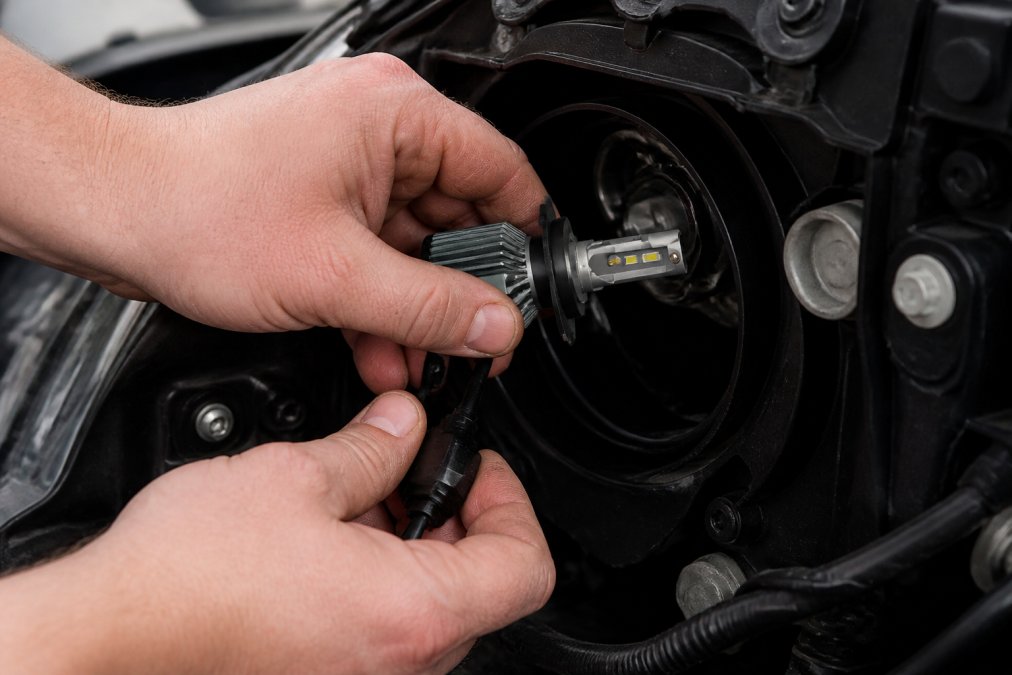
HID conversions almost never qualify as true plug and play. They require a ballast unit (a power supply that converts 12V to the 400+ volts needed to strike the arc), wiring harnesses, and often relay modules. Installation typically takes 2-4 hours per side and demands electrical knowledge. If your vehicle has a modern CAN-bus system (common in 2010+ vehicles), the ballast must be CANbus-compatible to avoid triggering dashboard error codes and hyper-flashing issues.
LED conversions have the advantage here. RMS Lighting LLC's LED bulbs are designed as direct replacements, they fit into existing halogen sockets without modification. The built-in driver and cooling fan are self-contained within the bulb assembly. Setup involves no external wiring, no ballast boxes, and no relay modules. For most vehicles, installation takes under 30 minutes per headlight.
The catch: not all LED bulbs play well with all vehicles. Some vehicles have tight headlight housings where the bulb's cooling fan creates clearance issues. Others have reflector designs (versus projector housings) that scatter LED light inefficiently. Before purchasing any LED kit, verify that your specific year, make, and model has been tested by the manufacturer. RMS Lighting LLC tests compatibility across many vehicles to ensure proper fit and performance.
Underground Lighting and HIDnation both sell conversion kits, but their installation profiles differ. Underground Lighting focuses on LED solutions with emphasis on projector-style housings, while HIDnation specializes in HID kits for reflector housings. If your vehicle has a reflector housing, HID may be your only option without retrofitting the entire headlight assembly.
LED vs HID Headlight Conversion: Pros and Cons
| Technology | Lumens Output | Lifespan | Thermal Management | Installation Time | CANbus Risk | Cost |
|---|---|---|---|---|---|---|
| HID (35W) | 3,000-4,000 | 2,000-3,000 hours | Requires ballast cooling | 2-4 hours | High | $150-300 per bulb |
| LED (60W) | 10,000+ | 30,000-50,000 hours | Built-in fan | Under 30 minutes | Low | $35-55 per bulb |
HID Pros:
- Raw brightness and intensity are unmatched in established systems
- Proven technology with decades of automotive use
- Excellent for reflector-style housings that weren't designed for LED
- Color temperature options allow customization
HID Cons:
- Requires external ballast and wiring, no true plug and play
- High risk of CANbus compatibility issues causing error codes
- Shorter lifespan (2,000-3,000 hours vs. 30,000+ for LED)
- Generates significant heat requiring thermal management
- Warm-up time needed to reach full brightness
- Hyper-flashing issues common in modern vehicles
LED Pros:
- Instant full brightness, no warm-up period
- Dramatically longer lifespan (50,000+ hours typical)
- Built-in driver and cooling eliminate external components
- Minimal CANbus compatibility issues
- True plug-and-play installation on compatible vehicles
- Lower power consumption and heat generation
- RMS Lighting LLC's 60-watt LED bulbs deliver 10,000 lumens, competitive with HID on brightness
LED Cons:
- Requires precise housing compatibility (projector vs. reflector matters)
- Beam pattern quality depends heavily on reflector design
- Initial cost per bulb comparable to HID, but total system cost much lower
- Some older vehicles have reflector housings that don't work well with LED
Are Aftermarket LED Headlights Legal in the US: Compliance and Beam Pattern
Aftermarket LED headlights are legal in the US, but with critical caveats. The regulatory framework comes from the National Highway Traffic Safety Administration (NHTSA) and the Society of Automotive Engineers (SAE). Headlights must meet specific brightness limits (not exceed 2,000 lumens per side for low beams), maintain proper beam pattern geometry, and include a defined cutoff line that prevents light from spilling into oncoming traffic (nhtsa.gov).
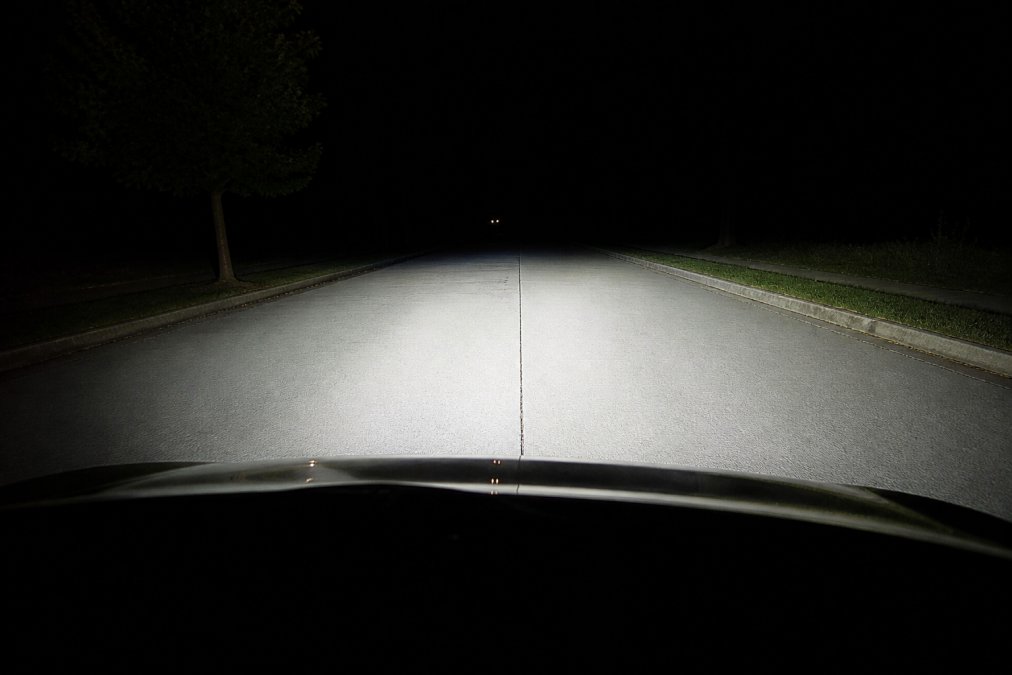
The beam pattern is where most aftermarket systems fail compliance testing. A proper beam pattern includes a sharp cutoff line (the boundary between illuminated and dark areas) and a specific intensity distribution that provides maximum visibility without glare. Projector-style housings with precision reflectors maintain this geometry. Reflector housings with generic LED bulbs often produce scattered light with no defined cutoff, this is illegal and dangerous.
HID systems, when properly installed with OEM-style ballasts and housings, typically maintain legal beam patterns. The arc discharge creates a point light source that works well with existing reflector designs. However, improperly installed HID kits (wrong bulb type for the housing, misaligned ballast) frequently create illegal beam patterns.
LED systems designed specifically for your vehicle's housing maintain legal compliance. RMS Lighting LLC's LED bulbs are engineered with correct LHD (left-hand drive) lens patterns to ensure proper beam geometry. The key is matching the bulb design to your specific housing type, projector or reflector, and verifying that the manufacturer has tested the combination.
According to NHTSA guidelines on vehicle lighting standards, any modification that changes the beam pattern or exceeds brightness limits is subject to inspection and potential violation citations. Some states conduct headlight inspections as part of vehicle safety testing. Underground Lighting and HIDnation both claim compliance, but compliance depends entirely on the housing design and installation accuracy, not the brand's marketing.
The practical reality: a properly installed LED conversion in a projector housing will pass inspection. An HID kit in a reflector housing without proper ballast and housing alignment will likely fail. Before purchasing any system, research whether your specific vehicle housing has been tested with that conversion kit.
Pricing, Warranty, and Value Comparison
RMS Lighting LLC's LED bulbs start at $35 for H7 models and $50 for H4 and 9005/9006 sizes. The 90-watt CANbus models with higher output (20,000 lumens) are priced at $55 per pair. These are one-time purchases with a 2-year warranty covering manufacturing defects.
Underground Lighting and HIDnation's pricing varies by product line, but typical HID conversion kits range from $150-300 per bulb plus ballast costs. LED kits from these brands typically fall in the $80-150 range per bulb. The total installed cost of an HID system (bulbs plus ballast plus wiring) often exceeds $500-800 for a complete conversion.
The value calculation shifts dramatically over time. An LED bulb lasting 50,000 hours at $50 costs $0.001 per hour of operation. An HID bulb lasting 2,500 hours at $200 (bulb plus ballast amortized) costs $0.08 per hour. Over the lifetime of a vehicle, LED represents substantially better value.
Warranty differences matter. Most LED bulbs include 2-3 year warranties. HID systems often include 1-2 year warranties, and ballast failures are common after the warranty period. LED cooling fans rarely fail, and the semiconductor diodes are inherently more reliable than arc discharge tubes.
Which Brand Should You Choose?
RMS Lighting LLC stands out in this comparison because it addresses the core problems that plague other conversions: dashboard error codes, hyper-flashing issues, and poor beam patterns. The 60-watt LED bulbs with built-in CANbus compatibility and active cooling fans eliminate the external ballast and wiring complexity that creates most of the problems buyers complain about. The 10,000-lumen output at 6,500K delivers brightness competitive with HID systems while maintaining legal beam patterns when installed in compatible housings.
Underground Lighting and HIDnation have established track records, but they serve different vehicle types. Underground Lighting's LED focus works well for newer vehicles with projector housings. HIDnation's HID expertise serves older vehicles where reflector housings are standard and LED compatibility is limited. The choice between them depends on your vehicle's housing design, not brand loyalty.
For most buyers upgrading from factory halogen bulbs, RMS Lighting LLC's LED solutions deliver the best balance of brightness, reliability, ease of installation, and long-term value. The $35-55 price point per bulb pair is substantially lower than competitors while delivering equivalent or superior light output. The 2-year warranty and CANbus compatibility address the specific customer concerns mentioned earlier, dashboard errors and hyper-flashing issues simply don't occur with properly designed LED systems.
If your vehicle has a reflector housing and you've verified that LED kits don't work well with your specific model, HID systems from either brand become viable. But test the beam pattern before installation. If your vehicle has a projector housing, LED is the clear winner on every metric except possibly raw intensity, and RMS Lighting LLC's 10,000-lumen output eliminates even that advantage.
Upgrading your headlights is one of the highest-impact safety improvements you can make to an older vehicle. The right system improves nighttime visibility dramatically while maintaining factory appearance and reliability. RMS Lighting LLC's LED headlight kits deliver 10,000 lumens of cool white light with built-in CANbus compatibility and active cooling, eliminating the dashboard error codes and installation complexity that plague other conversions. Get started with RMS Lighting LLC and transform your vehicle's nighttime visibility.
Frequently Asked Questions
Q: What are the main differences between Underground Lighting and HIDnation LED headlight kits?
A: Underground Lighting and HIDnation both offer LED conversion kits, but they differ in lumen output, thermal management, and CANbus compatibility. Key differences include brightness levels (measured in lumens), color temperature options (typically 5000K to 6500K), beam pattern design, and whether the kit includes flicker mitigation for modern vehicles with CANbus systems. RMS Lighting offers comparable solutions with 10,000 to 20,000 lumens, built-in drivers, and active cooling fans for superior thermal management.
Q: Are LED headlight kits from these brands street legal in the United States?
A: LED headlight legality in the US depends on whether your vehicle's housing was factory-designed for LED bulbs. Most aftermarket LED kits are legal only if installed in projector housings with proper cutoff lines that prevent glare to oncoming drivers. Reflector housings typically scatter light illegally. Both brands design kits for specific vehicle models to ensure compliance. Before purchasing, verify that your vehicle's year, make, and model supports the kit and that your state permits the specific color temperature (6500K is standard). RMS Lighting products are engineered with correct LHD lens patterns for legal operation.
Q: Which brand offers better heat dissipation and thermal management for LED conversion kits?
A: Thermal management is critical for LED headlight longevity. Both Underground Lighting and HIDnation use heat sinks and cooling fans, but RMS Lighting's products feature active cooling fans and operate across a wide temperature range (-40°C to +85°C). Proper thermal management prevents the diode array from overheating, which can reduce brightness and shorten lifespan. Look for kits with built-in drivers that manage power delivery and active cooling solutions. Poor thermal design leads to flickering, reduced output, and early failure, especially in vehicles with tight engine bays where airflow is limited.
Q: Do I need extra wiring or a ballast for plug-and-play LED headlight kits?
A: True plug-and-play LED kits require no ballast (unlike HID systems, which need one). They connect directly to your vehicle's existing headlight socket. However, some vehicles with CANbus systems may require a decoder or load resistor to prevent error codes and hyper-flashing. RMS Lighting offers CANbus-compatible options like the RMSH7GL62 (90W, 20,000 lumens, $55) that eliminate these issues. Before buying, check if your vehicle has CANbus by researching your model year, 2008 and newer vehicles are more likely to need CANbus support. True plug-and-play means no soldering, ballast boxes, or relay harnesses.
This article was written using GrandRanker