

Diode Dynamics vs GTR Lighting: LED Comparison

Table of Contents
- Diode Dynamics vs GTR Lighting: Brand Overview
- Comparison Table: Diode Dynamics vs GTR Lighting
- LED Headlight Bulb Beam Pattern Analysis
- How to Choose LED Headlight Bulbs for Your Vehicle
- Heat Management and Long-Term Degradation
- Best Plug and Play LED Headlight Kits
- DOT Compliance and Street Legality
- Conclusion
- Frequently Asked Questions
Last Updated: September 13, 2026
Diode Dynamics vs GTR Lighting: Brand Overview
The diode dynamics vs gtr lighting comparison comes down to a single question: which brand gives you a beam pattern you can actually trust on a dark road? Both companies sell LED headlight conversion products for older vehicles, and both have loyal followings. The difference shows up in optical engineering philosophy, not marketing copy.
Diode Dynamics built its reputation on controlled beam output and US-based production. GTR Lighting leans toward higher raw lumen claims and aggressive pricing. At RMS Lighting LLC, we provide products that have been rigorously researched and tested.
Here's the part most buyers miss. A brighter bulb in a poorly matched housing produces more glare, not more usable light. That single fact decides most of this comparison. Below, we break down beam pattern, fitment, CANbus behavior, and heat management so you can choose with real data instead of forum anecdotes.
Comparison Table: Diode Dynamics vs GTR Lighting
| Factor | Diode Dynamics | GTR Lighting |
|---|---|---|
| Beam pattern focus | Optical engineering, sharp cutoff | Output-focused, varies by model |
| Housing compatibility | Projector and reflector options | Broad fitment, model dependent |
| CANbus/driver module | Integrated anti-flicker options | External modules common |
| Heat sink design | Passive and active cooling | Passive cooling, size varies |
| Color temperature | Consistent Kelvin ratings | Range of Kelvin options |
| Street legality | DOT-compliant options | DOT-compliant options |
Neither brand wins every row. Diode Dynamics tends to edge ahead on beam focus and output consistency. GTR Lighting often wins on upfront cost and model coverage. The right pick depends on your housing type and how much glare control matters to you.
LED Headlight Bulb Beam Pattern Analysis
Beam pattern is the single most important factor in any LED headlight bulb beam pattern analysis. A conversion bulb can only work as well as the housing it sits in, and the cutoff line is what keeps light on the road instead of in oncoming drivers' eyes.
Cutoff Line and Glare Reduction
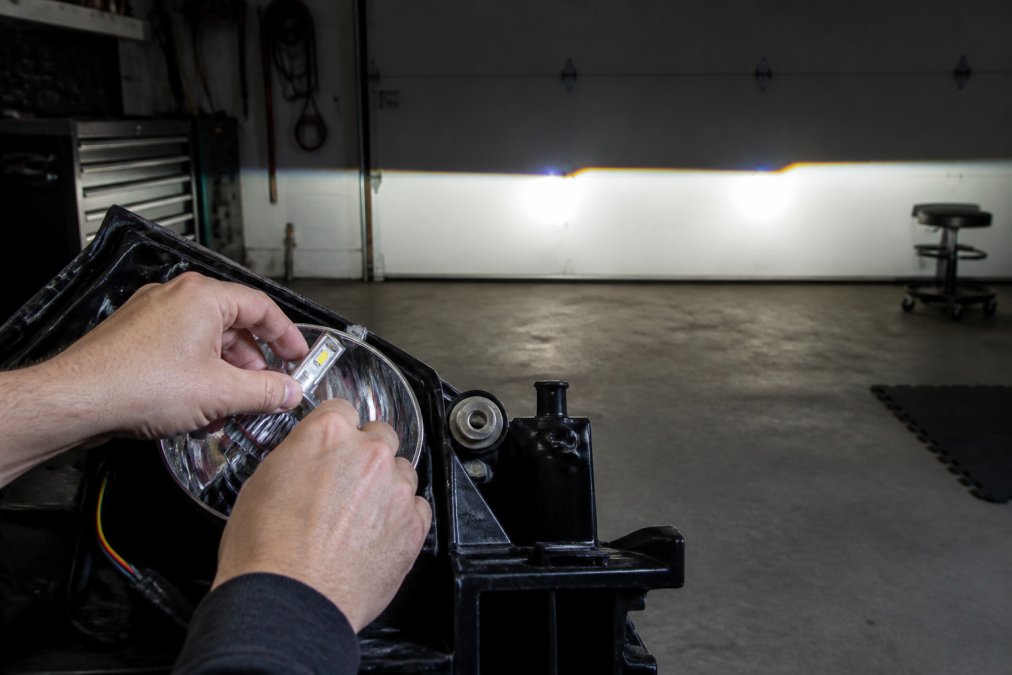
The cutoff line is the sharp upper edge of your low beam pattern. A clean cutoff directs light down and to the right, away from oncoming traffic. A sloppy cutoff scatters light upward and creates glare.
Diode Dynamics designs many of its bulbs around specific housing types, which helps preserve the factory cutoff. GTR Lighting bulbs vary more by model, so results depend heavily on which unit you buy. In practice, the bulb's diode placement and orientation inside the housing determine whether the cutoff survives the swap.
The mechanism is worth understanding. A halogen filament emits light in roughly all directions from a small, near-point source (energy.gov). An LED conversion bulb uses one or more chips mounted on a flat substrate, so its light-emitting surface is a plane, not a point. If that plane does not sit at the same focal position as the original filament, and at the same height relative to the reflector or projector bowl, the housing's optics focus the light to the wrong place. The result is a cutoff that smears, steps, or lifts into oncoming lanes. This is why two bulbs with identical lumen ratings can produce completely different beam patterns in the same housing.
Lumen Output vs Effective Brightness
Raw lumen output is not the same as effective brightness on the road. Lux measurement at a fixed distance tells you how much usable light actually reaches the pavement.
A bulb rated at a higher lumen number can throw less usable light if its beam focus is poor. This is where the diode dynamics vs gtr lighting comparison gets interesting: GTR Lighting often advertises higher numbers, while Diode Dynamics emphasizes where the light lands. For real driving, beam focus beats a bigger number every time.
How to Test a Beam Pattern Objectively
Most comparisons rely on forum photos taken against a garage door, which are inconsistent and easy to stage. A more reliable approach uses a few repeatable steps:
- Park the vehicle on a level surface 25 feet from a flat, light-colored wall, with tires at the same pressure and the fuel tank at a similar level.
- Mark the vertical centerline of the vehicle and the horizontal height of the low-beam cutoff on the wall before any bulb swap.
- Install one bulb at a time, let it stabilize for several minutes, and photograph the pattern from the same camera position with fixed exposure.
- Measure the cutoff height and the width of the hot spot, and note any upward light above the cutoff line.
- Repeat with the opposite brand in the same housing so the only variable is the bulb.
A goniophotometer, the instrument labs use to map light distribution in three dimensions, gives the most rigorous result, but very few enthusiasts have access to one. The wall-and-tape method above is the practical middle ground, and it is far more useful than a single marketing photo.
What the Pattern Tells You About Each Brand
A common pattern in enthusiast testing is that Diode Dynamics bulbs tend to hold the factory cutoff more consistently across housing types, because the company publishes which housings each bulb was validated against. GTR Lighting results are more variable: some models produce a clean cutoff in projector housings, while others show a lifted or stepped pattern in reflector housings. Neither outcome is universal, the housing, not the brand, is the dominant variable. That is why the same bulb can earn praise in one vehicle and complaints in another.
How to Choose LED Headlight Bulbs for Your Vehicle
Choosing the right LED headlight bulbs starts with your housing type, not the brand name. Match the bulb to your reflector or projector housing, confirm CANbus compatibility, and check physical clearance before you buy.
- Identify your housing: reflector or projector
- Confirm bulb size and base type for your vehicle
- Check whether you need a CANbus-ready driver module
- Measure dust cover clearance behind the bulb
- Verify DOT compliance for street use
Fitment and Housing Compatibility
Fitment issues cause more returns than any other problem. Older vehicles often have tight dust covers and shallow housings that reject oversized heat sinks.
Diode Dynamics publishes detailed fitment guidance per model, which reduces guesswork. GTR Lighting covers many vehicles, but you should confirm clearance yourself. A wiring harness or adapter may be required on some vehicles, and that requirement is vehicle-specific rather than brand-wide.
CANbus and Flicker Issues
CANbus systems monitor electrical load and can trigger dashboard error codes or flicker when a low-draw LED replaces a halogen bulb. A driver module or resistor pack resolves most of these cases.
Cheap kits skip this step and cause hyper-flashing and warning lights. Both Diode Dynamics and GTR Lighting offer anti-flicker solutions on many models, but you need to confirm the specific kit matches your vehicle's electrical load and voltage regulation behavior.
Heat Management and Long-Term Degradation
Heat is what kills LED bulbs slowly. A diode that runs hot loses output over time, and thermal management determines how long a kit stays bright. Most reviews stop at the first-night impression, this section covers what happens after 12 to 24 months, which is where the two brands actually diverge.
The Mechanism Behind LED Dimming
An LED's light output falls as its junction temperature rises. That is not a defect; it is physics. The chip sits on a substrate, the substrate sits on a thermal pad, and the pad sits on a heat sink. Every layer in that stack adds thermal resistance, and every bit of resistance means the junction runs hotter than the surrounding air.
Two things happen when a bulb runs hot:
- Immediate output drop. Many drivers use a thermal rollback circuit that reduces current when the heat sink reaches a set temperature. You may not notice it on a cool night, but on a hot summer commute the bulb can quietly dim to protect itself.
- Permanent degradation. Over thousands of hours, sustained heat degrades the phosphor coating and the chip's internal structure. Output that was acceptable at month one can fall noticeably by month 18, and the color temperature can shift as the phosphor ages.
Why Housing Type Matters More Than Brand
Heat sink size, driver module quality, and airflow behind the dust cover all matter. Passive cooling works in open housings; sealed housings need more care. A bulb crammed into a sealed housing with no airflow will dim noticeably within months and can fail outright, leaving you to buy a replacement kit sooner than expected.
What to Expect Over 12 to 24 Months
A common pattern reported by long-term owners is a gradual loss of perceived brightness rather than a sudden failure. The bulb still lights, but the beam looks flatter and less punchy than it did when new. Because the change is slow, drivers often blame their own eyes rather than the bulb.
To track this yourself, note your lux reading at a fixed distance when the kit is new, then re-measure at 6, 12, and 24 months under the same conditions. A drop of a few percent is normal aging. A drop large enough to notice on the road usually points to a thermal problem in the housing, not a defective bulb.
How the Two Brands Approach Thermal Design
Diode Dynamics generally builds more conservative, cooler-running designs, often with larger heat sinks and drivers that manage current more gently. GTR Lighting's higher-output models can run hotter, which makes housing airflow more critical. Neither brand escapes physics: if the housing traps heat, output consistency suffers.
The practical takeaway is that thermal design is a system, not a spec sheet line. A well-cooled bulb in a ventilated housing will outlast a premium bulb in a sealed one. When you compare the two brands, weigh how each kit's heat sink fits your specific housing and whether the driver module adds heat inside the dust cover. That fitment question matters more to long-term output than any initial brightness claim.
Best Plug and Play LED Headlight Kits
The best plug and play LED headlight kits combine correct fitment, CANbus-ready drivers, and a beam pattern that respects your housing. Plug-and-play means the connector matches your factory harness, not that installation is effortless on every vehicle.
For most classic car and truck owners, RMS Lighting LLC offers original style conversion kits for easy installation, featuring correct LHD lens patterns and options to upgrade to 90-Watt or 130-Watt bulbs. That approach keeps installation simple while preserving the factory look.
When comparing the diode dynamics vs gtr lighting options against what RMS Lighting LLC provides, weigh three things: connector match, driver module inclusion, and whether the kit was tested for your housing type.
DOT Compliance and Street Legality
DOT compliance is not optional if you drive on public roads. Federal motor vehicle safety standards govern headlamp performance, and a conversion that fails them can fail a state inspection (nhtsa.gov).
Both Diode Dynamics and GTR Lighting offer DOT-compliant options, but compliance is model-specific. Check the NHTSA Federal Motor Vehicle Safety Standards for lighting before you assume a kit is street legal. Glare reduction matters here too: a compliant bulb still needs a correct beam pattern to pass.
Conclusion
Sorting through the diode dynamics vs gtr lighting debate gets easier once you stop comparing lumen numbers and start comparing beam patterns, fitment, and thermal design. The brand that matches your housing and electrical system wins, regardless of marketing.
For classic car and truck owners who want a factory look with modern output, RMS Lighting LLC builds researched, tested conversion kits with original-style connectors, correct lens patterns, and 90-Watt or 130-Watt upgrade options. Get started with RMS Lighting LLC and find the kit that fits your vehicle.
Frequently Asked Questions
Is GTR Lighting a good brand for LED headlights?
GTR Lighting has built a following among enthusiasts for its high-output LED bulbs and plug-and-play kits. The brand focuses on lumen output and offers a range of color temperatures. However, independent beam pattern testing is limited, and some users report fitment challenges in older reflector housings. For buyers prioritizing verified beam focus and DOT compliance, it pays to compare GTR Lighting against brands that publish standardized lux measurements and cutoff line data.
Are Diode Dynamics LED bulbs street legal in the United States?
Diode Dynamics offers some products that are DOT compliant when installed in the correct housing and aimed properly. However, not every LED bulb they sell is street legal in every state. Federal law requires headlamps to meet FMVSS 108, and many LED conversions are sold for off-road use only. Always check the product listing for DOT compliance and confirm your state's inspection rules before installing any LED headlight conversion.
How does Diode Dynamics compare to GTR Lighting in terms of beam pattern?
Beam pattern depends heavily on bulb orientation, diode placement, and how the bulb sits in the reflector or projector housing. Diode Dynamics generally engineers its bulbs to mimic the filament position of factory halogens, which helps maintain a sharp cutoff line. GTR Lighting bulbs often produce higher raw lumen output, but without a properly matched beam focus, that extra brightness can scatter and cause glare. Objective lux testing at 25 feet is the best way to compare real-world beam performance.
Do GTR Lighting and Diode Dynamics offer plug-and-play compatibility for most vehicles?
Both brands offer plug-and-play designs for many vehicles, but compatibility varies by model year and housing type. Older vehicles with CANbus systems may need additional resistors or anti-flicker modules. Some kits include vehicle-specific wiring harnesses; others require you to reuse factory connectors. Before buying, verify the bulb size (such as H11, 9006, or H4), check whether your vehicle uses a reflector or projector housing, and confirm whether a dust cover will fit over the new bulb's heat sink.
Choosing between Diode Dynamics and GTR Lighting really comes down to matching a kit to your specific housing, wiring, and driving needs. RMS Lighting LLC takes the guesswork out of that decision with rigorously tested LED headlamp conversion kits, original-style connectors for easy installation, correct left-hand-drive lens patterns, and bulb options up to 90 or 130 watts. Get started with RMS Lighting LLC and upgrade to lighting you can trust on every night drive.