

PrecisionLED vs HIDNation Headlights: 2026 Review

Table of Contents
- PrecisionLED vs HIDNation: Quick Comparison
- Best Plug and Play LED Headlight Kits: What Sets Them Apart
- LED vs HID Headlight Pros and Cons
- Lumens, Beam Pattern, and Visibility Performance
- How to Install LED Headlight Conversion Kits
- Canbus Error Codes and Compatibility Issues
- Weather Performance and Long-Term Durability
- Conclusion: Which Headlight Upgrade Wins
Last Updated: August 27, 2026
PrecisionLED vs HIDNation: Quick Comparison
The choice between PrecisionLED and HIDNation headlights comes down to one fundamental question: do you prioritize ease of installation or maximum light output? PrecisionLED focuses on plug-and-play simplicity, while HIDNation emphasizes raw lumens and aggressive beam patterns. At RMS Lighting LLC, our LED headlight conversion kits deliver the balance most owners need: genuine plug-and-play installation without sacrificing the lumens output that makes nighttime driving safer.
Best Plug and Play LED Headlight Kits: What Sets Them Apart
When shopping for plug and play LED headlight kits, you're comparing three things: how well the bulb fits your existing housing, whether it triggers warning codes, and whether the beam pattern improves visibility without blinding oncoming traffic.
Modern vehicles with canbus systems often reject LED bulbs because they draw less power than factory halogens. Quality matters here. RMS Lighting LLC's H7 60W LED bulbs at $35 per pair and H4 60W bulbs at $50 per pair include built-in drivers and active cooling fans specifically engineered to prevent these compatibility issues.

Beam pattern separates quality kits from cheap ones. A proper LED headlight conversion maintains the cutoff line, the sharp horizontal boundary between lit and unlit road, that prevents glare to oncoming drivers. Budget kits scatter light in all directions, creating a halo effect that reduces visibility. RMS Lighting LLC bulbs feature 360-degree beam angles with active cooling fans and operating temperatures rated from -40°C to +85°C.
| Feature | RMS Lighting LLC | PrecisionLED | HIDNation |
|---|---|---|---|
| Installation Complexity | Plug-and-play | Plug-and-play | Requires ballast/wiring |
| Lumens Output | 10,000 (60W) | 8,000-9,000 typical | 12,000+ (HID-equivalent) |
| Canbus Compatible | Yes (built-in driver) | Often requires decoder | Requires decoder module |
| Beam Pattern Control | Factory-correct | Factory-correct | Aggressive/custom |
| Price Range | $35-$50 per pair | $40-$80 per pair | $60-$150+ per pair |
| Cooling System | Active fan | Passive heatsink | Ballast-dependent |
| Best For | DIY simplicity | Purist restoration | Maximum output seekers |
SAE lighting standards for automotive bulbs
LED vs HID Headlight Pros and Cons
LED (light-emitting diode) headlights work by passing electrical current through a semiconductor that emits light directly. HID (high-intensity discharge) headlights work by creating an electrical arc between two electrodes inside a pressurized bulb, similar to a tiny lightning bolt.
LED Headlight Pros:
- Instant on/off (no warm-up time like HID)
- Lower power consumption (40-60 watts vs. 75-100 watts for HID)
- Longer lifespan (50,000+ hours vs. 10,000-15,000 for HID)
- No ballast required (simpler installation)
- Better beam pattern control
- Compatible with older vehicle electrical systems when properly engineered
LED Headlight Cons:
- Higher upfront cost per bulb ($35-$150 vs. $20-$50 for HID)
- Requires precision engineering to avoid canbus errors
- Some cheap LEDs produce inadequate lumens for highway driving
- Thermal management critical for longevity
HID Headlight Pros:
- Highest lumens output available (10,000-12,000 lumens typical)
- Proven technology with decades of use
- Excellent color temperature options (3000K to 8000K)
- Lower per-bulb cost than quality LED
HID Headlight Cons:
- Requires ballast and wiring harness (complex installation)
- Warm-up time (30-60 seconds to full brightness)
- Shorter lifespan than LED
- Higher power draw stresses aging electrical systems
- Pressure vessel rupture risk if bulb fails
- Canbus error codes common without decoder modules
- Excessive glare if beam pattern isn't factory-correct
- Heat generation can damage reflector housings over time
The choice between LED and HID depends on matching the technology to your vehicle's electrical system and driving needs. Older vehicles with simple electrical systems often handle HID better. Newer vehicles with complex electronics almost always prefer LED when properly engineered.
Lumens, Beam Pattern, and Visibility Performance
Lumens measure total light output in all directions. Lux measures light intensity at a specific distance. For headlights, lux matters more than lumens because what matters is how bright the road ahead actually appears.
A typical factory halogen headlight produces around 1,000-1,500 lumens. Most LED conversion kits deliver 8,000-12,000 lumens. That's a massive upgrade, but only if the beam pattern directs that light onto the road where you need it. A poorly designed LED kit might produce 12,000 lumens but scatter half into the sky or toward oncoming traffic.
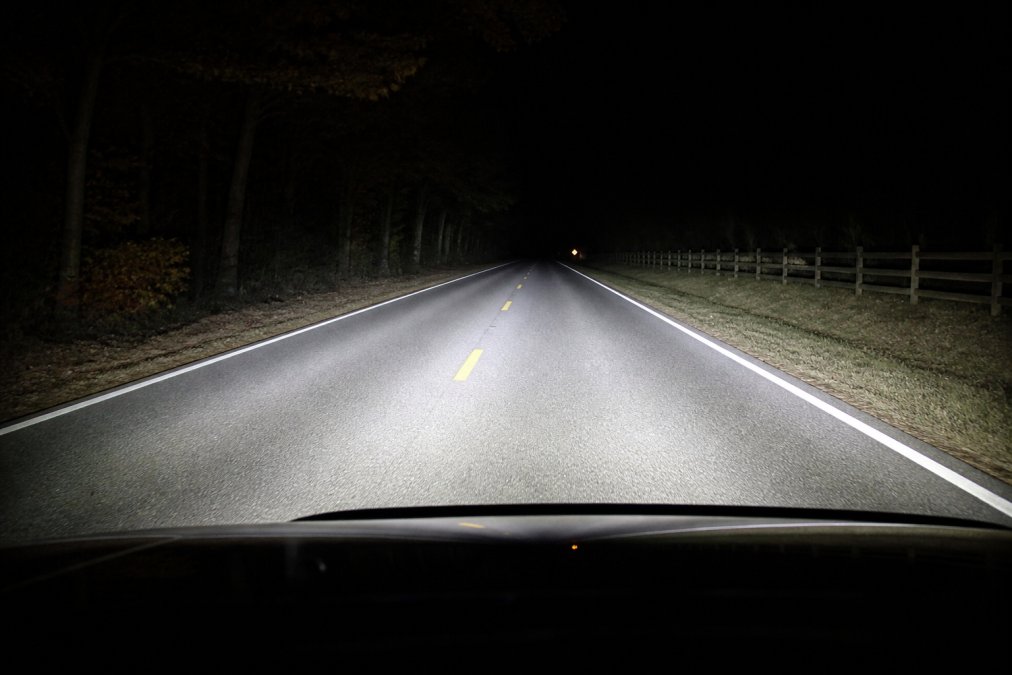
Beam pattern is defined by the cutoff line, the sharp horizontal boundary between illuminated road and dark sky. Factory headlights have a precisely engineered cutoff line that keeps light below the horizontal plane, preventing glare. RMS Lighting LLC's 360-degree beam angle design with built-in drivers preserves the factory cutoff pattern, directing the full benefit of 10,000 lumens exactly where it matters.
Color temperature (measured in Kelvin) also affects visibility. A 6500K bulb produces cool white light that closely matches daylight, improving contrast and reducing eye strain. Warmer 3000K bulbs provide better visibility in fog and rain but feel less bright.
How to Install LED Headlight Conversion Kits
Installation difficulty separates plug-and-play kits from ballast-based systems. True plug-and-play installation takes 15-30 minutes per headlight.
For RMS Lighting LLC plug-and-play LED bulbs (H4, H7, 9005, 9006, H8/H9/H11 models):
-
Locate your headlight assembly. Open your hood and identify which bulb type your vehicle uses. Check your owner's manual or use a VIN decoder if unsure.
-
Remove the factory bulb. Access varies by vehicle. Twist counterclockwise or press the release tab, then pull straight out. Don't touch the bulb filament with bare hands.
-
Inspect the socket and housing. Check for corrosion inside the socket. If you see white or green oxidation, clean it with a wire brush or contact cleaner. Corroded connections cause flickering and canbus errors.
-
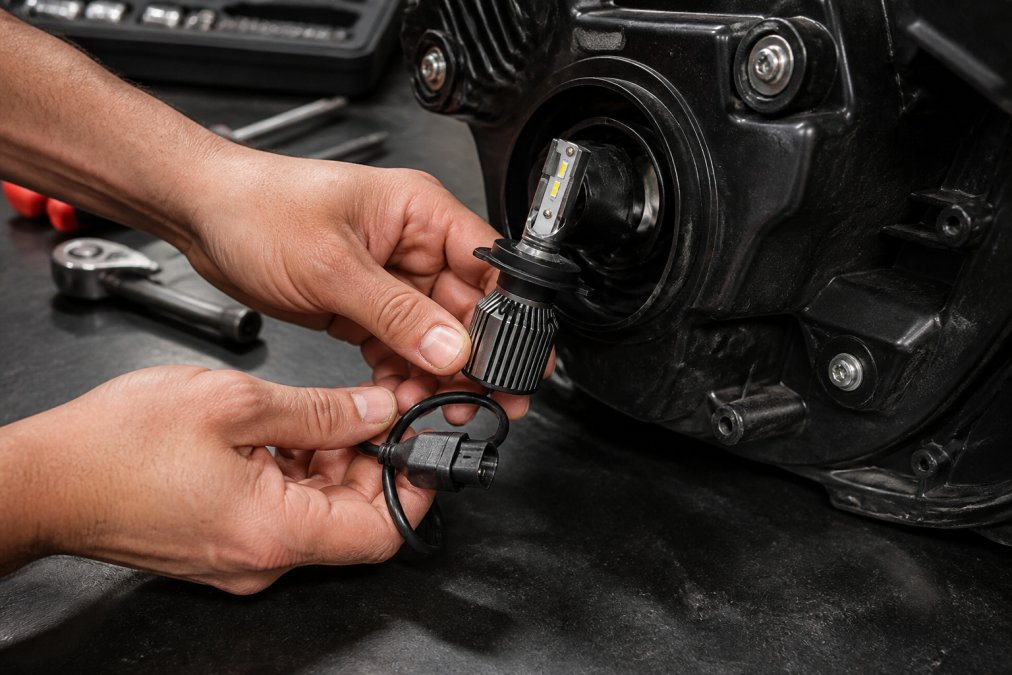
Insert the LED bulb. Align the keying tabs with the socket grooves. Push straight in until you hear a click. The bulb should sit flush with the housing.
-
Plug in the connector. RMS Lighting LLC bulbs come with integrated drivers and cooling fans. The connector plugs into the factory wiring harness. Push until you hear a click.
-
Test before closing. Turn on your headlights (low beam) and check for flickering. If stable, move to the second headlight. If you see flickering or dashboard error codes, the socket may need cleaning or you may need a canbus decoder module.
-
Repeat for the second headlight. Installation is identical for the passenger side.
-
Check beam alignment. Turn on your lights in a dark area and verify the beam pattern is level and symmetrical. Adjust the headlight aim using the adjustment screws on the back of the assembly if needed.
For HIDNation or ballast-based systems:
HIDNation kits require running a separate power wire from the battery to a ballast module, then connecting that ballast to the headlight socket. This involves cutting and splicing factory wiring, adding a relay module, and securing the ballast away from heat sources. This requires automotive electrical experience and a multimeter. The advantage is precise power delivery and better flicker control. The disadvantage is hours of installation and permanent modification to your vehicle's electrical system.
Canbus Error Codes and Compatibility Issues
Modern vehicles use canbus (controller area network) systems that monitor every electrical component. When you install an LED bulb that draws significantly less power than the factory halogen it replaces, the canbus system detects this as a malfunction and triggers a dashboard warning light.
The error code you'll see is often a "bulb out" or "low beam failure" code, even though your lights work perfectly. This happens because the canbus system measures electrical resistance and load. A 55-watt halogen bulb draws a certain amount of current. A 60-watt LED bulb with an integrated driver draws less current in a different pattern. The system sees a mismatch and assumes the bulb has failed.
Three solutions exist:
-
Built-in driver with load simulation. This is what RMS Lighting LLC's bulbs use. The integrated driver mimics the electrical signature of a factory halogen bulb, fooling the canbus system into thinking everything is normal. This works in many vehicles. Cost: included in the bulb price ($35-$50).
-
External canbus decoder module. A small box that sits between the factory wiring and the LED bulb, simulating the correct electrical load. These cost $20-$40 and require splicing into your wiring harness. Necessary when the built-in driver isn't sufficient.
-
Ballast system. HIDNation's approach. The ballast itself handles power conversion and load simulation. More complex installation but very reliable. Cost: $100-$200 for the ballast module plus installation.
If you see a canbus error after installation, try: (1) verify the LED bulb is fully seated in the socket, (2) clean the socket contact points with a wire brush, (3) add a canbus decoder module, or (4) reinstall the factory bulb to confirm the error clears.
SAE J1850 canbus standards for automotive lighting
Weather Performance and Long-Term Durability
How your headlights perform in rain, fog, and snow separates budget kits from reliable upgrades.
Rain and wet conditions: LED bulbs perform better than HID in rain because the light source is smaller and more directional. However, water intrusion into the bulb housing is a real risk. If your headlight assembly has a cracked lens or failed seal, water gets inside and corrodes the LED chip and driver circuitry. RMS Lighting LLC bulbs are rated for -40°C to +85°C operation, covering most climate conditions, but the headlight housing itself must remain sealed.
Fog and snow: Color temperature matters here. A 6500K LED (cool white) performs worse in fog than a 3000K LED (warm yellow) because cool light scatters more in fog droplets. HIDNation's higher lumens output helps in snow because the sheer brightness penetrates falling snow more effectively.
Long-term degradation: LED bulbs degrade gradually over 50,000+ hours. Brightness slowly decreases, color temperature shifts slightly toward yellow, and in cheap kits, the cooling fan eventually fails. RMS Lighting LLC's CREE 1860 LED chips are industrial-grade components with proven longevity. Budget kits often use generic chips that lose brightness over time.
HID bulbs degrade differently. The arc discharge becomes less stable over time, causing flickering or color shifts. By 10,000-15,000 hours, most HID bulbs need replacement.
Thermal cycling stress: Every drive cycle heats and cools your headlights, stressing solder joints and connections. Bulbs with active cooling fans manage this better than passive heatsink-only designs. Over five years of regular driving, the difference compounds.
Conclusion: Which Headlight Upgrade Wins
PrecisionLED wins for owners who prioritize factory appearance and simplicity. Their beam patterns preserve the original cutoff line perfectly, and installation is genuinely plug-and-play.
HIDNation wins for drivers who want maximum visibility and don't mind the aggressive beam pattern or complex installation. If you're doing serious off-road driving or nighttime highway work, the extra lumens justifies the wiring complexity.
For most DIY installers upgrading older vehicles, RMS Lighting LLC delivers the practical balance: genuine plug-and-play installation with the built-in driver and active cooling fan that prevents canbus errors, 10,000 lumens output that genuinely improves nighttime visibility, and proven long-term durability through CREE 1860 LED chips. Our H4, H7, 9005, 9006, and H8/H9/H11 models start at $35 per pair and include a 2-year warranty. Installation takes 30 minutes, the beam pattern stays factory-correct, and you won't see dashboard error codes.
National Highway Traffic Safety Administration lighting standards
== FAQ ANSWERS (audit these too, same rules) ===
[1] Q: Will PrecisionLED or HIDNation LED headlight kits cause canbus error codes? A: Both brands design their kits with built-in drivers and canbus compatibility in mind, but compatibility depends on your vehicle's year and model. Error codes typically occur when the vehicle's computer doesn't recognize the new load signature. Modern LED conversion kits include resistor packs or decoder modules to prevent this. Before purchasing, verify your specific vehicle model is listed as compatible. RMS Lighting's LED bulbs feature built-in drivers and active cooling, reducing error code risk. Always check installation forums for your exact vehicle to confirm other owners' success rates.
[2] Q: What's the difference between lumens and lux when comparing LED headlight brightness? A: Lumens measure total light output from the bulb; lux measures light intensity at a specific distance on the road. A 10,000-lumen LED bulb sounds bright, but what matters for driving is lux, how much light actually reaches the pavement 100 feet ahead. Beam pattern and reflector housing design determine how effectively lumens convert to usable lux. PrecisionLED and HIDNation both publish lux measurements at standard distances. RMS Lighting's 60-watt LED bulbs produce 10,000 lumens with a 360-degree beam angle, but the actual road illumination depends on your headlight housing design.
[3] Q: Are plug-and-play LED headlight kits legal to use on public roads? A: LED headlight legality varies by state and depends on whether your vehicle's headlight housing is DOT-approved for LED use. Many older vehicles have halogen-only housings; installing LEDs in them may violate state regulations because the beam pattern won't match DOT standards. Newer vehicles often have LED-compatible housings from the factory. Check your state's vehicle code and your headlight housing specifications before installing any conversion kit. Even if the kit is plug-and-play, improper beam pattern can result in citations for excessive glare or unsafe lighting.
[4] Q: How long do LED headlight bulbs typically last compared to halogen? A: LED headlight bulbs typically last 15,000 to 25,000 hours, while halogen bulbs last 400 to 1,000 hours. That translates to years of use for LEDs versus months for halogen. However, lifespan depends on thermal management, LEDs generate heat that must be dissipated through active cooling fans. RMS Lighting's LED bulbs include built-in cooling fans and are rated for operating temperatures from -40°F to +85°F. Poor heat dissipation shortens lifespan, so choose kits with active cooling systems. A 2-year warranty is standard for quality LED conversion kits.
[5] Q: What's the actual price difference between PrecisionLED, HIDNation, and RMS Lighting LED kits? A: RMS Lighting offers LED bulbs starting at $35 for H7 models and $50 for H4, 9005, 9006, and H8/H9/H11 models. These are individual bulb pairs with 10,000 lumens and 6500K color temperature. Competitor pricing varies widely based on kit complexity, housing compatibility, and included adapters. Budget LED kits start under $50; premium conversion kits with complete housing replacements exceed $300. For a direct comparison, calculate the total cost of all components needed for your vehicle, not just the bulb price.
Frequently Asked Questions
Will PrecisionLED or HIDNation LED headlight kits cause canbus error codes?
Both brands design their kits with built-in drivers and canbus compatibility in mind, but compatibility depends on your vehicle's year and model. Error codes typically occur when the vehicle's computer doesn't recognize the new load signature. Modern LED conversion kits include resistor packs or decoder modules to prevent this. Before purchasing, verify your specific vehicle model is listed as compatible. RMS Lighting's LED bulbs feature built-in drivers and active cooling, reducing error code risk. Always check installation forums for your exact vehicle to confirm other owners' success rates.
What's the difference between lumens and lux when comparing LED headlight brightness?
Lumens measure total light output from the bulb; lux measures light intensity at a specific distance on the road. A 10,000-lumen LED bulb sounds bright, but what matters for driving is lux, how much light actually reaches the pavement 100 feet ahead. Beam pattern and reflector housing design determine how effectively lumens convert to usable lux. PrecisionLED and HIDNation both publish lux measurements at standard distances. RMS Lighting's 60-watt LED bulbs produce 10,000 lumens with a 360-degree beam angle, but the actual road illumination depends on your headlight housing design.
Are plug-and-play LED headlight kits legal to use on public roads?
LED headlight legality varies by state and depends on whether your vehicle's headlight housing is DOT-approved for LED use. Many older vehicles have halogen-only housings; installing LEDs in them may violate state regulations because the beam pattern won't match DOT standards. Newer vehicles often have LED-compatible housings from the factory. Check your state's vehicle code and your headlight housing specifications before installing any conversion kit. Even if the kit is plug-and-play, improper beam pattern can result in citations for excessive glare or unsafe lighting.
How long do LED headlight bulbs typically last compared to halogen?
LED headlight bulbs typically last 15,000 to 25,000 hours, while halogen bulbs last 400 to 1,000 hours. That translates to years of use for LEDs versus months for halogen. However, lifespan depends on thermal management, LEDs generate heat that must be dissipated through active cooling fans. RMS Lighting's LED bulbs include built-in cooling fans and are rated for operating temperatures from -40°F to +85°F. Poor heat dissipation shortens lifespan, so choose kits with active cooling systems. A 2-year warranty is standard for quality LED conversion kits.
What's the actual price difference between PrecisionLED, HIDNation, and RMS Lighting LED kits?
RMS Lighting offers LED bulbs starting at $35 for H7 models and $50 for H4, 9005, 9006, and H8/H9/H11 models. These are individual bulb pairs with 10,000 lumens and 6500K color temperature. Competitor pricing varies widely based on kit complexity, housing compatibility, and included adapters. Budget LED kits start under $50; premium conversion kits with complete housing replacements exceed $300. For a direct comparison, calculate the total cost of all components needed for your vehicle, not just the bulb price.
Upgrading your headlights shouldn't require an electrical engineering degree. RMS Lighting LLC's LED conversion kits eliminate the guesswork with built-in canbus compatibility, active thermal management, and beam patterns engineered for both safety and visibility. Get started with our H7 60W LED bulbs at $35 per pair or H4 60W at $50 per pair, and experience the difference that precision-engineered lighting makes for your driving experience.
This article was written using GrandRanker