

HIDnation Alternatives for Performance Lighting

Table of Contents
- Why Performance Lighting Matters: Beyond Factory Halogen Bulbs
- HID vs LED Headlight Pros and Cons
- Energy Efficiency and Power Consumption Comparison
- Light Output, Lumens, and Visibility Performance
- DOT Compliance for Aftermarket Headlights
- How to Install HID Conversion Kits and LED Retrofit Options
- Projector vs. Reflector Housing Compatibility
- Performance Lighting Alternatives: Choosing the Right Upgrade
Last Updated: August 16, 2026
Why Performance Lighting Matters: Beyond Factory Halogen Bulbs
Factory halogen bulbs are dim, fail frequently, and force drivers to squint through the dark. Poor nighttime visibility, constant replacements, and safety risks are the inevitable result. Modern LED and HID technology have transformed what's possible in automotive lighting. The real question isn't whether you should upgrade, it's which technology makes sense for your vehicle, budget, and needs.
HID vs LED Headlight Pros and Cons
High-intensity discharge and light-emitting diode technology represent the two dominant paths for modernizing your vehicle's lighting.
High-Intensity Discharge Technology and Reliability
HID systems create light through an electrical arc between two electrodes inside a pressurized gas-filled bulb, producing 3,000 lumens or more, significantly brighter than halogen. Modern ballast systems are far more stable than earlier generations, and a quality HID conversion kit lasts thousands of hours. The drawback is complexity: HID systems require a ballast (external power converter), wiring harnesses, and sometimes capacitors. If the ballast fails, replacement costs more than a simple bulb swap. HID bulbs also run hot, and poor thermal management shortens lifespan.
Light-Emitting Diode Advantages and Solid-State Durability
LEDs produce light through semiconductor physics, no moving parts, no pressurized gas, no ballast needed in most modern designs. This solid-state approach delivers genuine reliability: LEDs operate for 30,000 to 50,000 hours or more, far outlasting HID systems. They run cooler, which matters for longevity and thermal management. Modern LED conversion kits deliver lumens comparable to HID, with many premium options hitting 30,000 lumens or higher. The trade-off is upfront cost; quality LED kits typically cost more than HID alternatives.
Energy Efficiency and Power Consumption Comparison
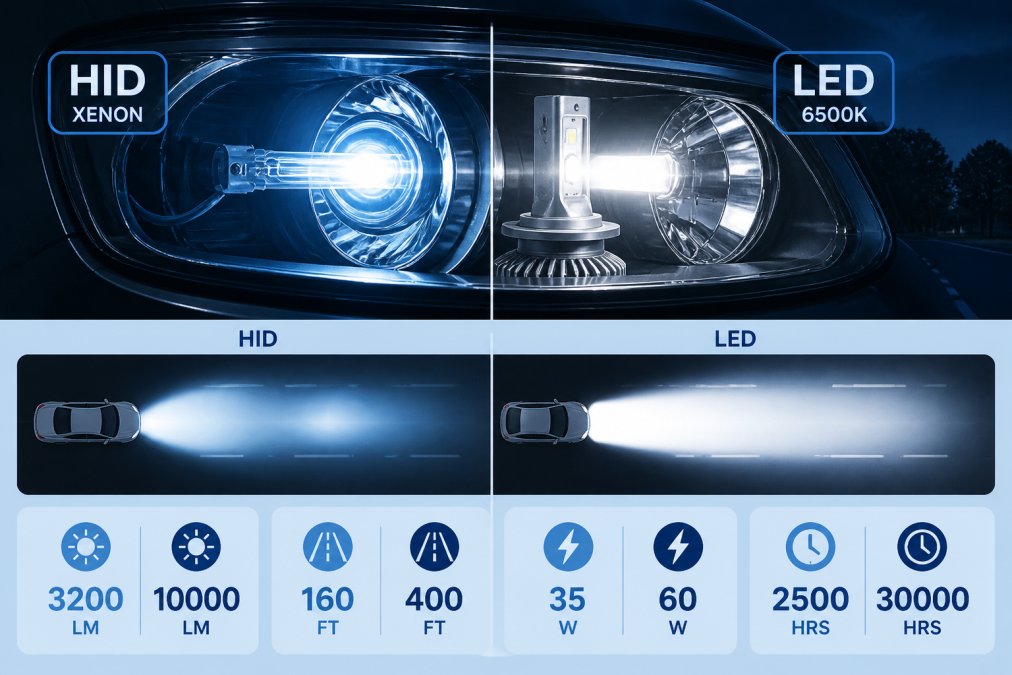
Factory halogen bulbs typically draw 55 watts per bulb. HID systems consume 35-55 watts depending on ballast and bulb design, offering modest efficiency gains over halogen. LED conversion kits are the efficiency winners, drawing 30-45 watts per bulb. RMS Lighting LLC's 130-watt canbus LED bulbs operate at 65 watts per bulb (130 watts for a pair), delivering exceptional brightness while minimizing electrical load. This efficiency matters for classic cars and trucks with older alternators that struggle to supply power to modern accessories.

| Technology | Typical Wattage | Light Output (Lumens) | Efficiency | Best For |
|---|---|---|---|---|
| Halogen | 55W | 1,200-1,500 | Baseline | Stock vehicles, minimal upgrades |
| HID | 35-55W | 3,000-4,000 | Moderate | Brightness-focused upgrades, projector housings |
| LED | 30-65W | 3,000-30,000+ | High | Modern vehicles, older electrical systems, longevity |
Light Output, Lumens, and Visibility Performance
Factory halogen bulbs produce roughly 1,200-1,500 lumens, adequate for city driving but limiting on dark rural roads. HID systems jump to 3,000-4,000 lumens at 4,300K to 6,000K color temperature, delivering a genuine step change in visibility. LED conversion kits can exceed 30,000 lumens with advanced chip designs. At 30,000 lumens with proper beam pattern engineering, you'll see road details clearly from 300+ feet away; at 1,500 lumens, you're seeing maybe 100-150 feet ahead.
DOT Compliance for Aftermarket Headlights
The Department of Transportation sets standards for vehicle lighting through Federal Motor Vehicle Safety Standard 108 (FMVSS 108), defining beam pattern, intensity, color, and cutoff requirements. FMVSS 108 is written around halogen and HID technology; LED conversion kits occupy a gray area. A retrofit LED bulb installed in a halogen reflector housing may not meet DOT standards because the beam pattern isn't engineered correctly, creating glare.
If your conversion kit creates unsafe glare or fails to meet beam pattern requirements, you could face citations or be required to revert to factory lighting. The solution is choosing conversion kits specifically designed for your vehicle's housing type. If you have a projector housing, LED or HID retrofits work well because projector lenses control the beam pattern. If you have a reflector housing, you need a kit engineered specifically for reflector compatibility or you need to upgrade to projector housings.
How to Install HID Conversion Kits and LED Retrofit Options
Plug-and-Play LED Kits vs. Ballast-Based HID Systems
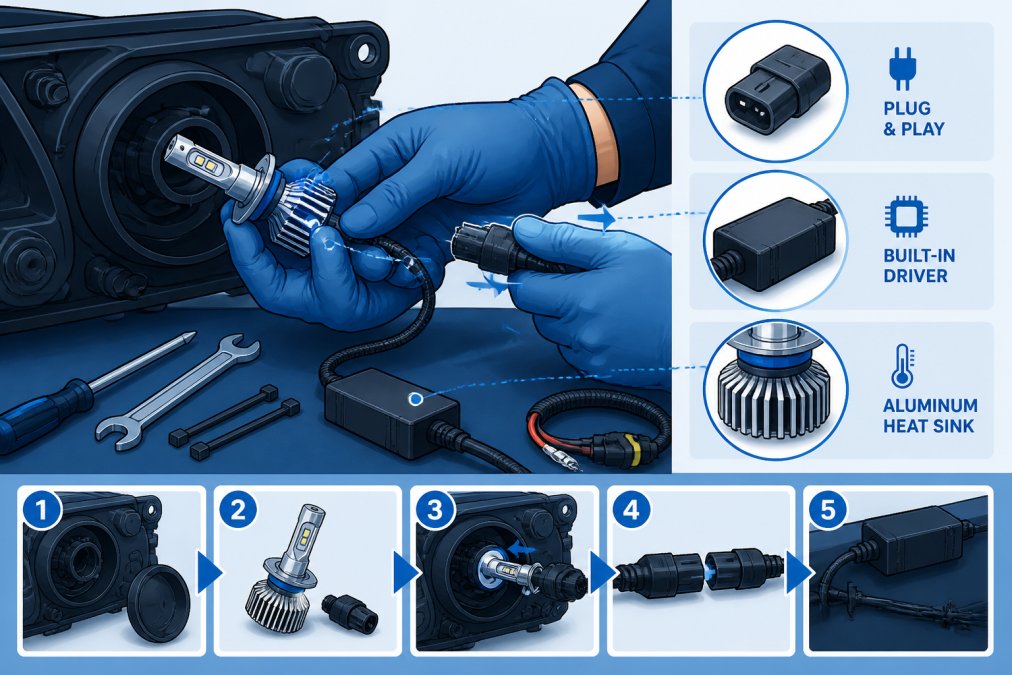
LED conversion kits marketed as "plug-and-play" are genuinely simpler than HID. You remove the factory halogen bulb, insert the LED bulb into the socket, and you're done. No ballast, no additional wiring, no capacitors. Modern LED bulbs include a built-in driver that handles voltage conversion. RMS Lighting LLC's 130-watt canbus LED bulbs follow this pattern, with installation taking 15-30 minutes per headlight for most vehicles.
HID conversion kits require more work: installing a ballast (typically near the battery), running power and ground wires, connecting a relay, and installing the HID bulb. This is a 1-2 hour job for someone with basic automotive electrical knowledge. The installation advantage goes decisively to LED.
Handling Canbus and Error Code Troubleshooting
Modern vehicles use canbus (Controller Area Network) wiring to communicate between electrical components. When you install an LED bulb that draws significantly less power than the factory halogen it replaces, the vehicle's onboard diagnostic system sometimes detects this as a fault, triggering dashboard error codes and flickering.
The fix is a canbus-compatible LED bulb or a load resistor. Canbus-compatible LEDs include internal circuitry that mimics the electrical signature of the original halogen bulb. RMS Lighting LLC's canbus LED bulbs solve this problem at the source, with built-in canbus-compatible design that prevents dashboard errors.
If your vehicle is newer than 2005, assume it has canbus wiring. Choose LED bulbs or HID kits specifically rated as canbus-compatible for your vehicle model.
Projector vs. Reflector Housing Compatibility
Reflector housings use a curved mirror behind the bulb to direct light forward. When you install an LED or HID bulb in a reflector housing, the light source is in a different position, so the reflector doesn't focus the light correctly, creating scattered light and glare. Reflector housings are common in vehicles made before 2010.
Projector housings use a lens in front of the bulb to focus and direct light. This design is much more forgiving of different bulb types. LED and HID retrofits work well in projector housings because the lens controls the beam pattern. Projector housings are standard in most vehicles made after 2010.
If you have a reflector housing and want to upgrade, buy a conversion kit specifically engineered for reflector compatibility, or upgrade to projector housings. If you have a projector housing, almost any quality LED or HID conversion kit will work.
Performance Lighting Alternatives: Choosing the Right Upgrade
For maximum brightness and modern aesthetics: LED conversion kits are the clear winner. They're brighter, more efficient, run cooler, and last longer. RMS Lighting LLC's 130-watt canbus LED bulbs deliver 30,000 lumens with proper beam pattern engineering and canbus compatibility built in. Installation is straightforward, and you avoid ballast complexity.
For older vehicles with reflector housings and budget constraints: HID conversion kits may make sense. They're less expensive than quality LED kits and deliver genuine brightness improvements. The trade-off is complexity and ongoing maintenance risk.
For classic cars where factory appearance matters: Choose LED conversion kits designed to fit inside factory housings without modification. RMS Lighting LLC specializes in this approach.
LED Conversion Kits for Classic and Older Vehicles
Classic car owners want modern lighting performance without losing the original look. The best approach is finding a kit engineered specifically for your vehicle's year, make, and model. These kits account for your exact headlight housing design, wiring configuration, and canbus system. They fit without modification, install in 30 minutes or less, and deliver modern LED technology's brightness and reliability.
RMS Lighting LLC offers canbus LED bulbs in multiple socket types, H4, 9004, 9005, 9006, and 9007, to cover most classic and older vehicles. Each is engineered to work within factory housings and includes canbus compatibility to prevent dashboard errors.
Environmental Impact and Thermal Management
LED technology has a lower environmental footprint than both halogen and HID. LEDs consume less power, generate less heat, and last far longer. A quality LED bulb might last 50,000 hours; a halogen bulb lasts 1,000 hours. You replace halogen bulbs 50 times more often.
Thermal management is critical for longevity. HID bulbs run hot, stressing the bulb envelope and reducing lifespan if the housing doesn't dissipate heat effectively. LED bulbs run much cooler. Modern LED designs include aluminum heat sinks and active cooling fans to move heat away from the bulb.
RMS Lighting LLC's canbus LED bulbs feature aluminum alloy housing and active cooling fans for thermal management, ensuring reliable operation in -40°C to +85°C temperature ranges.
Upgrading your vehicle's lighting is one of the highest-impact modifications you can make. The difference between factory halogen and modern performance lighting alternatives is night and day, visibility, safety, and reliability all improve dramatically. RMS Lighting LLC's 130-watt canbus LED bulbs deliver 30,000 lumens of 6500K cool white light, feature built-in canbus compatibility to eliminate dashboard errors, and include active cooling for reliable long-term performance. Whether you're restoring a classic vehicle or modernizing an older truck, quality LED conversion kits represent the best path forward for performance lighting.
Frequently Asked Questions
Are LED conversion kits street legal in the US?
LED conversion kits are street legal only if they meet DOT standards and produce the correct beam pattern with proper cutoff lines. Many aftermarket kits fail inspection because they create glare or scattered light that violates federal motor vehicle safety standards. Look for kits specifically designed for your vehicle's headlight housing type, whether projector or reflector. RMS Lighting's canbus LED bulbs are engineered to maintain factory-correct beam patterns and lumen output, reducing the risk of error codes or visibility issues that could trigger legal concerns.
What's the difference between HID and LED performance lighting?
HID (high-intensity discharge) bulbs produce light through an electrical arc between two electrodes and require a ballast to operate. LED (light-emitting diode) bulbs use solid-state technology with no moving parts, offering faster startup, longer lifespan, and better energy efficiency. HID excels in raw light output and color temperature range, while LED provides superior durability, lower heat output, and instant-on performance. For older vehicles with reflector housings, LED is typically the safer choice due to thermal management and compatibility with existing wiring.
How do I avoid canbus error codes and flicker when installing LED bulbs?
Canbus-compatible LED bulbs have built-in drivers that communicate with your vehicle's computer system, preventing dashboard error codes and hyper-flashing. Standard LED bulbs lack this feature and trigger warning lights on many modern vehicles. When choosing a conversion kit, verify it includes canbus technology for your specific vehicle model. RMS Lighting's 130-watt canbus LED bulbs are designed with premium CSP3570 LED chips and active cooling fans to eliminate flicker and maintain stable operation across operating temperatures from -40°C to +85°C.
Will aftermarket LED kits fit in my older vehicle's headlight housing?
Fit depends on whether your vehicle has projector or reflector headlight housings. Projector lenses have a built-in cutoff line that works well with LED bulbs, while reflector housings scatter light more widely and may produce glare with standard LED kits. Many older vehicles use reflector housings, which require either a properly designed retrofit kit or conversion to a projector housing. Before purchasing, confirm your headlight type and verify the kit is compatible with your specific year, make, and model to avoid installation issues or poor beam patterns.
This article was written using GrandRanker